



Academic all state is a designation schools and state athletic associations award to student-athletes who meet defined academic thresholds—typically a minimum GPA—while competing in a recognized varsity sport. Unlike an all-state athletic honor, which measures on-field performance, an academic all-state honor measures classroom achievement within the context of active athletic participation.
That distinction matters because families frequently confuse the two. When an athletic department publishes a list of academic all-state honorees without explanation, recipients and their parents can misread what was earned—or, just as often, underestimate how meaningful the recognition actually is.
This article explains the academic all state meaning in plain language, outlines the information fields that should accompany any academic all-state display, and gives athletic directors a practical checklist for communicating the honor clearly before it goes public.
Academic all state recognition has grown significantly as state athletic associations expanded their programs to incentivize GPA maintenance alongside competitive athletics. According to the National Federation of State High School Associations (NFHS), every state athletic association now administers some form of academic recognition for participating student-athletes, though criteria, names, and tier structures vary widely from state to state.

Digital academic recognition walls give schools a scalable way to display academic all-state honors with full context—sport, GPA tier, and season—rather than a name-only list
What Does Academic All State Mean, Exactly?
The core academic all state meaning is straightforward: a student-athlete earned recognition from a state-level body—typically the state high school athletic association or an affiliated coaches’ association—specifically because of their academic performance during a sport season.
Most academic all-state programs share three structural elements:
- GPA threshold. The student must have achieved a minimum cumulative or semester GPA, most commonly 3.0 on a 4.0 scale, though many state programs set the bar at 3.5 or higher.
- Active athletic participation. The student must have been a rostered, eligible participant in a recognized varsity sport during the award period. Academic performance in isolation is not enough—the combination of athletic eligibility and academic achievement is what the honor recognizes.
- Selecting body. A state athletic association, a coaches’ association for a specific sport, or both may administer the recognition. The selecting body matters for how the honor should be credited in displays and communications.
What academic all state does not mean: it does not designate athletic skill or performance ranking. A first-team all-state athletic selection and an academic all-state selection are different honors recognizing different things. Schools that publish both lists together without labels risk conflating them in the minds of readers.
How Academic All State Differs from Athletic All-State
Before an athletic department publishes honors—whether on a website, in a program, or on a recognition display—clarifying this distinction explicitly reduces family confusion and strengthens the perceived value of both honors.
| Honor | What It Measures | Selecting Body |
|---|---|---|
| Athletic All-State | Performance ranking among athletes statewide | Coaches’ association, media panel, or state association |
| Academic All-State | GPA achievement while competing in a sport | State athletic association or coaches’ organization |
| Academic All-Conference | GPA achievement within a single conference | Conference or league body |
| Team Academic Award | Team average GPA above a defined threshold | State association or national body |
A student-athlete can earn both an athletic all-state and an academic all-state designation in the same season. When that happens, the dual recognition deserves its own callout—these are among the rarest combinations in scholastic sports and should be displayed as such.
For schools building out broader recognition infrastructure, the guide to how schools define, display, and preserve academic awards provides useful frameworks for distinguishing overlapping honor types across an entire recognition program.
Why Academic All State Confusion Happens—and Why It Matters
Athletic departments publish recognition lists frequently—all-conference, all-state, academic all-state, all-region, team awards—and the terminology overlaps enough that confusion is predictable rather than exceptional. Several common publication errors contribute to the problem:
Name-only lists without context. Publishing “Academic All-State Selections: Smith, Johnson, Patel” tells the reader nothing about what threshold was met, which sport, which year, or who selected the honorees. For a family reading that list, the recognition appears bureaucratic rather than meaningful.
Mixed lists without labels. Some schools publish a single “All-State” section and include both athletic and academic honorees without labeling which is which. First-year parents reading the list often have no basis for distinguishing them.
Inconsistent tier labeling. Many state programs include multiple academic tiers—Gold, Silver, or similar designations reflecting different GPA brackets. When publications strip tier labels and list all recipients together, recipients who earned a Gold-level designation receive no visible differentiation from those who earned the lower tier.
Outdated or missing source attribution. If an athletic department is uncertain which body officially selects academic all-state honorees, the published list will lack attribution—and that omission weakens the honor’s credibility with families and media alike.
The practical consequence is that families of honorees who don’t receive an explanation may not realize the significance of what their student earned. Coaches who rely on academic all-state recognition for program culture messaging lose impact when the honor is presented without context.

Displays that combine photos, achievement context, and clear honor labels help students and families understand exactly what each recognition represents
The Information Fields Every Academic All-State Display Should Include
Whether a school publishes academic all-state recognition on a website, in a printed program, or on a permanent display, each honoree’s entry should include the same structured set of fields. Consistency matters both for legibility and for the long-term integrity of the record.
Required fields:
- Athlete name (first and last)
- Sport (the sport in which the student was participating when nominated)
- School year or graduation year (Class of 2026, or the season year—not just “2026”)
- Award name and tier (e.g., “MHSAA Academic All-State, Gold Level”)
- Selecting body (state association, coaches’ association, or combined)
- GPA requirement for the specific award received, if publicly stated by the selecting body
Recommended fields for digital and web displays:
- Sport season (Fall, Winter, Spring)
- Cumulative GPA at time of award (if the student consents to inclusion)
- Athlete photo
- Coach name, connecting the honoree to the program that supported them
Optional fields for deeper profiles:
- Academic course concentration (AP, IB, dual enrollment)
- Post-graduation academic plans
- Dual honors notation (if the student also earned athletic all-state recognition)
Standardizing these fields across all honorees—not just filling in what’s available for some—ensures the display reads as an intentional record rather than an ad-hoc list. For schools thinking systematically about academic recognition infrastructure, the academic recognition programs guide from Archival Displays covers program design principles that apply directly to academic all-state record-keeping.
What Athletic Directors Should Do Before Publishing
Athletic departments that publish academic all-state honors without a communication plan create problems for themselves later. Before any list goes live—on a website, in a program, or on a display—complete the following checklist:
Verification steps:
- Confirm the selecting body and official program name
- Verify GPA threshold for each tier being recognized
- Confirm the sport season and classification year
- Cross-check published names against the official list from the selecting body
- Identify any dual honorees (athletic all-state + academic all-state)
Communication steps:
- Notify athletes and families directly before public announcement
- Include a brief explanation of what the honor means in the notification
- Specify the GPA tier earned and the selecting body
- Separate academic all-state from athletic all-state in any combined publication
- Direct families to the state association’s website for program-specific details
Display and archiving steps:
- Add honorees to permanent recognition records with all required fields
- Update digital displays and websites within the same week as official announcement
- Photograph physical plaque additions for digital backup
- Store official selecting body documentation for each class of honorees
This sequence matters because athletic departments that notify families before lists go public—and include context with the notification—avoid the situation where a parent learns their student is on a recognition list from a social media post without understanding what was earned. Athletic directors navigating staff transitions where institutional knowledge about recognition programs can be lost will find the athletic director transition plan guide a useful reference for preserving these communication workflows across leadership changes.
Communicating Academic All-State Meaning to Families
The communication framing an athletic department uses shapes how families receive the recognition. Several practical approaches improve the quality of family communication around academic all-state honors.
Lead with what the student did, not just the title they received. “Your student earned academic all-state recognition because they maintained a 3.7 GPA while competing on the varsity soccer team” lands differently than “Your student received an academic all-state award.”
Explain the statewide context. The NFHS reports that more than 7.8 million students participate in high school athletics annually. Academic all-state programs recognize the subset of those participants who demonstrate that competitive athletic participation and strong academic performance are compatible—and that combination deserves explicit naming.
Distinguish tiers explicitly. If your state program uses Gold, Silver, and Scholar tiers, or similar tier structures, name the specific tier in all communications. A student who earned Gold should know their GPA placed them at the highest tier, not just that they received some form of recognition.
Connect recognition to permanent record. Families who know an honor will appear on a permanent display—whether physical or digital—respond differently than those who receive a certificate with no indication of where the recognition will be preserved. Letting families know the honor will be part of a permanent school record reinforces its significance.
For schools evaluating how academic all-state recognition fits into a broader day-to-day display environment, the day in the life of school digital displays piece demonstrates how recognition touchpoints integrate into the daily rhythm of a school facility.

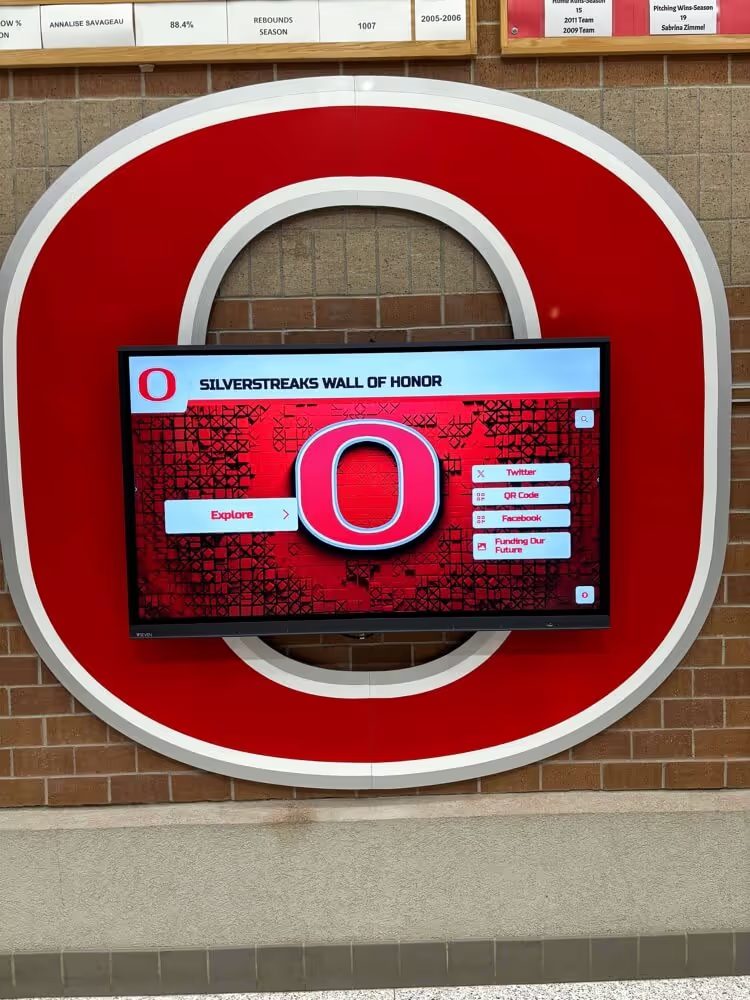
Touchscreen kiosks in trophy case areas allow schools to display academic all-state honorees with full context—sport, tier, GPA range, and selecting body—in the same space as athletic recognition
Displaying Academic All-State Honors Permanently
Academic all-state recognition earns its place in permanent institutional records the same way athletic honors do. Schools that treat academic all-state as temporary—posting a list for the season and removing it from the website—are discarding a record of institutional achievement that would have motivated future student-athletes.
Physical Display Options
Dedicated academic recognition sections in trophy corridors or lobby display cases work well for high schools with significant annual all-state volume. Organizing by year and sport allows visitors to scan program history at a glance.
Combined academic and athletic honor walls are appropriate when the display clearly labels each category. Schools that intermix athletic and academic recognition without labeling undermine both honors.
Certificate and plaque cases with clear sport-year-tier labels serve smaller programs well. The key is consistent formatting—every honoree in the same format, not a mix of handwritten cards and printed certificates.
Digital Display Options
Digital recognition systems offer capabilities physical plaques cannot match for academic all-state programs specifically:
- Unlimited honoree profiles with photos, sport, tier, and GPA context
- Search and filter by sport, year, or tier level
- Instant updates when new classes of honorees are announced
- Dual honor notation linking a student’s academic and athletic recognitions in a single profile
- QR code integration allowing hallway plaques to link to deeper digital profiles
The difference between a plaque listing a name and a digital profile explaining what that name represents is the difference between a record and a story. Schools that make academic all-state recognition legible to future visitors—not just current students and families—build institutional memory that compounds over time.
Rocket Alumni Solutions builds touchscreen wall of fame systems that let schools display academic all-state honorees with full context alongside athletic recognition—no physical space constraints, no engraving lead times, and instant updates when new honorees are announced.
For schools assessing which digital recognition tools fit their program, the 10 best hall of fame tools for athletics and donors covers platform options with criteria that apply directly to academic recognition alongside athletic records. A parallel evaluation at Digital Record Board reviews similar tools from a record-keeping and administrative perspective.

Portrait-style recognition cards allow schools to give academic all-state honorees individual visibility with photos and context—a format that a name-only list cannot replicate
FAQ: Academic All State Meaning
What does academic all state mean?
Academic all state means a student-athlete has been recognized by a state athletic association or affiliated coaches’ organization for achieving a defined minimum GPA while actively participating in a varsity sport. It is an academic honor, not an athletic performance ranking. Most state programs require a minimum GPA between 3.0 and 3.5, and many include multiple tiers recognizing different achievement levels.
Is academic all state the same as athletic all-state?
No. Academic all state recognizes GPA achievement during an athletic season. Athletic all-state recognizes athletic performance ranking among competitors statewide. Both are statewide honors, but they measure entirely different things. A student-athlete can earn both in the same season—a dual honor worth displaying separately with clear labels for each.
What GPA is required for academic all state?
GPA requirements vary by state and program. Most set a minimum between 3.0 and 3.5 on a 4.0 scale. Some programs include tiered recognition—Gold, Silver, Scholar, or similar labels reflecting different GPA brackets. Athletic departments should cite the specific threshold from the official selecting body when publishing honoree lists.
Who selects academic all-state honorees?
Academic all-state honorees are typically selected by the state high school athletic association, a state-level coaches’ association for a specific sport, or a combination of both. The selecting body varies by state and sport. Athletic departments should identify the official selecting body for each program they publish to ensure accurate attribution.
How should schools display academic all-state honors?
Schools should display academic all-state honors with the athlete’s name, sport, year, award tier, and selecting body clearly labeled. Physical plaque sections work for traditional settings; digital recognition systems allow unlimited profiles with photos, GPA context, and tier labeling. Separating academic and athletic all-state in any combined display prevents the two honors from being conflated in the minds of readers.
Turning a List Into a Legacy
Academic all-state recognition represents a genuine achievement—one that most families will not fully appreciate without context from the institution that awarded it. Athletic departments that explain the academic all state meaning before publishing honors, standardize the information fields in their displays, and maintain permanent records of each class of honorees transform what could be a forgotten line on a certificate into a meaningful chapter in a student-athlete’s school story.
That story belongs on the walls of your facilities—not just in a folder handed out at an awards banquet and never seen again.
Display Academic All-State Honors With the Context They Deserve
Rocket Alumni Solutions builds digital recognition systems that let schools display academic all-state honorees with full context—sport, tier, GPA range, and selecting body—in a permanent, searchable format that families and future athletes can explore for years to come.
See a Demo of Academic Recognition Display