



Intent: define. An athletic award exception approval form is a written document that a school, athletic department, or recognition committee uses whenever a decision departs from the standard eligibility criteria, evidence requirements, timing rules, or publication procedures that govern an award program. The form captures who requested the exception, what standard rule it departs from, why the departure is justified in this specific case, and who in the approval matrix holds the authority to authorize it.
The short answer: an exception approval form does not create a loophole—it closes one. Without a form, exceptions happen informally, inconsistently, and invisibly. With a well-designed form and a clear approval matrix, every deviation from standard rules is documented, traceable, reviewable, and defensible. The sections below provide a complete form field guide, a tiered approval matrix, a six-step approval workflow, and a record-keeping protocol that athletic directors, school administrators, and recognition committee chairs can adapt for programs at any level.
Note: This article provides general operational guidance for school recognition programs. It does not constitute legal advice. Consult your school district’s legal counsel for questions related to student privacy, accommodation obligations under applicable law, or any exception that may trigger regulatory review.
Athletic award decisions are governed by written criteria for a reason: consistency, fairness, and institutional credibility. But real programs operate in real conditions—an athlete misses minimum participation benchmarks due to a documented injury, a selection committee meeting falls outside the published timeline due to a weather event, a unique achievement does not fit any existing award category, or a posthumous recognition request arrives long after the standard submission window has closed. Each of these situations may warrant a departure from standard procedure. None of them should be decided informally.
An athletic award exception approval form converts informal decisions into documented ones. It does not make exceptions easier to grant—it makes the grant defensible, traceable, and consistent across time and personnel. A program that documents every exception it approves protects itself from the most common governance failure in athletic recognition: a current administrator approves an exception with good intentions and no paper trail, and a successor is asked to explain—or reverse—a decision they had no part in making.

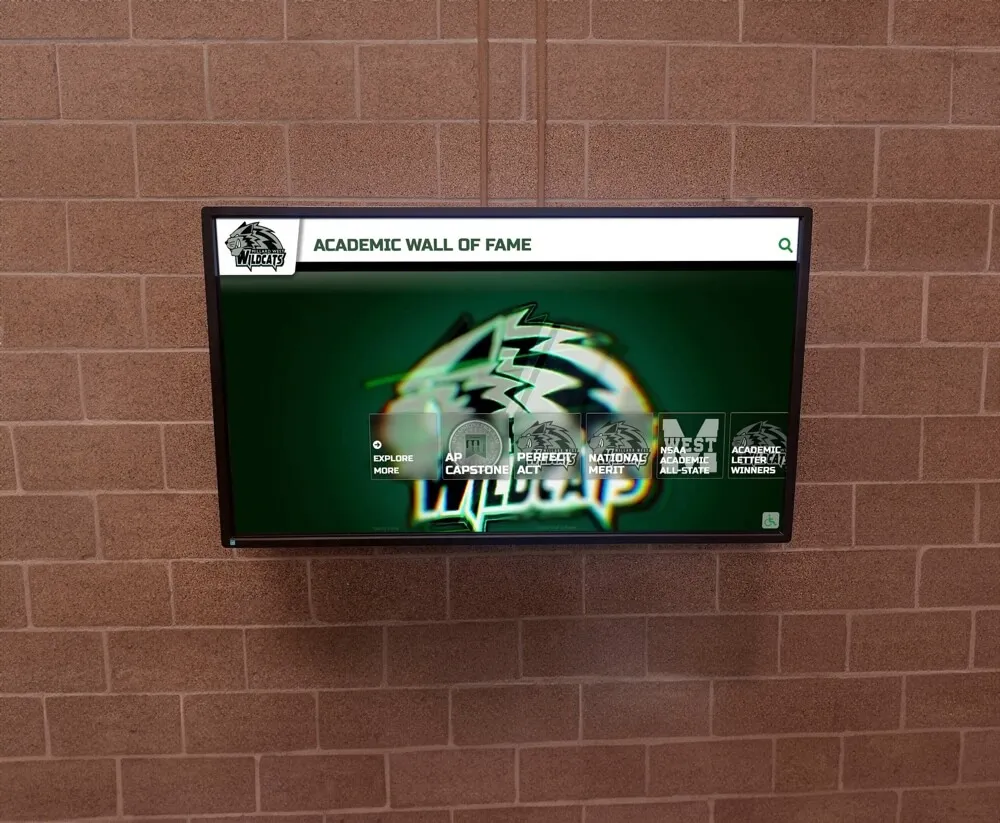
Recognition walls carry the institutional weight of every decision recorded in them—exception approval forms ensure that non-standard entries are as well-documented as standard ones
Four Categories of Athletic Award Exceptions That Require a Form
Not every administrative flexibility requires a formal exception form. A coach adjusting practice time does not. A recognition decision that departs from written criteria does. Programs should define which categories of deviation trigger the form requirement before any claim arrives. Four categories cover the overwhelming majority of cases.
1. Eligibility Exceptions
Standard athletic award programs set participation minimums—typically a percentage of games played or practices attended—as eligibility thresholds. When an athlete falls below a threshold due to a documented circumstance outside their control (verified injury, medical condition, family emergency, or school-sanctioned activity conflict), an eligibility exception may be appropriate. The form documents what the standard threshold is, by how much the athlete fell short, and what documentation supports the exception request.
2. Evidence or Verification Exceptions
Most award programs require specific documentation to verify a claim: selection committee minutes, coach nomination records, contemporary newspaper coverage, or official roster records. When required documentation is unavailable because of a records gap, a transition between systems, or the age of the records, an evidence exception may allow the claim to proceed on secondary sources. The form identifies which primary evidence standard cannot be met, why it is unavailable, and what secondary evidence is being offered in its place.
3. Timing or Procedural Exceptions
Standard award programs operate on published schedules—submission deadlines, review meeting dates, notification windows, publication dates. When a procedural deadline is missed due to a documented institutional disruption (school closure, technical failure, staff vacancy, or emergency), or when a unique circumstance requires recognition outside the normal cycle, a timing exception may apply. The form records the published deadline, the actual date, the reason for the deviation, and the authority approving the adjustment.
4. Category or Scope Exceptions
Some achievements do not fit existing award categories—a multi-sport contribution that does not qualify for any single-sport award, a service milestone that straddles athletic and academic recognition programs, or a posthumous recognition for someone who is not covered by the existing hall of fame or letter award frameworks. When a program grants recognition outside its published categories, a scope exception form documents the rationale and prevents the approval from becoming an implied precedent for similar requests in future cycles.
The Athletic Award Exception Approval Form: Complete Field Guide
The following field guide covers every element a well-designed exception approval form should include. Programs may adapt the format—paper, fillable PDF, or digital intake form—to match their existing administrative infrastructure. The fields themselves should not be reduced; each serves a specific governance function.
| Field | Content Required | Why It Matters |
|---|---|---|
| Form date | Date the form is submitted | Establishes the start of the review timeline |
| Requester name and role | Full name and role (athlete, parent, coach, administrator) | Identifies who initiated the exception request |
| Athlete or honoree name | Full name as it should appear on any recognition record | Ensures all downstream record updates use the correct name |
| Sport and season year | Sport, season (fall/winter/spring), and academic year | Scopes the exception to a specific program and cycle |
| Award category | Exact award title (e.g., “Varsity Letter Award,” “MVP,” “Hall of Fame Induction”) | Identifies which award program’s rules are being departed from |
| Standard rule being departed from | Verbatim citation of the written policy or criterion | Documents which specific rule applies and what it requires |
| Nature of deviation | Clear description of how the proposed recognition departs from the standard rule | Makes the gap between standard and exception explicit |
| Exception category | Eligibility / Evidence / Timing / Category (select one) | Allows the approving authority to apply the correct review standard |
| Documented basis for exception | Written explanation of why the deviation is warranted in this specific case | This is the substantive justification; must reference facts, not general sympathy |
| Supporting documentation attached | List each document included (medical record, system log, newspaper clip, coach statement) | Creates an evidence inventory tied to this exception decision |
| Requested outcome | Specific recognition action requested (grant award, adjust deadline, add display entry, etc.) | Prevents ambiguity about what the approving authority is being asked to authorize |
| Approver name and role | Name and institutional role of the person authorizing the exception | Ties the decision to a specific authority in the approval matrix |
| Approval matrix tier | Tier I / Tier II / Tier III (see matrix below) | Documents that the right level of authority reviewed the exception |
| Decision | Approved / Approved with Conditions / Denied | The formal outcome |
| Conditions (if applicable) | Any conditions attached to approval (e.g., “limited to this cycle,” “no precedent established”) | Prevents an approved exception from expanding beyond its intended scope |
| Decision date | Date the decision was made | Anchors the timeline for downstream record updates and notifications |
| Signature of approving authority | Wet or electronic signature | Authenticates the decision |
| Record update required | Yes / No — with specific systems listed | Triggers the records propagation step before the form is closed |
Programs that use digital forms should include a timestamp and user-attribution log for each field completion—this creates an audit trail without requiring wet signatures for routine approvals.
The Approval Matrix: Who Authorizes What
An approval matrix defines which institutional authority can grant which tier of exception. Without a matrix, programs face two failure modes: exceptions approved by an authority too low to bind the institution, or routine requests escalated unnecessarily to administrators with limited time and context. The tiered matrix below is a standard starting point—programs should adapt it to match their actual governance structure.
| Matrix Tier | Exception Type | Approving Authority | Escalation Trigger |
|---|---|---|---|
| Tier I — Routine | Minor timing or procedural adjustment (missed deadline within 5 business days; clerical correction to an existing entry) | Head Coach or Sport Coordinator | Escalate to Tier II if the exception affects public display records |
| Tier II — Standard | Eligibility exception (documented injury or school-sanctioned conflict); evidence exception where secondary sources meet the standard; timing exception beyond 5 business days | Athletic Director | Escalate to Tier III if the exception involves a deceased honoree, creates a new award category, or generates a community dispute |
| Tier III — Elevated | Scope exception (recognition outside published categories); posthumous exception; evidence exception where no primary documentation exists; any exception that sets a program-level precedent | Athletic Director + Principal or Academic Dean | No further escalation; Tier III is the final internal authority |
The approval matrix should be a section of the written exception approval policy—not left to each administrator to define independently. When an exception is reviewed at the wrong tier, either because a Tier III situation was resolved at Tier I or because a routine timing fix was unnecessarily escalated, the resulting decision is vulnerable to challenge regardless of its merit.
Programs that support booster club involvement in recognition funding should ensure the matrix also defines when booster leadership is informed of (but not decision-makers for) approved exceptions. Governance resources on booster club business continuity planning provide a useful model for how volunteer-supported programs document their governance structure in ways that survive staff and leadership transitions—the same principle applies to exception approval documentation.

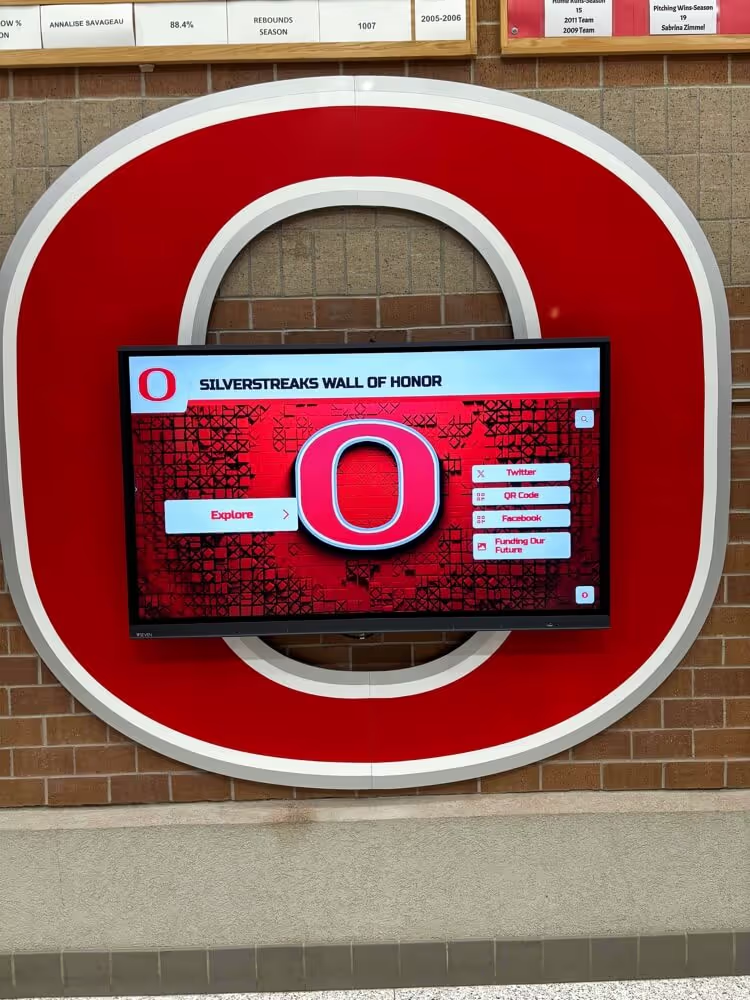
Athletic record displays document institutional decisions across decades—exception approval forms ensure that non-standard entries are as traceable as standard ones when future administrators review the record
The Six-Step Exception Approval Process
Once the form fields and approval matrix are in place, the process itself should follow a consistent, documented path from intake to record update.
Step 1 — Receive the Request in Writing
Every exception request must be submitted on the program’s standard exception approval form. Verbal requests, informal emails, or coaching staff recommendations without a completed form do not initiate the formal process. Written submission creates the documentary record that all subsequent steps depend on and establishes the start date for the review timeline.
The intake contact—typically the athletic director’s office or a designated administrative coordinator—acknowledges receipt in writing within three business days. This acknowledgment confirms the form was received, identifies which tier of the approval matrix applies, and communicates the expected review timeline.
Step 2 — Classify the Exception Type and Tier
Before the substantive review begins, the intake reviewer classifies the exception by type (eligibility, evidence, timing, or category) and assigns the appropriate approval matrix tier. This classification determines who reviews the form next, what the review standard is, and whether escalation is required.
If a request spans more than one exception type—for example, an eligibility exception for an athlete whose records were also partially lost in a system transition—it should be classified at the highest applicable tier and reviewed by the authority for that tier.
Step 3 — Compile and Review Supporting Documentation
The approving authority reviews all documentation submitted with the form and, where necessary, requests additional evidence from the claimant or conducts independent verification. The review addresses one question: Does the documentation demonstrate that the exception is warranted for the reason stated, and does the proposed outcome fall within the defined scope of the applicable exception category?
The review period has a defined duration—recommended maximum of 15 business days for Tier I and II exceptions, 30 business days for Tier III. Open-ended review periods create uncertainty for claimants and administrative backlog for departments.
Step 4 — Convene Approving Authority and Document the Decision
At the appropriate tier, the designated authority reviews the compiled evidence and makes a determination: approved, approved with conditions, or denied. Each outcome must be documented on the form with a brief written explanation referencing the specific evidence or policy basis for the decision.
Conditions attached to an approval—for example, “this exception applies to the current cycle only and does not establish a precedent for future requests”—must be stated explicitly and included in the final form documentation. Conditional approvals that are undocumented as such may later be cited as precedent in ways that expand their intended scope.
Step 5 — Notify the Requester in Writing
Within five business days of the decision, the approving authority notifies the requester in writing. The notification states the outcome, the specific policy basis for it, and—for denials—what conditions, if any, would need to change for the request to be reconsidered in a future cycle. Denial notifications should be specific enough to give the requester meaningful information, but should not suggest that the policy will accommodate the request on resubmission if the denial reflects a categorical exclusion.
For exceptions involving posthumous recognition, all notifications should be directed to the family member or legal representative identified in the submission—not to a third party advocate or community group that may have initiated the request.
Step 6 — Update Records and Close the File
Approved exceptions must propagate to every system that reflects the program’s recognition record. The “record update required” field on the form identifies which systems need updating before the form can be closed:
- Athletic records database (add or correct the entry with a notation of exception status)
- Physical recognition displays (nameplate, plaque, or honor board addition)
- Digital recognition platform (entry addition or correction with approval timestamp)
- Program publications or printed award registers
- The governance file (complete exception form, evidence inventory, and decision letter filed permanently)
The governance file is the single most important artifact of the exception approval process. It is the only document that connects the public recognition record to the institutional decision that created it. Programs should retain all exception governance files permanently for any award that results in a named entry on a physical or digital display, and for a minimum of seven years for procedural exceptions that did not result in a display change.
Update Recognition Displays the Moment an Exception Is Approved
Rocket Alumni Solutions gives athletic programs a cloud-based platform where approved exceptions can be added to recognition displays the same day—with full user attribution and timestamp for every change. No fabrication wait times, no vendor scheduling. Trusted by 600+ institutions. WCAG 2.1 AA compliant.
See Your Awards Display DemoLimiting Exception Creep: Conditions, Precedent Notes, and Annual Review
The most consistent risk in exception management is not that programs approve too many exceptions—it is that individually justified exceptions accumulate into an informal pattern that quietly undermines the standard rules they depart from. A Tier I timing waiver granted once during a school closure is defensible. The same waiver granted routinely whenever a coach misses a deadline is a policy change that was never formally made.
Three practices prevent exception creep.
Attach explicit precedent notes. Every approved exception form should include a statement specifying whether the approval is intended to apply only to this case, and if so, why. “This exception is approved on the documented basis of [specific circumstance] and does not modify the standard submission deadline for future cycles” is a complete precedent note. Forms that lack this statement invite future requesters to cite the prior approval as a policy baseline.
Distinguish program exceptions from financial accommodations. When an exception involves fee waivers, budget reallocations, or booster club funds, the financial and recognition governance tracks should be documented separately. Guidance on booster club credit card and financial policies illustrates how programs document financial decisions in ways that remain auditable across volunteer leadership transitions—the same transparency standard should apply when an exception has financial components.
Conduct an annual exception review. Each year, the athletic director reviews all exception approval forms from the prior cycle. If the same type of exception was approved five or more times in a year, that pattern suggests the standard rule may need revision—not that exceptions should continue to be granted informally. The annual review converts exception data into policy intelligence.
Connecting Exception Approvals to Digital Recognition Displays
When an exception approval results in a new entry or a corrected record on a recognition display, the digital infrastructure determines how quickly the approved change becomes visible and how reliably it propagates across all display locations.
Schools using interactive touchscreen recognition systems should verify that their platform supports user-attributed record edits with timestamps—so that the governance trail on the exception form corresponds to an auditable change log in the recognition database. Schools evaluating display options will find detailed guidance on platform capabilities and touchscreen software options for digital recognition systems useful for understanding which technical features support governance-quality record management.
Programs with physical hall of fame walls often use both static engraved elements and digital supplementary content. When a non-standard recognition is approved—particularly for an individual whose career predates the digital platform—the physical element requires separate coordination with facilities, while the digital record can be updated immediately. Schools assessing recognition wall installations should evaluate vendor credibility carefully; guidance on identifying reliable vendors in the digital hall of fame market helps programs avoid commitments to systems that cannot support the governance requirements exception approval documentation creates.
For programs that recognize posthumous honorees—a common Tier III exception category—the language of physical memorial recognition requires its own standards. Resources on memorial plaque wording for schools honoring teachers, alumni, and benefactors provide practical language guidance for the recognition elements that accompany an approved posthumous exception.
When an approved exception results in a new or non-standard award, recognition graphics—the visual identity of the award itself—may need to be developed outside the standard design cycle. Programs using graphic templates for recognition ceremonies should maintain a library of approved designs that can accommodate non-standard award text; commitment and recognition graphic templates illustrate how consistent visual frameworks can be adapted for individualized recognition content without requiring custom design work for each exception.

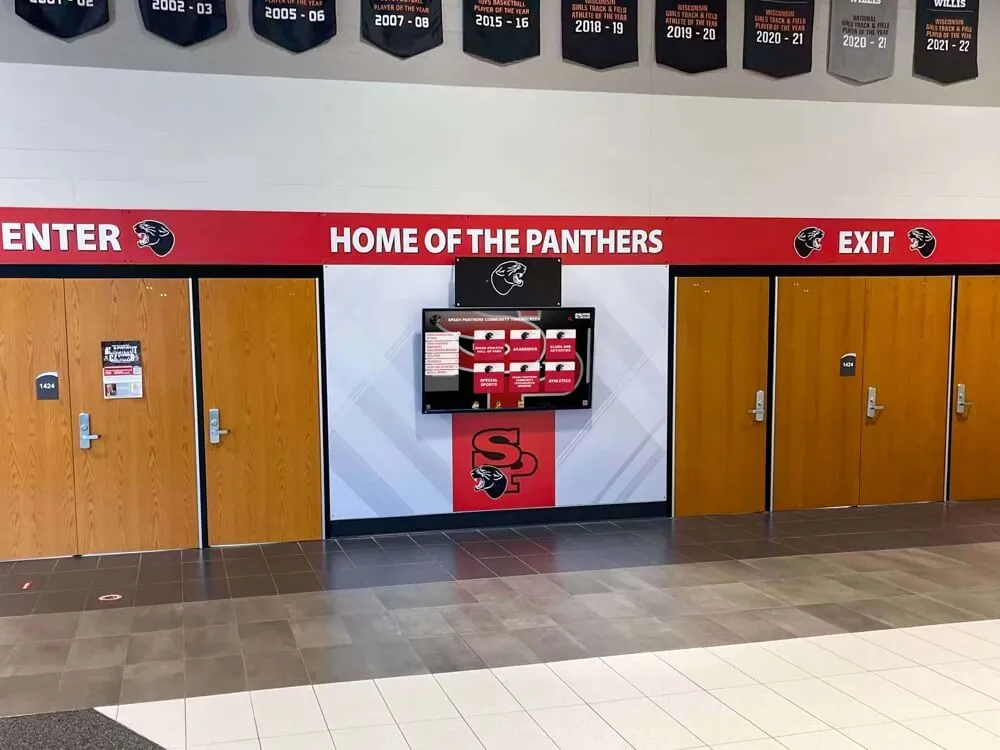
Physical honor board displays require physical updates when an exception is approved—digital recognition platforms eliminate that lag and propagate approved changes immediately across every display location
Exception Approval Form: Policy Checklist
Before finalizing the exception form and approval matrix, verify the following elements are addressed in the program’s written exception policy:
| Policy Element | Addressed? | Notes |
|---|---|---|
| Definition of which decisions require a form (vs. routine administrative flexibility) | ||
| Four exception categories defined with scope boundaries | ||
| Complete field list for the form | ||
| Three-tier approval matrix with specific authorities and escalation triggers | ||
| Intake acknowledgment timeline (recommended: 3 business days) | ||
| Review period maximum by tier (15 days for Tier I/II; 30 for Tier III) | ||
| Decision documentation requirement (written basis for all three outcomes) | ||
| Requester notification timeline (5 business days from decision) | ||
| Precedent note requirement on all approved exceptions | ||
| Record update trigger and system list | ||
| Governance file retention standard (permanent for display entries; 7 years for procedural exceptions) | ||
| Annual exception review process |
FAQ: Athletic Award Exception Approval Form
What is an athletic award exception approval form?
An athletic award exception approval form is a written document that records any recognition decision that departs from a program’s standard eligibility, evidence, timing, or category rules. It captures what standard rule is being departed from, why the departure is justified in this specific case, what documentation supports the exception, and which authority in the approval matrix authorized it. The form protects programs from inconsistent decision-making and creates a permanent governance record for every non-standard recognition outcome.
What is an approval matrix for athletic award exceptions?
An approval matrix is a tiered authority structure that defines which institutional role can authorize which type of exception. A typical three-tier matrix assigns routine procedural adjustments to the head coach or sport coordinator (Tier I), standard eligibility and evidence exceptions to the athletic director (Tier II), and scope exceptions, posthumous recognitions, and precedent-setting decisions to the athletic director and principal jointly (Tier III). The matrix prevents exceptions from being authorized at an authority level too low to bind the institution, and eliminates unnecessary escalation of routine decisions.
When does an athletic award exception require a formal approval form?
A form is required any time a recognition decision departs from the written criteria governing the award—including eligibility thresholds, evidence requirements, submission deadlines, publication schedules, or defined award categories. Routine administrative flexibility that does not affect a recognition determination does not require a form. The written exception policy should define this line before any requests arrive.
How do exception approval forms prevent exception creep?
Exception approval forms prevent exception creep by requiring an explicit precedent note on every approved exception, by creating an annual review trail that reveals when the same exception type recurs frequently enough to suggest the underlying policy needs revision, and by connecting each exception to a specific documented justification rather than a general practice. Without these records, individually justified exceptions can accumulate into an informal pattern that quietly replaces the standard rules they were designed to depart from in limited circumstances.
How long should exception approval documentation be retained?
Exception governance files for decisions that result in a named entry on a physical or digital recognition display should be retained permanently. Exception files for procedural decisions that did not result in a display change should be retained for a minimum of seven years, consistent with standard school administrative records policy. Both approved and denied exceptions require the same documentation and retention standards.
The Documentation Behind Every Fair Decision
Athletic award programs earn their credibility through consistency. Every exception that is documented, reviewed at the right authority tier, and closed with a complete governance file reinforces that credibility—even when it departs from standard rules. Every exception that happens informally, without a form or a file, erodes it—even when the departure was individually justified.
An athletic award exception approval form backed by a clear approval matrix and a consistent six-step workflow is not administrative overhead. It is the mechanism that keeps exception-handling transparent, fair, and traceable across the decades of personnel transitions and recognition decisions that a long-running athletic program accumulates. When a future administrator inherits the program, the exception file tells the story of every non-standard decision made before them—and gives them the foundation to make consistent decisions going forward.
Build a Recognition Display That Reflects Every Approved Decision
When an exception is approved, your recognition display should reflect that decision immediately—not weeks later. Rocket Alumni Solutions gives athletic programs a cloud-based platform with full CMS access, user-attributed change logs, and real-time updates across every display location. No fabrication wait times, no vendor visits required. Trusted by 600+ institutions. WCAG 2.1 AA compliant, accessible on any device via QR code.
Request a Custom Demo to see how a digital recognition platform makes non-standard entries as simple and auditable as any other update.