



Intent: define. An athletic awards database heap-bloat monitoring policy is a documented set of recurring queries, threshold definitions, alerting rules, and response procedures that tells a school IT team or database administrator exactly when the physical table storage in a recognition database has accumulated enough dead row versions to degrade award searches, athlete lookups, season-filter queries, and hall-of-fame display response times—before those problems become visible to users.
This guide explains what heap bloat is, why athletic recognition databases are especially vulnerable to it, how to build a monitoring policy from scratch in eight steps, which threshold values to use as decision criteria, how to respond when thresholds are crossed, and how the discipline fits within the broader database maintenance calendar that keeps a school’s recognition archive fast and dependable across years of seasonal updates.
An athletic awards database heap-bloat monitoring policy closes the gap between the moment dead tuples start accumulating in a recognition database and the moment a staff member notices that the award search interface has slowed down. Without a monitoring policy, that gap can span weeks—and because heap bloat degrades performance gradually rather than suddenly, the slowdown is often attributed to unrelated causes before the underlying storage problem is identified.
The core monitoring discipline is simple: query the database’s internal statistics views on a recurring schedule, compare dead tuple ratios against defined thresholds, and trigger a documented response whenever a table crosses into the warning range. What makes it a policy rather than an occasional check is the combination of a written schedule, threshold definitions tied to specific actions, a clear ownership assignment, and a log of every monitoring run and its findings.
For athletic recognition programs that maintain seasonal award archives, hall-of-fame records, and multi-sport honor displays, the cost of allowing heap bloat to accumulate undetected is measured in two currencies: query latency that degrades the interactive experience visitors get at recognition kiosks, and import run times that grow longer each season until the maintenance window no longer fits the available time slot.

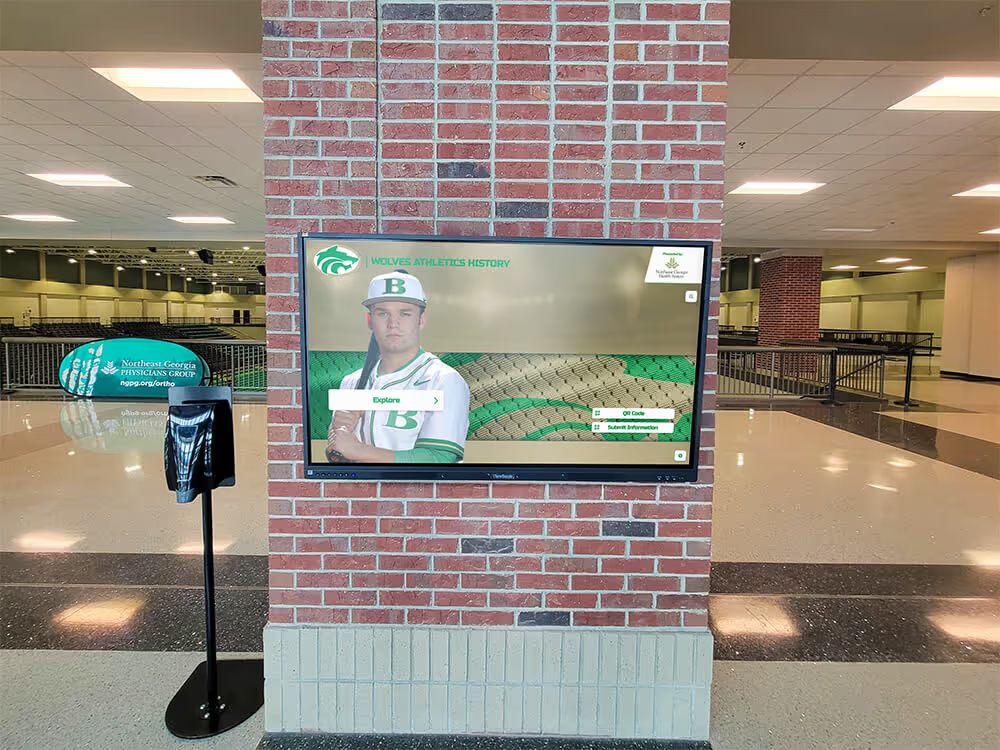
Interactive athletic recognition kiosks serve queries against the same tables that accumulate dead tuples after seasonal imports and correction cycles — a heap-bloat monitoring policy catches that accumulation before it slows search responses visitors notice
What Is Heap Bloat in an Athletic Awards Database?
PostgreSQL organizes table data in fixed-size pages, typically 8 KB each, stored in a file on disk called the heap. Every row version—live or dead—occupies space on those pages. When a record is deleted or updated, the old row version is marked as dead but remains physically in the heap until a VACUUM operation reclaims it. Until VACUUM runs, every query that scans the affected pages reads past dead row versions before returning live results.
Heap bloat is the condition in which the physical size of a table’s heap diverges significantly from the amount of live data it actually holds. A table with 5,000 live award records but 2,000 dead row versions that have not been reclaimed occupies more disk pages than the live data alone requires—and every sequential scan, every index-to-heap fetch for qualifying rows, and every export query that reads large ranges of the table carries the extra I/O cost of traversing pages densely packed with dead versions.
The distinction between heap bloat and index bloat is important for monitoring purposes. Index bloat accumulates dead entries inside the index structures used to locate rows. Heap bloat accumulates dead row versions in the table pages themselves. Both degrade query performance, but they are detected with different queries and remediated by different operations. A monitoring policy for heap bloat focuses on the ratio of dead tuples to live tuples in the table’s heap—a metric PostgreSQL tracks in pg_stat_user_tables and updates continuously as autovacuum runs and as new write operations create additional dead versions.
Athletic recognition databases generate heap bloat through three primary operations:
- Season-end bulk imports — hundreds or thousands of new award records are inserted, and existing records corrected, producing dead versions of every corrected row
- Name and record correction cycles — coaches, athletic directors, and archives staff update athlete names, award dates, team affiliations, and verified results throughout the year, each update leaving a dead version of the previous row
- Duplicate removal and data cleanup — when duplicate inductee entries, redundant award records, or test data are deleted, the physical space they occupied remains in the heap until reclaimed
For programs managing diverse recognition categories—varsity sports award records alongside academic honor certificates, arts achievement entries, and community service acknowledgments—the write surface is broader, and bloat accumulates across more tables than a pure athletic-data system would carry.
Why Athletic Recognition Databases Are Especially Vulnerable to Heap Bloat
Two characteristics of athletic recognition databases make them more vulnerable to heap bloat than databases with steady, distributed write patterns.
Burst write patterns. Athletic recognition data does not arrive in a steady stream. It arrives in concentrated bursts: the end-of-season awards ceremony produces dozens of new inductee records in a single afternoon; the annual hall-of-fame class is entered over two or three days; a historical digitization project imports hundreds of records from archived yearbooks in a single import session. These burst patterns generate dead tuples at a rate that PostgreSQL’s default autovacuum settings—calibrated for steady, moderate write traffic—may not clear fast enough to prevent meaningful bloat accumulation between the end of the import and the start of the high-read period that follows.
The data quality audit guide for athletic award display records at digitalawardsdisplay.com describes the name, title, and date reconciliation work that follows many seasonal imports—each reconciliation pass produces additional dead tuples as corrections overwrite existing field values, compounding the bloat generated by the initial import.
Long idle periods between bursts. Athletic recognition databases that receive concentrated seasonal writes are read-only for most of the year. Autovacuum’s cost-based throttling mechanism is designed to reduce interference with concurrent foreground traffic—but on a database with minimal foreground traffic during quiet periods, the throttling may hold autovacuum back from completing the full cleanup work the previous burst generated. The result is a table that enters the next import already carrying a dead-tuple backlog, which then grows with the new import’s corrections.
Both factors make active monitoring essential. A database that only appears to be under control—because it is quiet between seasons—may be carrying bloat that surfaces as visible degradation the moment the next season’s records are loaded and queries ramp up.
Building an Athletic Awards Database Heap-Bloat Monitoring Policy: Eight Steps
The following eight steps build a monitoring policy suited to any PostgreSQL-based athletic award database, from a single-school program with a few hundred records to a multi-campus archive spanning decades of recognition history.
Step 1: Identify the tables that require heap-bloat monitoring
Not every table in a recognition database accumulates bloat at the same rate. Focus monitoring resources on the tables that receive the most INSERT, UPDATE, and DELETE activity during seasonal import and correction cycles. In a typical athletic recognition schema, these are:
awards— the central fact table; receives one new row per award per athlete per season, plus result corrections throughout the yearathletes/people— updated each season with name corrections, graduation-year revisions, and duplicate mergesnominations— written in batches during nomination processing, then updated as statuses change and final decisions are recordedaward_recipients(join table) — updated when athlete-to-award assignments are corrected or when duplicate assignments are removed
Reference tables such as sports, award_types, and seasons receive lighter write traffic and can be monitored less frequently unless they are frequently renamed or merged.
Step 2: Establish baseline dead-tuple ratios before the monitoring policy begins
Before defining thresholds, measure the current state of each monitored table. Run this query against pg_stat_user_tables to capture the current dead tuple ratio, time since last autovacuum, and physical table size for each target table:
SELECT
  schemaname,
  relname AS table_name,
  n_live_tup,
  n_dead_tup,
  ROUND(
    100.0 * n_dead_tup::numeric / NULLIF(n_live_tup + n_dead_tup, 0),
    2
  ) AS dead_pct,
  last_autovacuum,
  last_autoanalyze,
  pg_size_pretty(pg_relation_size(schemaname || '.' || relname)) AS heap_size,
  pg_size_pretty(pg_total_relation_size(schemaname || '.' || relname)) AS total_size
FROM pg_stat_user_tables
WHERE schemaname = 'public'
  AND relname IN ('awards', 'athletes', 'nominations', 'award_recipients')
ORDER BY dead_pct DESC;
Record the output as the baseline. This establishes the starting dead-tuple ratio for each table and confirms the current autovacuum run frequency before any policy changes.
Step 3: Define threshold tiers and the response action each tier triggers
A monitoring policy without defined thresholds is a dashboard without a decision process. Assign each monitored table one of four status tiers based on its current dead-tuple ratio, and document the action each tier requires:
| Dead Tuple % | Status | Response Action |
|---|---|---|
| 0–5% | Healthy | Log result; no action required |
| 5–10% | Acceptable | Log result; verify autovacuum ran within past 24 hours |
| 10–20% | Warning | Run VACUUM ANALYZE <table> within 24 hours; investigate autovacuum delay |
| 20–40% | Critical | Run VACUUM ANALYZE <table> immediately; review autovacuum scale factor for this table |
| Above 40% | Emergency | Run VACUUM ANALYZE <table> immediately; consider VACUUM FULL during next maintenance window; escalate to DBA |
These thresholds apply to the high-write recognition tables identified in Step 1. Reference tables with low write activity can tolerate higher dead-tuple ratios without query impact and may use relaxed thresholds.
Step 4: Set the monitoring query schedule
Define how often each monitoring query runs and who reviews the results. Three schedules serve different monitoring needs:
- Daily check: Run the baseline query from Step 2 every morning before business hours. Confirm that dead-tuple ratios have not entered the Warning tier overnight. This is the primary detection mechanism for identifying autovacuum failures or missed post-import cleanups.
- Post-import check: Run the baseline query immediately after every seasonal import or bulk correction cycle completes. This check establishes the peak dead-tuple ratio for the import session and confirms whether autovacuum is reducing it within the expected window.
- Monthly review: Run a fuller check that includes historical trend data—comparing current dead-tuple ratios against the same tables’ ratios from 30 days prior. A trend moving consistently upward indicates that autovacuum is not keeping pace and that threshold settings need to be lowered.
For programs with constrained IT staffing, the daily and post-import checks can be automated using pg_cron, a database-internal scheduling extension, or a simple cron job that writes the query results to a monitoring log file and sends an alert when a table enters the Warning tier.
Schools evaluating digital recognition platforms that reduce the database administration burden will find the alumni management software feature comparison at best-touchscreen.com useful for understanding how managed platforms differ from self-hosted implementations—including which maintenance responsibilities shift to the vendor when a school moves to a hosted recognition system.
Step 5: Add a heap-size growth check to detect bloat accumulation separate from dead-tuple ratios
Dead-tuple ratios can be misleading when autovacuum is running but not returning space to the operating system. Standard VACUUM reclaims dead tuple space for reuse by future insertions, but it does not compact the heap or return pages to the OS. A table that has been vacuumed but not compacted may show a low dead-tuple ratio while still occupying significantly more disk space than its live data requires.
Monitor heap-size growth as a separate metric alongside dead-tuple ratios:
SELECT
  relname AS table_name,
  pg_size_pretty(pg_relation_size(oid)) AS heap_size,
  n_live_tup,
  ROUND(
    pg_relation_size(oid)::numeric / NULLIF(n_live_tup, 0),
    0
  ) AS bytes_per_live_row
FROM pg_stat_user_tables
JOIN pg_class ON pg_class.relname = pg_stat_user_tables.relname
WHERE schemaname = 'public'
  AND pg_stat_user_tables.relname IN ('awards', 'athletes', 'nominations')
ORDER BY pg_relation_size(oid) DESC;
A rising bytes_per_live_row value across successive monitoring runs—without a corresponding increase in n_live_tup—indicates that the heap is growing beyond what new data insertions justify. This pattern points to bloat that standard VACUUM is reclaiming for reuse without compacting, and signals that a VACUUM FULL or pg_repack operation may be needed during the next maintenance window.
Step 6: Monitor autovacuum frequency and confirm it is not being suppressed
A heap-bloat monitoring policy that only measures dead-tuple ratios will catch the symptom but miss the cause when autovacuum is failing to fire. Add a second monitoring query that checks autovacuum run frequency and identifies whether long-running queries or explicit autovacuum disablement are suppressing the process:
-- Check when autovacuum last ran and current dead tuple counts
SELECT
  relname,
  last_autovacuum,
  now() - last_autovacuum AS time_since_autovacuum,
  n_dead_tup,
  autovacuum_count
FROM pg_stat_user_tables
WHERE schemaname = 'public'
  AND relname IN ('awards', 'athletes', 'nominations', 'award_recipients')
ORDER BY last_autovacuum ASC NULLS FIRST;

-- Check for long-running queries that may be blocking autovacuum dead-tuple removal
SELECT
  pid,
  now() - query_start AS duration,
  LEFT(query, 100) AS query_snippet
FROM pg_stat_activity
WHERE state = 'active'
  AND now() - query_start > INTERVAL '30 minutes'
ORDER BY duration DESC;
A table showing last_autovacuum more than 24 hours in the past alongside a rising dead-tuple count indicates autovacuum suppression. Common causes in athletic recognition databases include seasonal import jobs that hold long transactions, export queries that run for hours during award ceremony preparation, and autovacuum_enabled = false settings applied during a previous maintenance session and never re-enabled.
Step 7: Establish a response runbook and assign ownership
A monitoring policy without a response runbook produces alerts with no clear next action. Document the exact commands and escalation path for each threshold tier defined in Step 3:
Warning tier response (10–20% dead tuples):
-- Run within 24 hours of detecting a Warning-tier table
VACUUM ANALYZE awards;
VACUUM ANALYZE athletes;
Log the run time, before-and-after dead-tuple ratio, and reviewer name. If the ratio does not return below 10% within 30 minutes of the VACUUM ANALYZE completing, escalate to the Critical tier response.
Critical tier response (20–40% dead tuples):
-- Run immediately on detection; may take several minutes on large tables
VACUUM ANALYZE awards;
-- Review autovacuum configuration for this table:
SELECT reloptions FROM pg_class WHERE relname = 'awards';
-- Tighten the scale factor if it is at the default 0.20:
ALTER TABLE awards SET (
  autovacuum_vacuum_scale_factor = 0.02,
  autovacuum_analyze_scale_factor = 0.01
);
Emergency tier response (above 40% dead tuples):
-- Notify DBA and athletic director immediately
-- Schedule VACUUM FULL during next confirmed maintenance window
-- VACUUM FULL requires exclusive lock — do not run during display hours
VACUUM FULL awards;  -- only during confirmed maintenance window
ANALYZE awards;
Assign a primary owner (typically the school’s IT administrator or database administrator) and a secondary contact (athletic director or recognition program manager) who is notified when the Critical or Emergency tier is reached. The primary owner executes the runbook; the secondary contact is informed of the timeline for resolution.
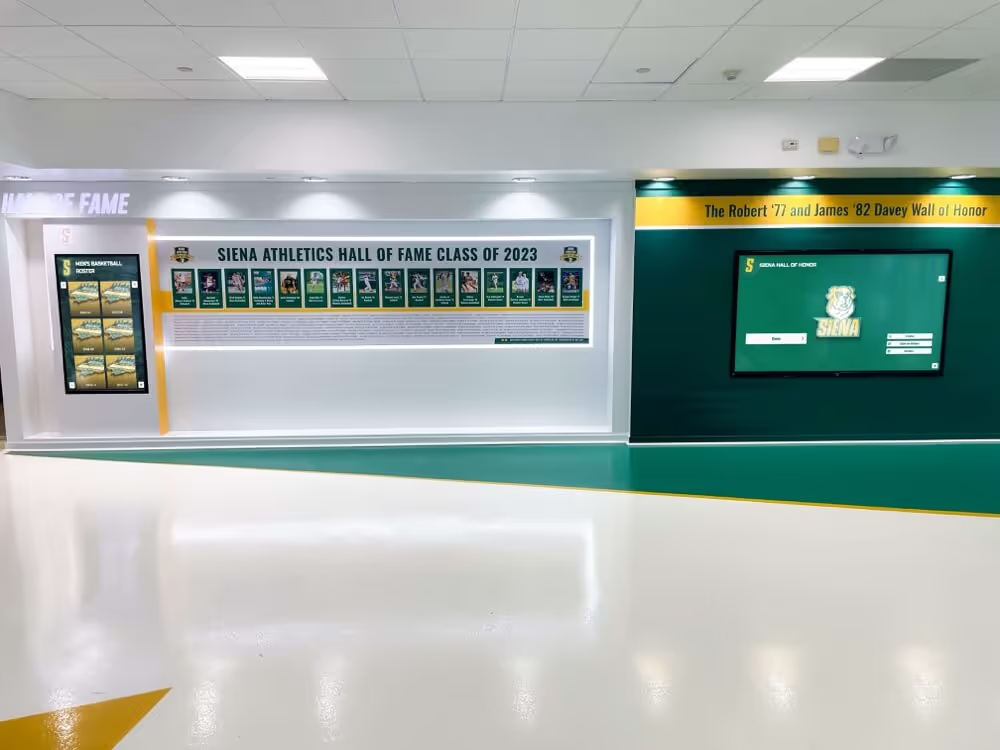
Interactive recognition displays that serve athlete records and award histories to visitors in school hallways and athletic facilities depend on the same tables that accumulate heap bloat after seasonal imports. The school recognition display technical configuration guide at touchscreenrecognition.com addresses the hardware layer that delivers those displays to visitors—the database monitoring policy described here addresses the software layer that determines whether the queries those displays execute return results in milliseconds or seconds.
Step 8: Document monitoring results and review the policy annually
After each monitoring run, log the results in a maintenance record: the date, the tables checked, the dead-tuple ratio for each, the threshold tier each table fell into, the action taken (if any), and the before-and-after ratio following any VACUUM operation. Retain at least one year of monitoring logs.
Review the policy itself annually. The thresholds calibrated for a program with 2,000 award records may not be appropriate once the archive grows to 10,000. Import volumes change as programs expand to new sports or incorporate historical records from predecessor schools. A policy that was effective when first written needs to be revisited when the conditions that generated its threshold values change materially.

School hallway digital recognition displays that surface athlete records and season-by-season award histories in real time depend on the underlying tables remaining free of dead tuple accumulation — a regular heap-bloat monitoring policy keeps those tables healthy across every season update
Heap-Bloat Monitoring Reference Table for Athletic Award Tables
Use this table as a quick reference when reviewing monitoring results. The threshold values are calibrated for the high-write tables in a typical athletic recognition database. Adjust the Warning and Critical boundaries if your program’s query response time requirements are more demanding than the defaults assume.
| Table | Typical Write Pattern | Monitoring Frequency | Warning Threshold | Critical Threshold |
|---|---|---|---|---|
awards (central fact table) | Burst writes at season end; result corrections year-round | Daily + post-import | 10% dead tuples | 20% dead tuples |
athletes / people | Name corrections and merges throughout year; bulk updates at season close | Daily + post-import | 10% dead tuples | 25% dead tuples |
nominations | Batch writes during nomination cycles; status updates as decisions finalize | Post-import; weekly during nomination season | 15% dead tuples | 30% dead tuples |
award_recipients (join) | Updated when award assignments are corrected; rows deleted when duplicates removed | Weekly; post-import | 15% dead tuples | 30% dead tuples |
sports / award_types (reference) | Occasional renames when programs merge or rebrand | Monthly | 25% dead tuples | 40% dead tuples |
The awards table carries the tightest threshold because it is the table most frequently queried by recognition displays, search interfaces, and export pipelines. A 10% dead-tuple ratio on a 5,000-row awards table means 555 dead row versions that every query touching those pages must skip over. On a display that runs dozens of concurrent queries during a peak alumni event, that overhead compounds across sessions in ways that are visible as lag on sport-filter and season-year selections.
For programs that have invested in permanent recognition installations—athletic hall-of-fame walls, lobby murals, and multi-panel honor displays—the hall-of-fame tools comparison at digital-trophy-case.com describes how institutions evaluate the full recognition platform stack, including the database management and content tooling that determines how easy or difficult it is to keep the displayed records current and accurate. A heap-bloat monitoring policy sits at the database layer of that stack and is equally relevant whether the school manages its own database or uses a platform whose database layer is vendor-managed.
Connecting Heap-Bloat Monitoring to Other Database Maintenance Disciplines
Heap-bloat monitoring does not operate in isolation. It is one component of a complete database maintenance discipline that includes index bloat management, autovacuum policy tuning, VACUUM FREEZE scheduling, and query performance review. Each component interacts with the others in ways that a monitoring policy needs to account for.
When heap bloat is cleared by VACUUM, the newly reclaimed pages become available for reuse by future insertions. This typically means that the next seasonal import fills existing pages rather than allocating new ones, keeping the table’s physical footprint stable across import cycles. But if the table’s indexes are also bloated, reclaiming heap space does not automatically reduce index size—a separate index maintenance pass is required. A school that monitors and addresses heap bloat while ignoring index bloat will see improved sequential scan performance but continued index scan degradation on filter queries.
The autovacuum policy configured for a table determines how quickly dead tuples are reclaimed between manual monitoring runs. A table with a tightly tuned autovacuum scale factor—set to 0.01 or 0.02 rather than the default 0.20—rarely crosses the Warning tier in daily monitoring because autovacuum fires before dead tuples accumulate to that level. A monitoring policy that consistently finds Warning-tier tables should trigger a review of the autovacuum configuration for those tables, not just a manual VACUUM run to address the immediate symptoms.
Schools that manage recognition programs spanning multiple decades of athletic achievement—records that include seasonal award data, hall-of-fame inductee profiles, championship rosters, and multi-sport honor rolls—often find that the monitoring discipline required to keep the database healthy is also what gives the IT team the visibility to plan capacity: how much data arrives each season, how much space seasonal corrections consume and reclaim, and when archive growth will require infrastructure changes.
The basketball hall of fame complete guide at touchhalloffame.us illustrates the kind of multi-decade recognition archive that creates sustained monitoring requirements—a basketball hall of fame that spans forty years of seasonal records includes inductees from before digital data entry was standard, requiring historical transcription batches that generate concentrated write bursts exactly like seasonal imports.
The Relationship Between Heap Bloat and Display Performance
School athletic recognition displays—whether interactive touchscreen kiosks in a gymnasium lobby or wall-mounted screens in a varsity hallway—execute database queries in real time as visitors browse athlete profiles, filter records by sport and season, and search for specific inductees by name. The response time those visitors experience is a direct function of query execution time, which is itself a function of table health.
A heap-bloated awards table forces every query that touches those pages to do more work than the live data volume requires. A year-filter query that scans the awards table to return records for a specific season reads every page that contains qualifying rows—including pages that are partially or densely packed with dead versions. The query must evaluate each row version it encounters to determine whether it is live and visible to the current transaction before returning it to the application. That evaluation step adds latency proportionally to how many dead versions each page contains.
For an interactive recognition kiosk that serves visitors during a busy alumni weekend or an end-of-year awards event, query latency in the hundreds of milliseconds is noticeable. A display that responds to filter selections in under 200 milliseconds feels responsive; one that takes 600–800 milliseconds feels sluggish and reflects poorly on the recognition program’s investment in its digital display infrastructure.
WCAG 2.1 AA compliance—a standard for accessible digital recognition that the digital hall of fame text spacing audit at halloffametouchscreen.com covers in detail for the layout layer—also has implications at the database layer. Visitors using assistive technologies interact with recognition displays more slowly and may hold sessions open longer than sighted visitors. A database query that takes twice as long during a bloated period does not affect sighted and screen-reader users equally. Performance consistency is an accessibility consideration, not only a user-experience one.
For institutions recognizing student athletes through multi-sport hall-of-fame programs and end-of-season award ceremonies, the cumulative investment in that recognition—the physical displays, the digital kiosk systems, the ceremony programs, the community engagement—depends on a database layer that consistently delivers accurate, fast results. The basketball senior night celebration guide at digitalwalloffame.com illustrates the kind of high-visibility event where recognition displays receive their peak visitor load—exactly the moment when a bloated, underperforming database makes the worst impression.
How Digital Recognition Platforms Reduce Heap-Bloat Monitoring Burden
Schools that manage athletic award records on a purpose-built digital recognition platform rather than a self-managed PostgreSQL instance shift the heap-bloat monitoring burden to the platform provider. A managed platform runs its own internal monitoring for table health, autovacuum performance, and storage growth, and responds to threshold crossings without requiring the school’s IT team to schedule monitoring queries, interpret pg_stat_user_tables output, or coordinate VACUUM ANALYZE runs around busy display periods.
For programs managing their own PostgreSQL instance—either on-premises or on a cloud virtual machine—the eight-step monitoring policy in this guide provides the structure to maintain table health without a managed service. But many school IT teams find that the cumulative monitoring and maintenance effort across heap bloat, index bloat, autovacuum tuning, and VACUUM FREEZE scheduling exceeds the capacity of staff who also support network infrastructure, classroom technology, and administrative systems.
The back-to-school events and community building guide at touchscreenwebsite.com touches on how schools mobilize their community around student achievement events at the start of each academic year—recognition displays are often central to those events, and their performance at the moment of peak community engagement is a direct reflection of the maintenance discipline that precedes it.
A cloud-based recognition platform eliminates the monitoring stack while delivering the same award search performance, year-filter interactivity, and export reliability that schools depend on during peak recognition periods. Trusted by 600+ institutions, Rocket Alumni Solutions’ platform gives athletic departments the ability to load new season data, update award records, and publish recognition displays remotely—with database health, table maintenance, and query performance managed at the platform level. The CMS enforces required-field validation at entry, supports WCAG 2.1 AA compliant displays on any screen from 32" to 100"+, and includes unlimited inductees, award categories, photos, and videos.

Athletic recognition wall displays that surface award records during visitor events and alumni gatherings depend on fast database queries — a heap-bloat monitoring policy ensures those queries remain responsive across seasonal import cycles and year-round correction activity
FAQ: Athletic Awards Database Heap-Bloat Monitoring
What is heap bloat in an athletic awards database?
Heap bloat is the accumulation of dead row versions in the physical table storage (the heap) caused by DELETE and UPDATE operations. When a record is corrected or updated, PostgreSQL marks the old version as dead but leaves it in the heap until VACUUM reclaims it. Every query that scans those pages reads past dead versions before returning results. Athletic recognition databases are especially vulnerable because seasonal correction cycles produce concentrated dead tuple accumulation across multiple tables simultaneously.
How do I measure heap bloat in a PostgreSQL athletic recognition database?
Query pg_stat_user_tables for n_dead_tup and n_live_tup on each monitored table. The dead tuple percentage is ROUND(100.0 * n_dead_tup / NULLIF(n_live_tup + n_dead_tup, 0), 2). Also monitor bytes_per_live_row—dividing pg_relation_size() by n_live_tup. A rising value across successive monitoring runs, without a corresponding rise in live rows, indicates heap growth from bloat that VACUUM is reclaiming for reuse but not compacting.
What dead-tuple percentage should trigger a VACUUM ANALYZE on an awards table?
For the central awards and athletes tables, 10% dead tuples is the Warning threshold—run VACUUM ANALYZE within 24 hours. Above 20% is Critical and warrants immediate action. Above 40% is an Emergency that requires immediate VACUUM ANALYZE, autovacuum investigation, and scheduling of VACUUM FULL during the next confirmed maintenance window.
What is the difference between heap bloat and index bloat?
Heap bloat is dead row versions in table pages, detected via n_dead_tup in pg_stat_user_tables, remediated by VACUUM or VACUUM FULL. Index bloat is dead entries inside index structures, detected via pg_stat_user_indexes or pgstattuple, remediated by REINDEX CONCURRENTLY. Both degrade query performance through different mechanisms, and a complete maintenance discipline monitors and addresses both independently.
Does PostgreSQL autovacuum eliminate the need for a heap-bloat monitoring policy?
No. Autovacuum is throttled by cost-delay settings, can be blocked by long-running queries, and does not compact heap pages or return storage to the OS. A monitoring policy detects when autovacuum is failing—through threshold crossings, rising heap size, or unusually long intervals between runs—and triggers a documented response that autovacuum cannot provide on its own.
A Monitoring Discipline That Scales With Your Recognition Archive
An athletic awards database heap-bloat monitoring policy is most valuable when it is treated as a standing calendar item rather than a reactive measure. Running the daily check query, reviewing post-import results, and producing a monthly trend summary each take minutes when the queries are already written, the thresholds are already defined, and the response runbook is already documented. The policy’s value is in making database health legible to staff who are not database specialists—giving an athletic director or recognition program manager the ability to understand what the monitoring results mean and what action they require, without needing to diagnose PostgreSQL internals.
Schools that build this monitoring discipline early—before archives grow large enough for bloat to produce noticeable performance degradation—carry less remediation debt into each seasonal update cycle. The eight-step process in this guide applies directly whether your program maintains a few hundred award records across a handful of sports or a multi-decade archive spanning every athletic program in a large school district.
For programs honoring student-athletes who have contributed to the school community through competition, leadership, and academic achievement, the database that stores their records and powers their public recognition deserves the same maintenance attention as the display hardware that surfaces that recognition to visitors and alumni. A heap-bloat monitoring policy is the lowest-cost, highest-visibility investment a school IT team can make to ensure that the database layer never becomes the reason a recognition display falls short.
See How 600+ Schools Keep Award Records Fast and Display-Ready
Rocket Alumni Solutions' cloud-based digital recognition platform manages the database infrastructure behind your award displays—including table health monitoring, autovacuum tuning, and seasonal import performance—so your team can focus on recognizing student athletes, not maintaining database infrastructure. WCAG 2.1 AA compliant displays work on any touchscreen from 32" to 100"+, with unlimited inductees, categories, and multimedia content.
Request a Custom Demo