



An athletic awards database LISTEN/NOTIFY policy defines how the software components that drive recognition displays treat PostgreSQL notifications: as a lightweight wake-up signal that prompts a re-read of the authoritative award table, never as a durable delivery channel that guarantees every change arrives. When a listener disconnects — because of a network restart, an application crash, or a routine maintenance window — every NOTIFY sent during that gap is gone. The display process has no automatic way to know it missed anything. A policy that reconciles against the database rather than trusting notification count prevents stale records from appearing on hall-of-fame kiosks, lobby honor walls, and championship displays long after the underlying data has changed.
School athletic directors and the facilities or IT partners who support their recognition systems routinely encounter a specific failure mode: a display shows an old award list, a missing inductee, or a season record that should have been updated days ago. The cause is almost never a corrupt database. It is almost always a listener that disconnected and reconnected without running the reconciliation step that closes the notification gap.
This guide explains why that happens, what PostgreSQL’s own documentation says about notification delivery, and how to implement a numbered reconciliation policy that any qualified IT partner can follow on behalf of an athletic program. Examples throughout are hypothetical and illustrative.
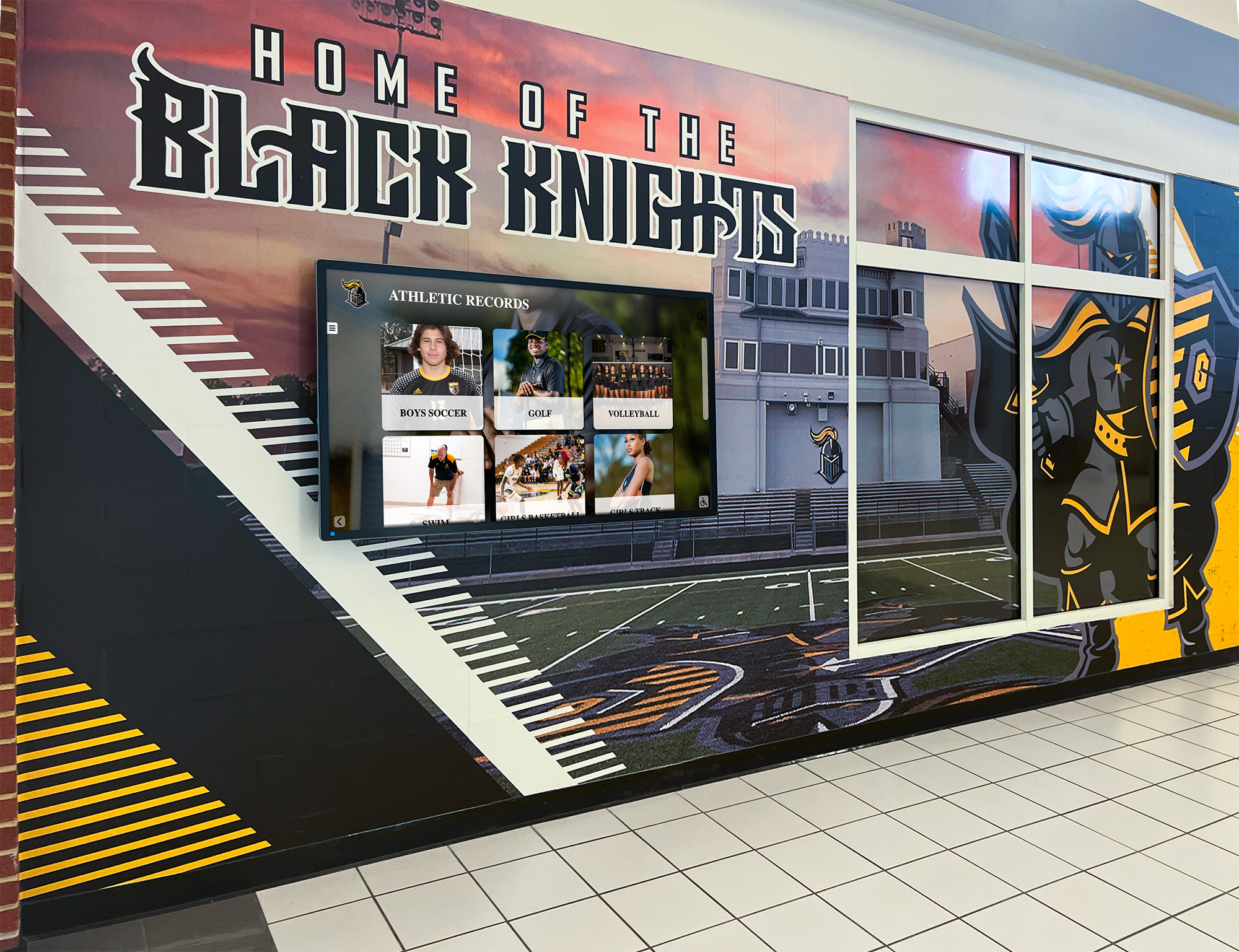
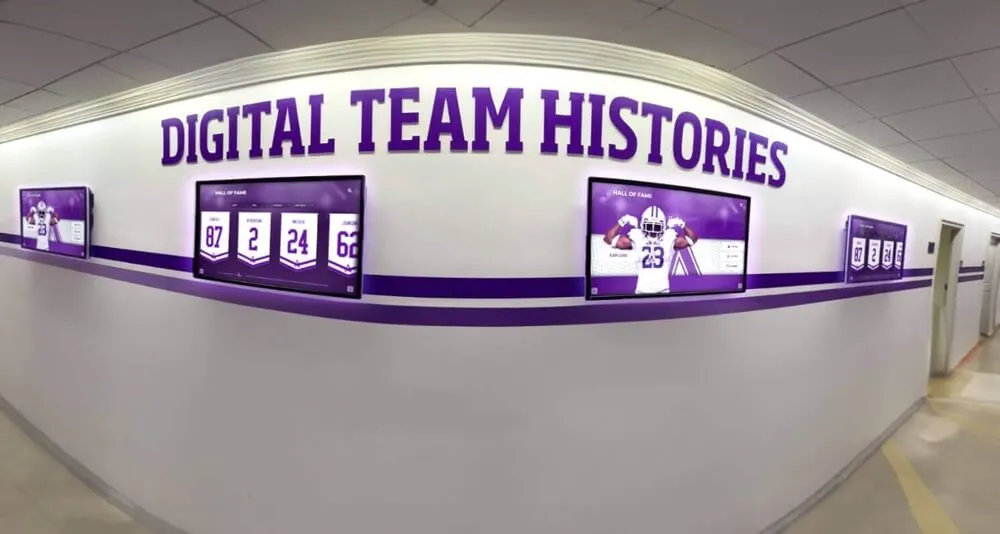
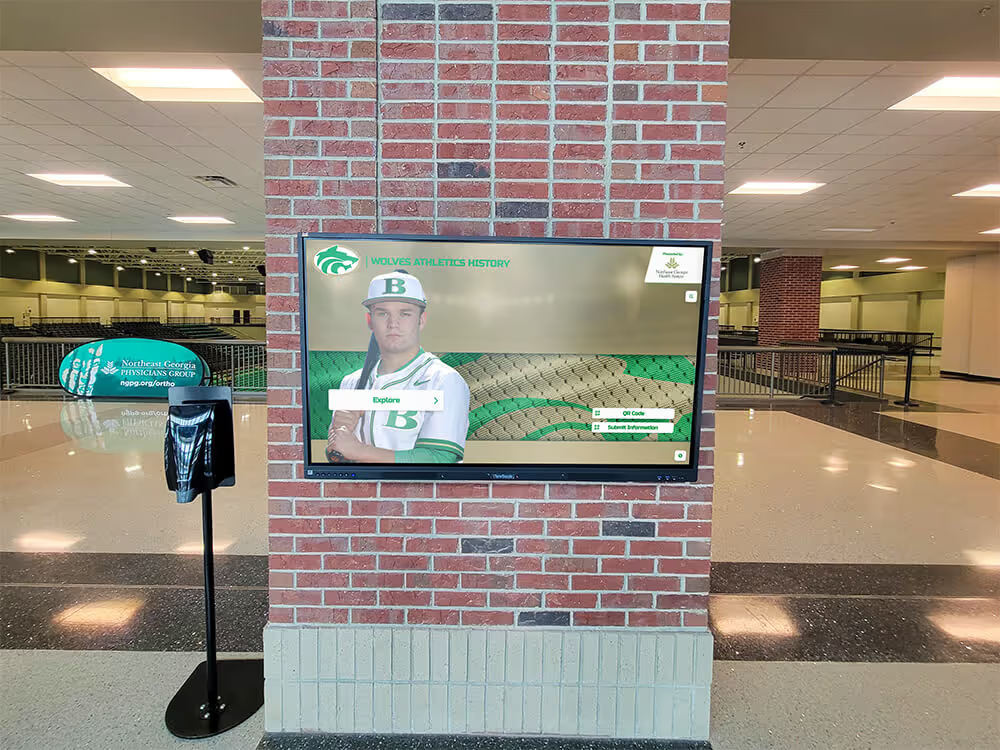
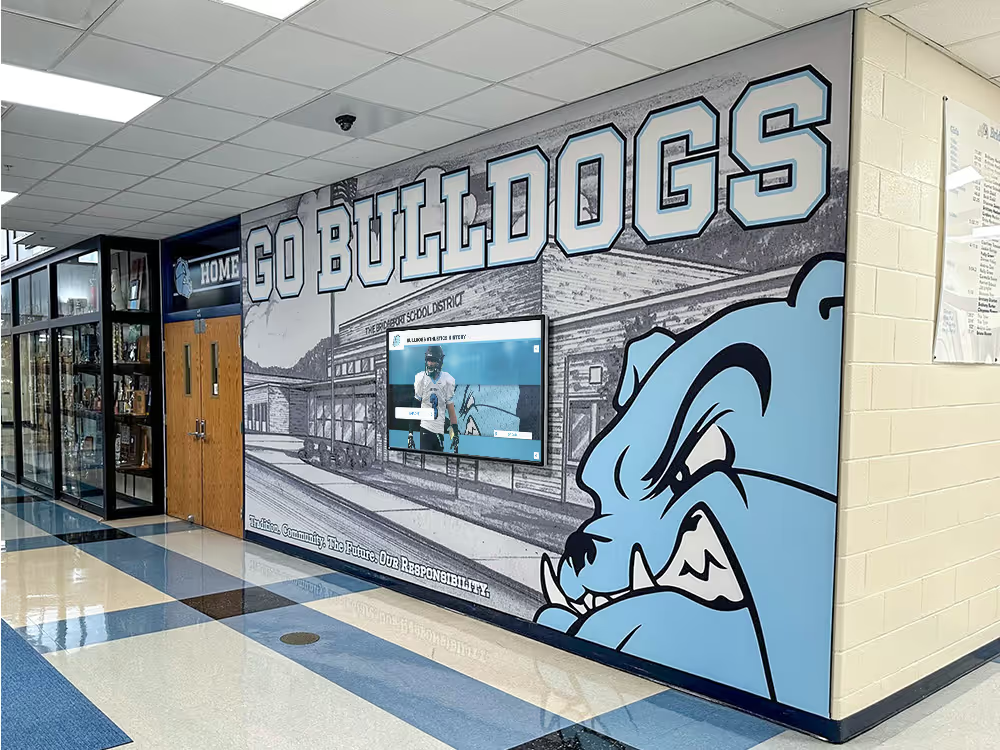
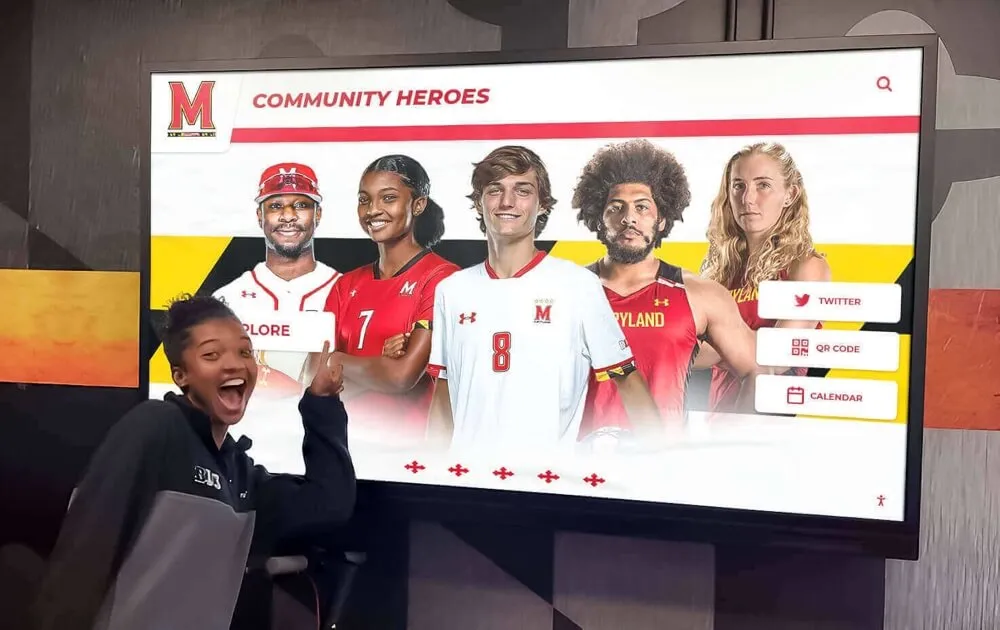
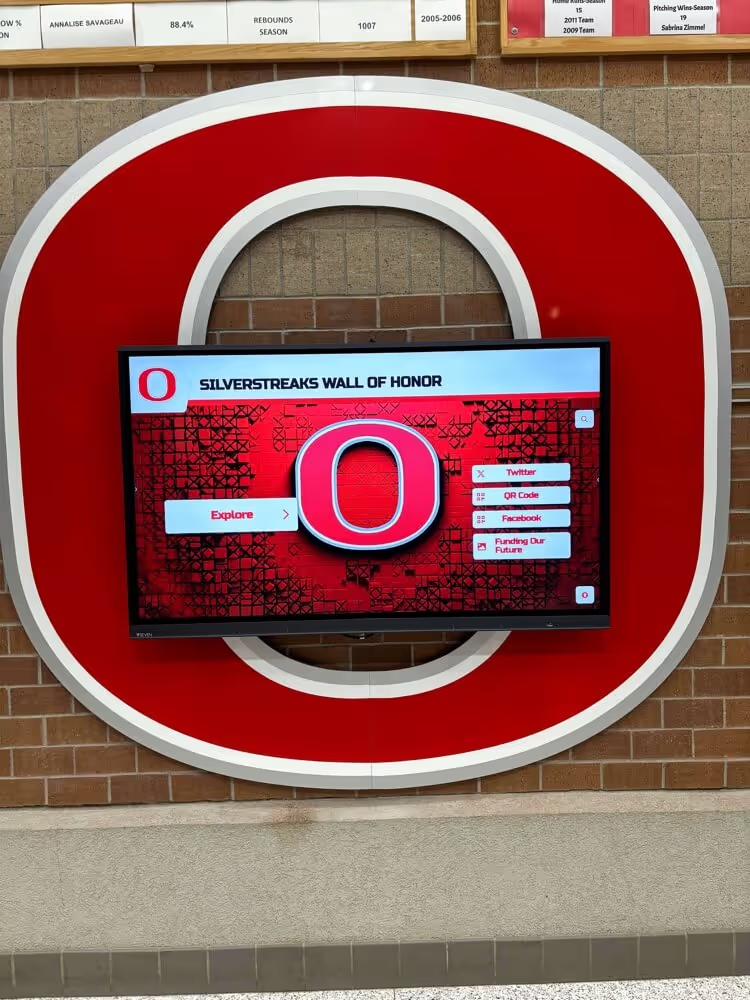
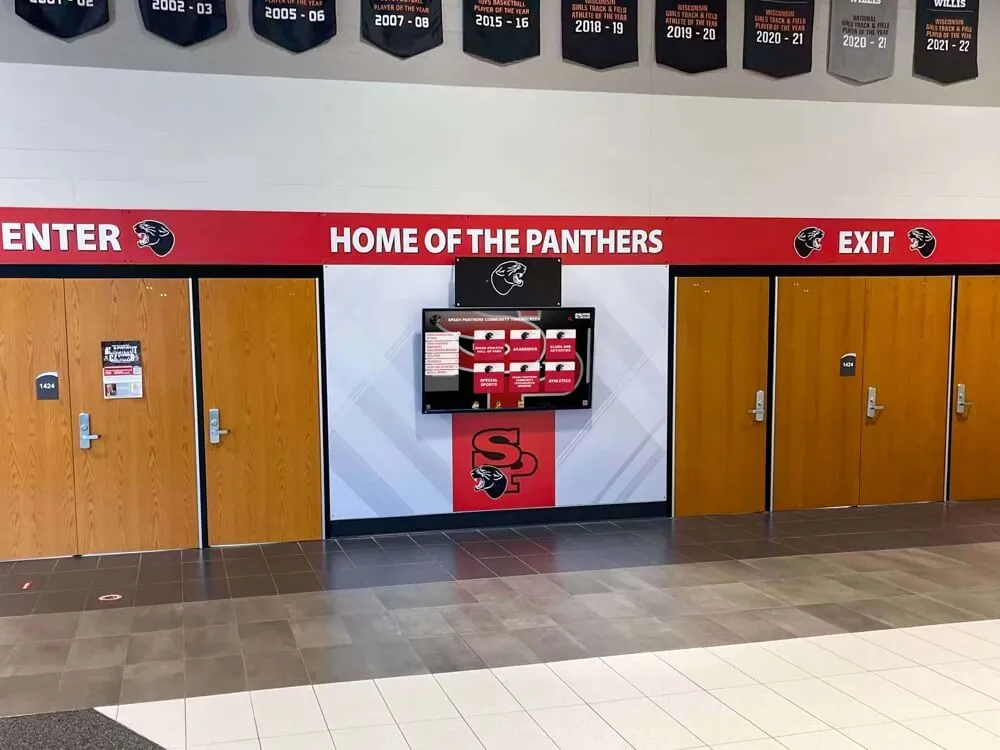
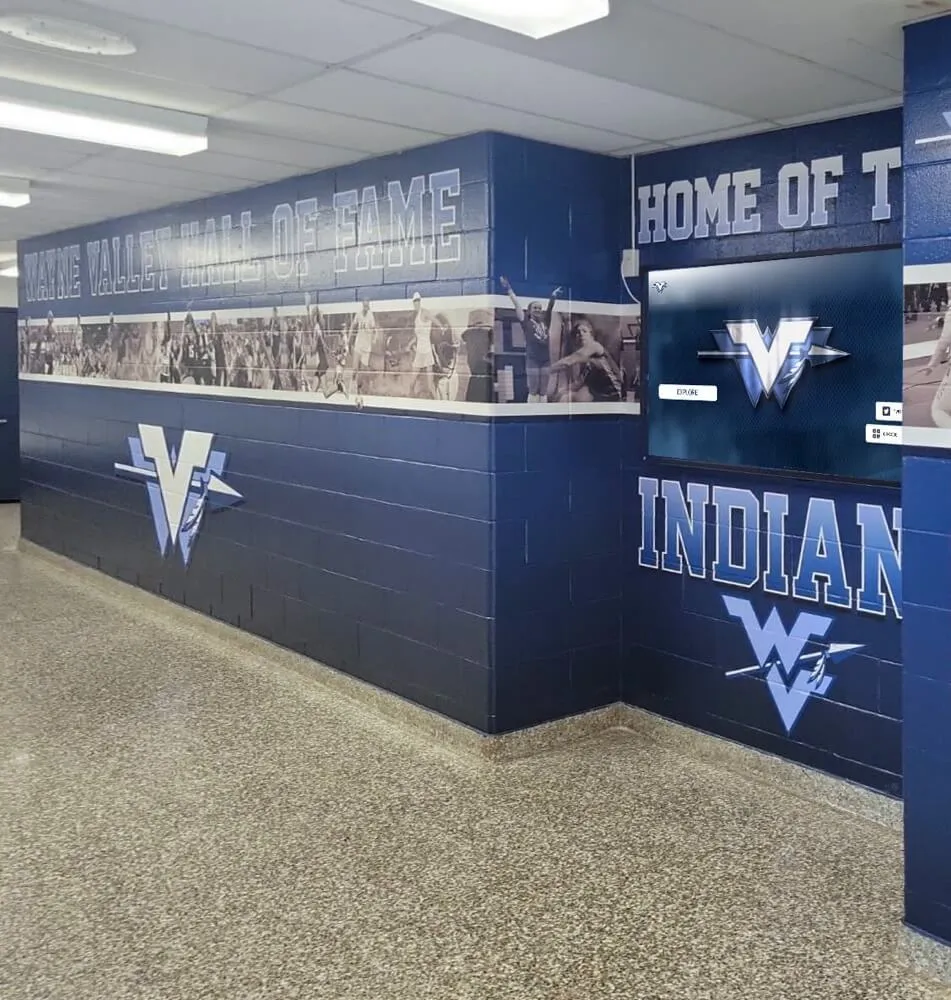
Recognition displays in school hallways are only as current as the data policies behind them — a listener gap without reconciliation can leave a display showing records that were updated or corrected hours earlier
What PostgreSQL LISTEN/NOTIFY Does — and Does Not — Do
Understanding the policy starts with understanding what the underlying mechanism actually guarantees. The PostgreSQL NOTIFY documentation is explicit on the key points, and they differ from what many application developers assume.
Notifications are sent after commit, not immediately. A NOTIFY command inside a transaction does not deliver the notification until and unless the transaction commits. If the transaction rolls back, no notification is sent. This is correct behavior for an award record system — it means a listener never receives a notification for a record that was not actually saved — but it also means that the timing of notifications reflects commit order, not write order.
NOTIFY is not a durable queue. The PostgreSQL LISTEN documentation describes what happens when a listener disconnects: listen registrations are automatically cleared when the session ends, and there is no queue of missed notifications. A client that reconnects and re-executes LISTEN will receive only notifications committed after its new registration takes effect. Everything sent while the listener was disconnected is gone.
Duplicate notifications within the same transaction are coalesced. If the same channel name is signaled multiple times with identical payload strings within a single transaction, only one notification is delivered. This is a useful optimization for high-frequency award-update workflows, but it also means the listener cannot use notification count as a record count.
The payload has a size limit. In the default PostgreSQL configuration, notification payloads must be shorter than 8,000 bytes. The documentation recommends storing the full record in the database table and sending only the record key as the payload — which is the correct pattern for an award record system regardless of size, because it forces the listener to read from the authoritative table rather than trusting the notification payload.
There is a listener registration race. The LISTEN documentation describes a race condition that affects newly-registered listeners: a session that executes LISTEN and then immediately reads the award table may receive notifications referring to updates it already observed in its initial read. The recommended pattern — execute and commit LISTEN, then open a new transaction to read the table, then rely on subsequent notifications — is the correct sequence and is the basis for the reconciliation steps below.
Why “Just Use NOTIFY” Is Not a Sufficient Policy
A common simplification in award display systems is to treat NOTIFY as a reliable change stream: every award record update fires a notification, every notification updates the display, and the display is therefore always current. This works correctly until a listener gap occurs — which it always eventually does.
Consider a hypothetical scenario familiar to many school IT coordinators: a recognition kiosk application restarts after a routine server update at 2:00 AM. Between midnight and 2:00 AM, the athletic records staff had imported the end-of-season award list — triggering dozens of NOTIFY events. The kiosk reconnects, re-registers its listener, and waits for the next notification. It never arrives, because the import is complete. The display shows the pre-import list until someone notices the discrepancy during the following day’s ceremony rehearsal.
The problem is not the import, the notification, or the reconnect. The problem is the absence of a policy requiring the kiosk to reconcile against the award table immediately after reconnection, before waiting for the next event.
Decision Table: When to Trust NOTIFY vs. When to Reconcile
| Situation | Correct Action | Rationale |
|---|---|---|
| Listener continuously connected, notification received | Read the record identified in the notification payload from the award table | Notification is a wake-up, not a data payload — always read from the authoritative table |
| Application starts fresh for the first time | Execute LISTEN, commit, then read the full award table in a new transaction | No prior state; full table read establishes baseline |
| Listener disconnects and reconnects (any reason) | Execute LISTEN, commit, then read the full award table in a new transaction | Gap in notification stream; missed events cannot be recovered |
| Application crash and restart | Same as reconnect — LISTEN, commit, full table read | Session ended; registration was cleared automatically |
| Maintenance window ends; application resumes | Same as reconnect | Any notifications sent during maintenance are unrecoverable |
| Notification received with empty or malformed payload | Read the full award table, not just the implied record | Payload cannot be trusted to identify a specific record safely |
| Notification queue overflow condition detected | Alert IT; do not attempt to replay from notifications | Overflow causes the NOTIFY transaction to fail; source-of-truth is the table |
| Scheduled display refresh cycle fires | Read the full award table regardless of notification state | Belt-and-suspenders reconciliation catches any missed events |
The consistent principle: NOTIFY tells the listener something changed; the authoritative award table tells the listener what changed. The policy always reads the table.
Athletic Awards Database LISTEN/NOTIFY Policy: Numbered Steps
The following steps define and implement the reconciliation policy for a PostgreSQL-backed athletic recognition system. They are written for a school IT administrator or a qualified technical partner supporting an athletic program’s recognition infrastructure. Steps 1 through 4 are design-time decisions. Steps 5 through 9 are operational procedures that govern runtime behavior.
Step 1: Assign One Channel Per Logical Award Scope
Define a NOTIFY channel name for each logical scope of award data the display cares about — for example, award_records_updated for all recipient changes, or separate channels per award category if displays are filtered by type. Document the channel names and their intended scopes in writing before any listener code is deployed.
Avoid a single global channel for all database activity. A channel that fires on every table change anywhere in the database gives the listener no context to scope its reconciliation read, and it increases notification volume in ways that may mask real award events.
Step 2: Restrict NOTIFY to Committed Award Record Writes
Issue NOTIFY only from within the same transaction that writes the award record — not from a separate application step after the write. This ensures the notification cannot fire if the write is rolled back, and it ensures the notification fires as soon as the commit is visible to other sessions.
BEGIN;

INSERT INTO award_recipients (
    athlete_id,
    award_type,
    season_year,
    awarded_by,
    created_at
)
VALUES (
    $1, $2, $3, $4, NOW()
);

NOTIFY award_records_updated, 'season_year=2026';

COMMIT;
The payload here carries a filter hint — not a complete record — consistent with the 8,000-byte payload limit and with the policy requirement that the listener always re-reads from the table.
Step 3: Register LISTEN Before Reading the Initial Table State
At application startup, execute LISTEN in its own transaction and commit it before reading the award table. This is the sequence the LISTEN documentation recommends to avoid the registration race:
-- Transaction 1: register the listener
LISTEN award_records_updated;
-- COMMIT here

-- Transaction 2: read the current award state (separate transaction)
SELECT * FROM award_recipients
WHERE season_year = 2026
ORDER BY award_type, athlete_id;
If these two steps are collapsed into a single transaction, notifications committed between the LISTEN execution and the table read may be delivered before the table read completes, creating a window where the display has both a notification and a stale snapshot simultaneously.
Step 4: Treat Every Notification as a Read Trigger, Not a Data Source
When the listener receives a notification, it must read from the award table. It must not update the display based solely on the notification payload. The payload is a routing hint; the table is the source of truth.
A minimal listener loop in pseudocode:
loop:
  wait for notification on award_records_updated
  on receive:
    open new read transaction
    SELECT current award records (scoped by payload hint if available)
    update display from query result
    commit read transaction
  on connection error:
    reconnect
    goto: reconnection procedure (Step 7)
Step 5: Log Every Listener State Transition
Write a log entry for every state transition the listener experiences: startup, successful LISTEN registration, notification received, reconciliation read completed, disconnect detected, reconnect initiated, and reconnect completed. Include a timestamp and the listener’s connection identifier in each entry.
This log is the primary diagnostic tool when a display is found showing stale data. Without it, determining whether a gap occurred — and how long it lasted — requires inference rather than evidence.
Step 6: Implement a Scheduled Reconciliation Poll as a Safety Net
Do not rely exclusively on notifications to keep the display current. Schedule a full award table read at a fixed interval — for example, every five minutes for active ceremony periods, every thirty minutes during off-season — regardless of notification activity.
This scheduled poll catches two classes of problems that notifications cannot address:
- Missed notifications during listener gaps: The poll reads whatever is in the table now, regardless of whether any notification was sent during the gap.
- Notification delivery failures: Although rare, notification delivery can be disrupted by conditions the listener has no visibility into. The poll provides an independent reconciliation path.
The poll does not replace notification-triggered reads; it supplements them. A display that updates on both notification receipt and scheduled poll is more reliable than one that depends on either mechanism alone.
Step 7: Define the Reconnection Reconciliation Procedure
When the listener detects a disconnection and successfully reconnects, it must execute the following sequence before resuming normal notification monitoring:
- Execute
LISTEN award_records_updatedin a new transaction and commit it. - Open a separate new transaction immediately after commit.
- Read the complete award table state relevant to the display.
- Update the display from the query result.
- Commit the read transaction.
- Log the reconnection event, the duration of the gap (if determinable from connection logs), and the row count returned by the reconciliation read.
- Resume the notification monitoring loop.
This sequence must be completed in full before the listener resumes normal operation. A listener that reconnects, re-registers, and then waits for the next notification before updating the display has left a gap that may not close for hours if no further award activity occurs.
Step 8: Decide What to Display During a Listener Gap
Before deploying any display system that uses LISTEN/NOTIFY, decide and document what the display should show if the listener cannot connect or cannot reconcile:
- Show last known state with a visual indicator (for example, a “Last updated: [timestamp]” label) so staff can identify a stale display.
- Show a maintenance message that prompts staff to contact IT.
- Show nothing until reconciliation completes — acceptable for kiosks during off-hours, not for ceremony displays.
Document the chosen behavior in the system runbook. Include who is responsible for monitoring the last-updated timestamp and at what threshold they should escalate to IT.
Step 9: Test Listener Gap Behavior Before Each Ceremony Season
Before each major awards season — end-of-season banquets, hall of fame induction events, academic honors nights — run a simulated listener gap test in a staging environment:
- Start the listener application and confirm the display is current.
- Terminate the listener connection (not the database) while the staging database is available.
- Apply a batch of award record changes directly to the staging database.
- Reconnect the listener and confirm it executes the full reconnection reconciliation procedure.
- Confirm the display reflects all changes applied during the gap, not just changes since reconnection.
- Document the elapsed time from reconnection to confirmed reconciliation.
That elapsed time is the practical recovery window for a listener gap — the period during which a display may show stale data after the listener reconnects. If the window is longer than acceptable given the display’s role (a lobby kiosk versus a live ceremony screen), reduce the scheduled reconciliation poll interval or add a forced reconciliation trigger to the reconnection procedure.
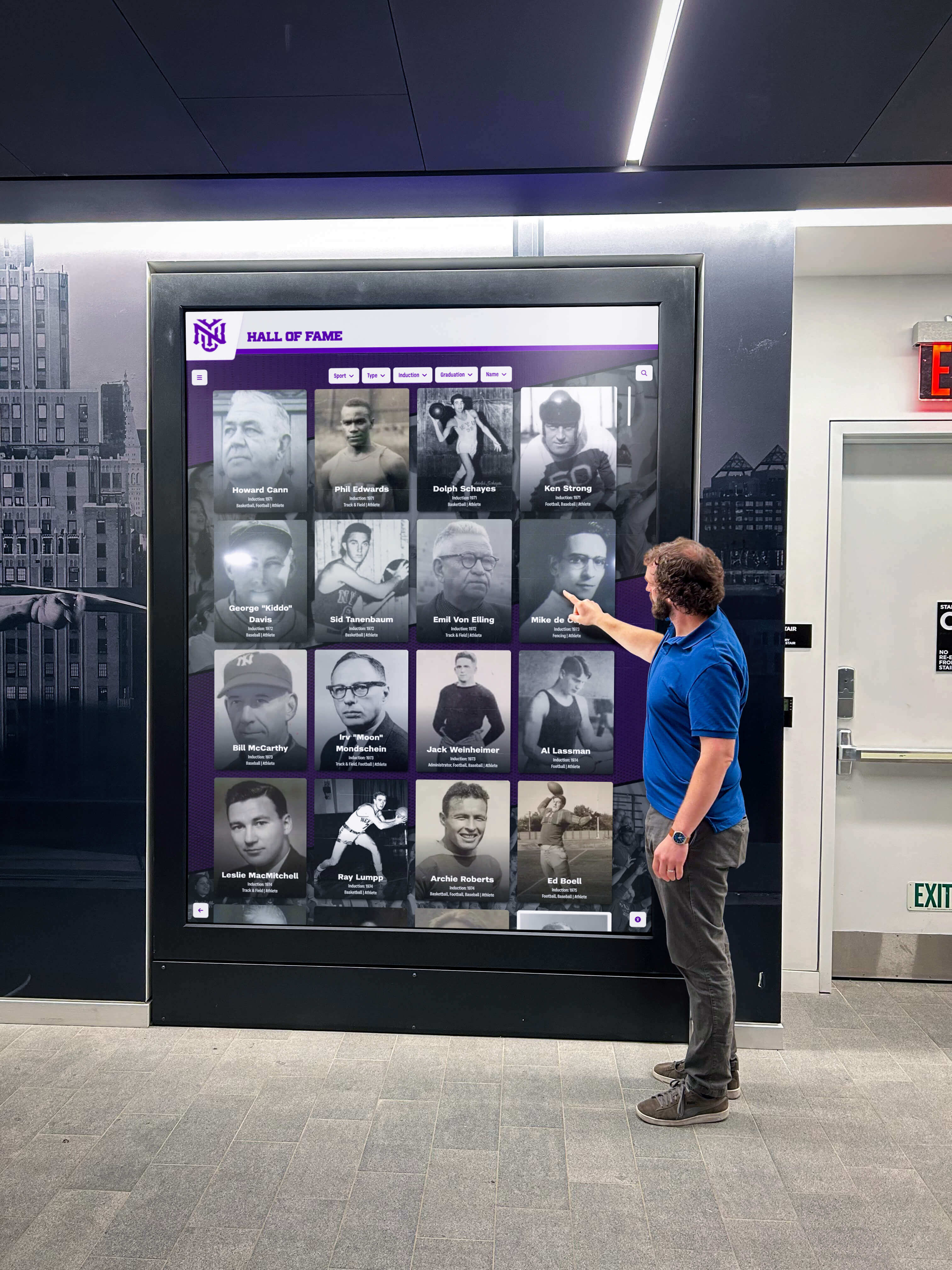
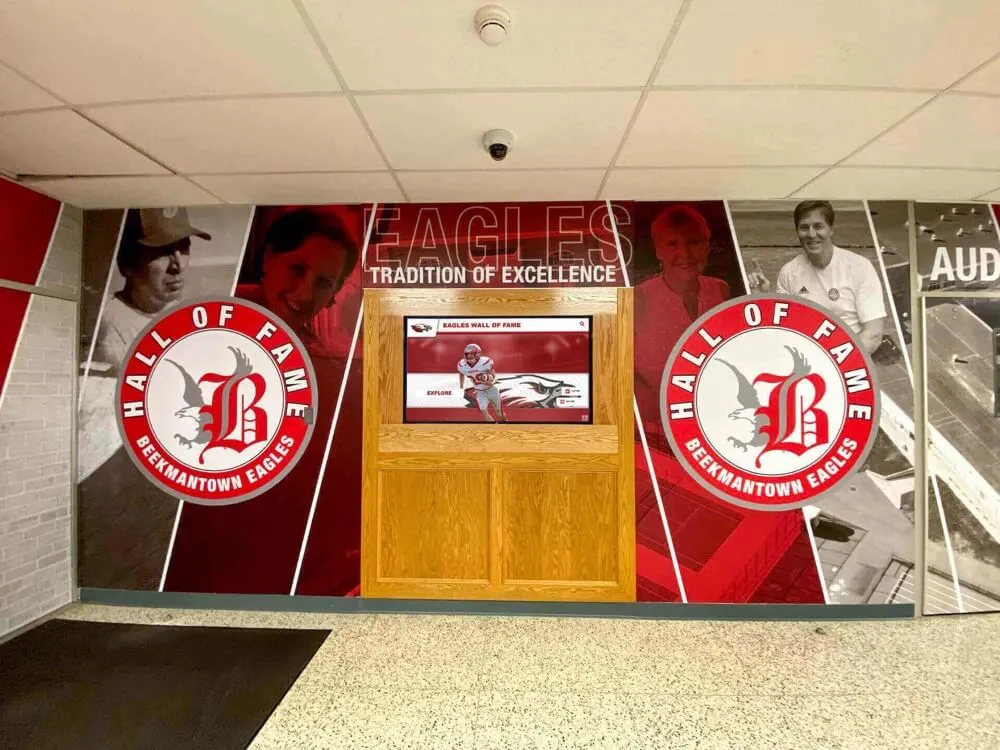
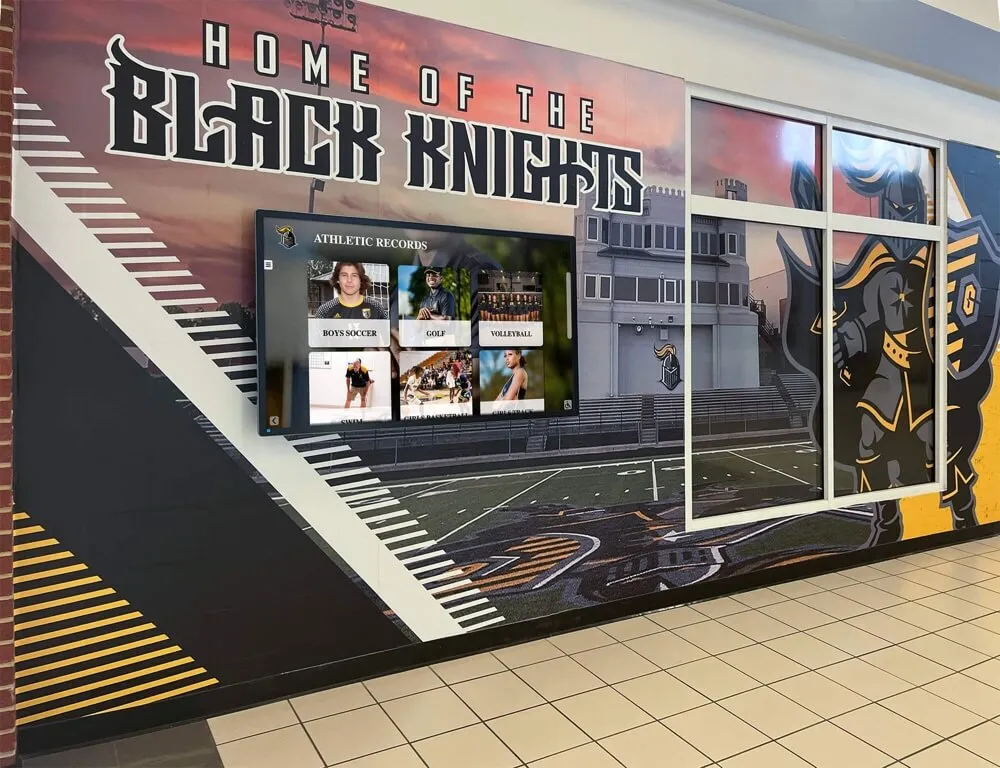
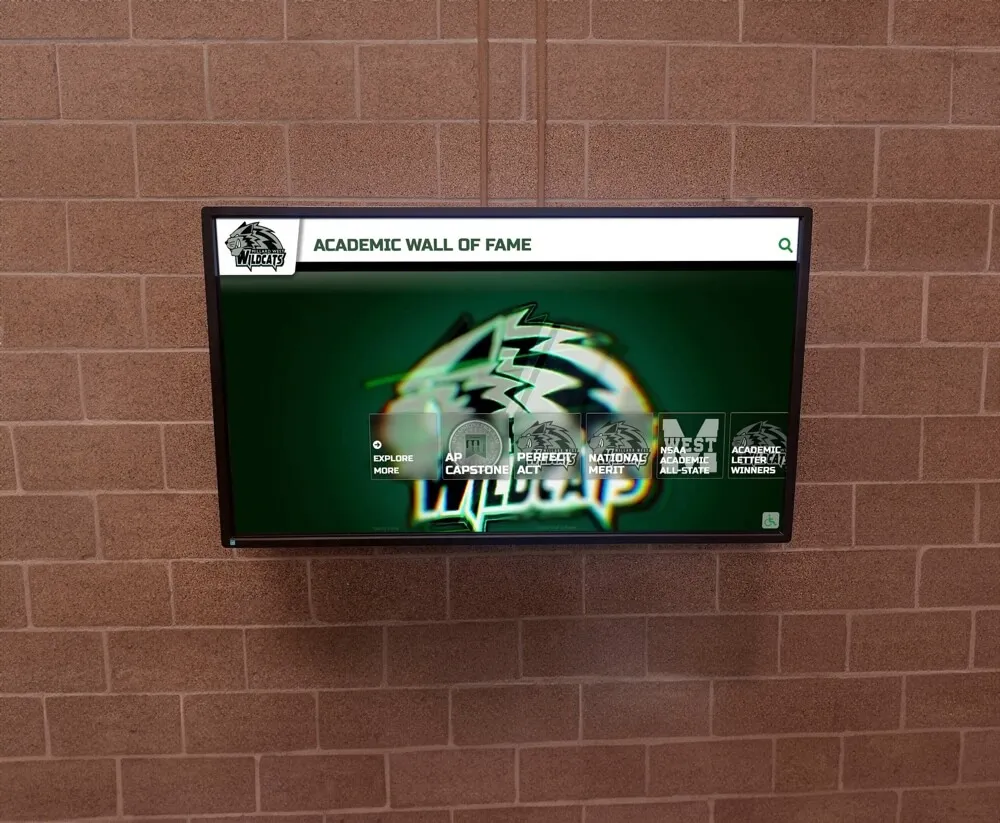
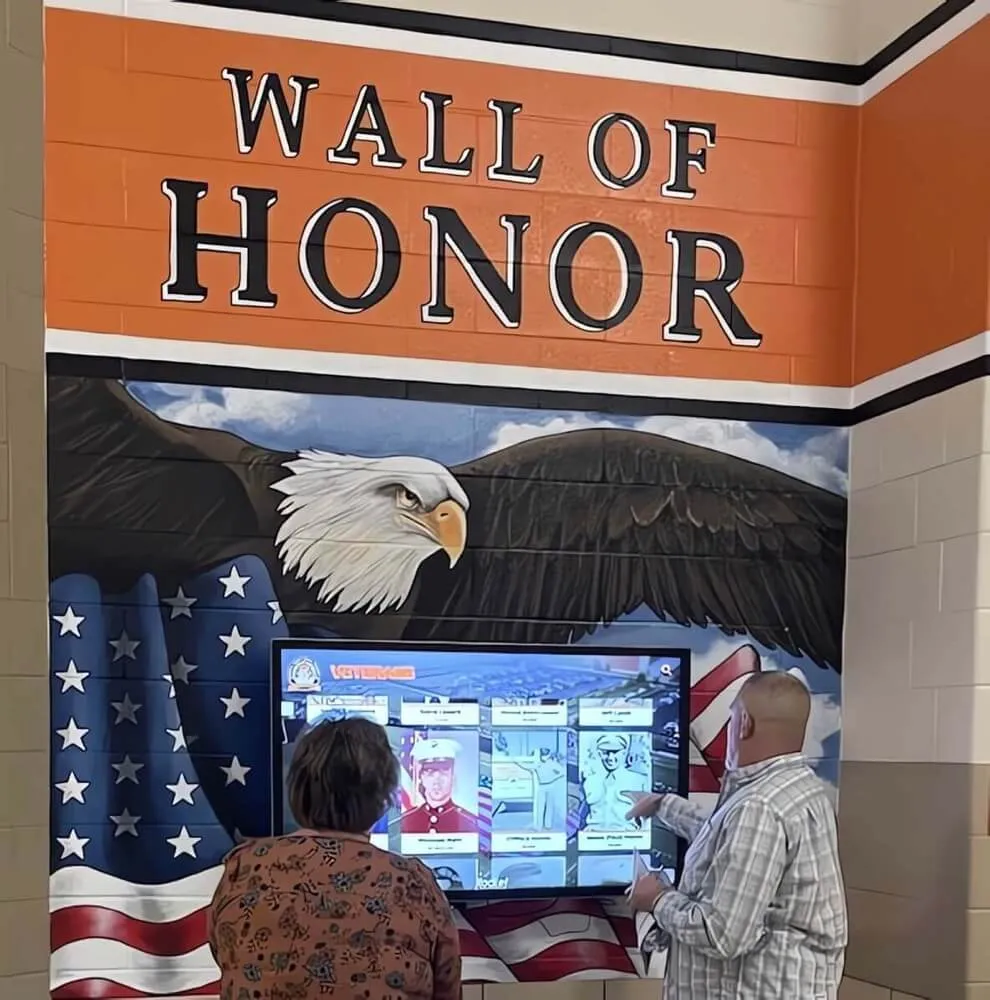
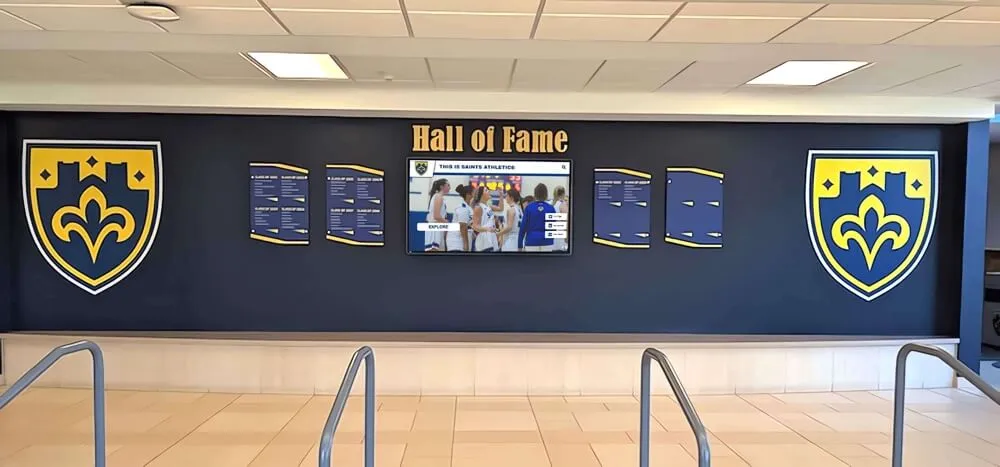
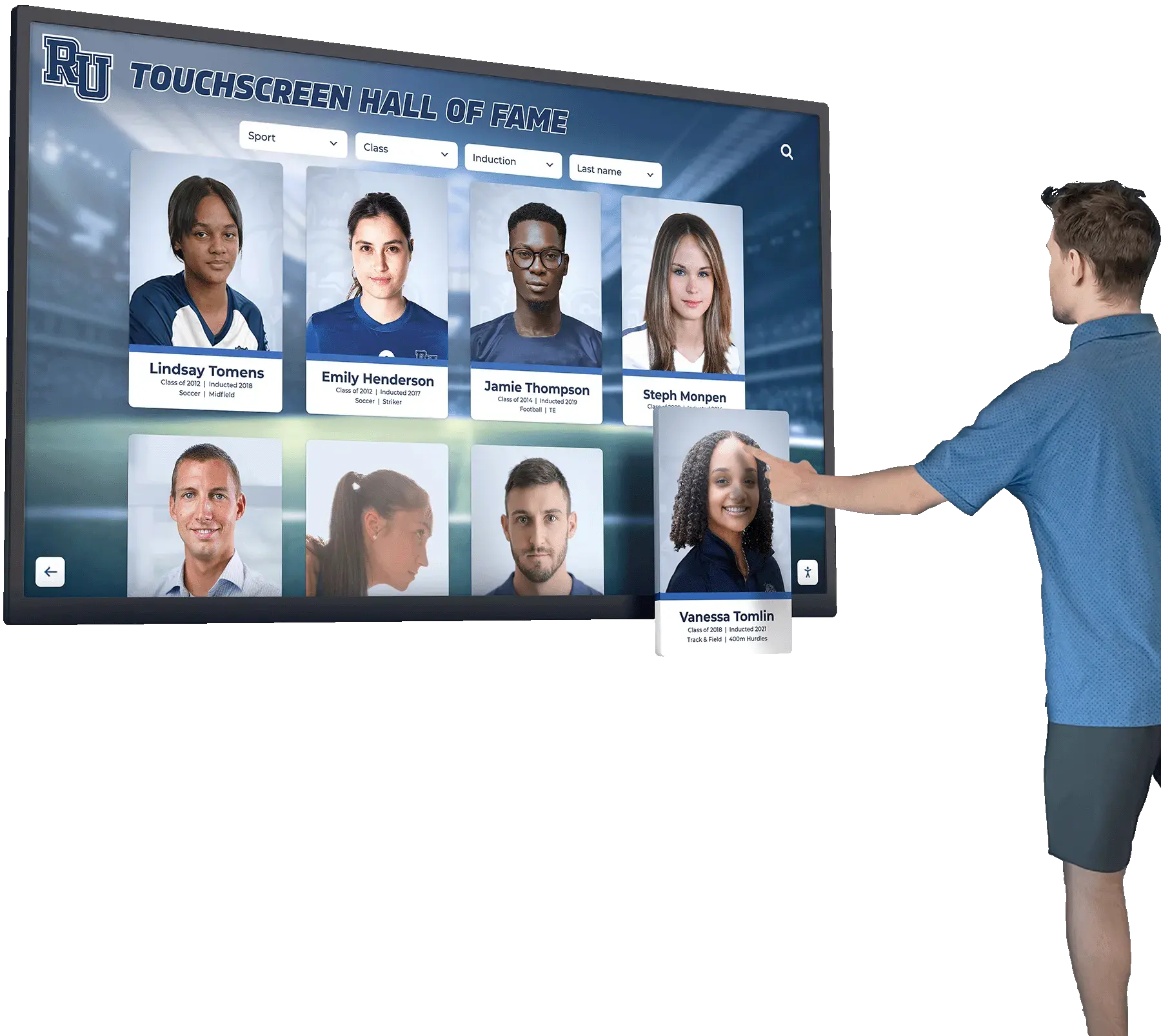
A visitor pointing at a recognition display expects the records shown to be accurate — a listener gap without a reconciliation procedure is the most common reason a display appears current but is not
Connecting This Policy to What Families and Staff Actually See
The technical details above exist to solve a concrete problem: a student, family member, or colleague walks up to a recognition display and sees an award list that does not include a recent honoree, a corrected name, or an updated season record. They report it. Staff investigate. The data is correct in the database. The display just never received the notification — or received it, but the listener was down at the time.
A reconciliation policy does not change the recognition data itself. It changes whether the display reliably reflects the data that was already committed correctly by the athletic records staff who maintains it.
For programs thinking through everything that feeds a recognition display — team histories, sponsor pages, archival records, alumni profiles — the school recognition display DNS negative caching checklist at touchscreenwebsite.com addresses a different but related layer: how DNS caching can prevent a display from resolving updated content addresses after an infrastructure change, and how to pre-clear that cache before a ceremony.

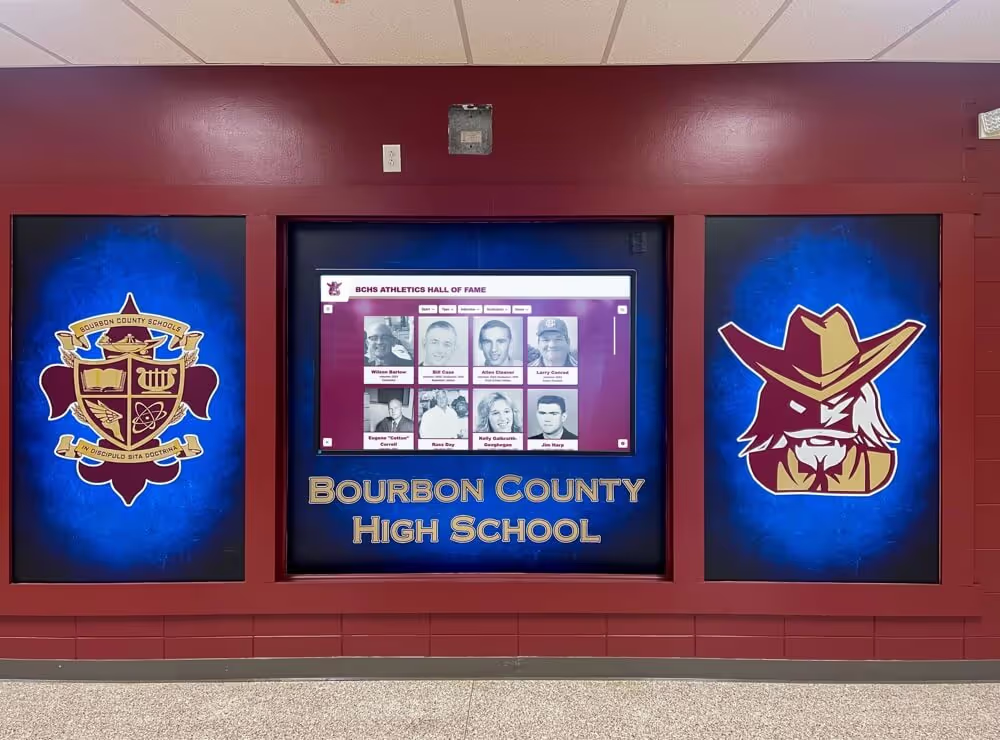
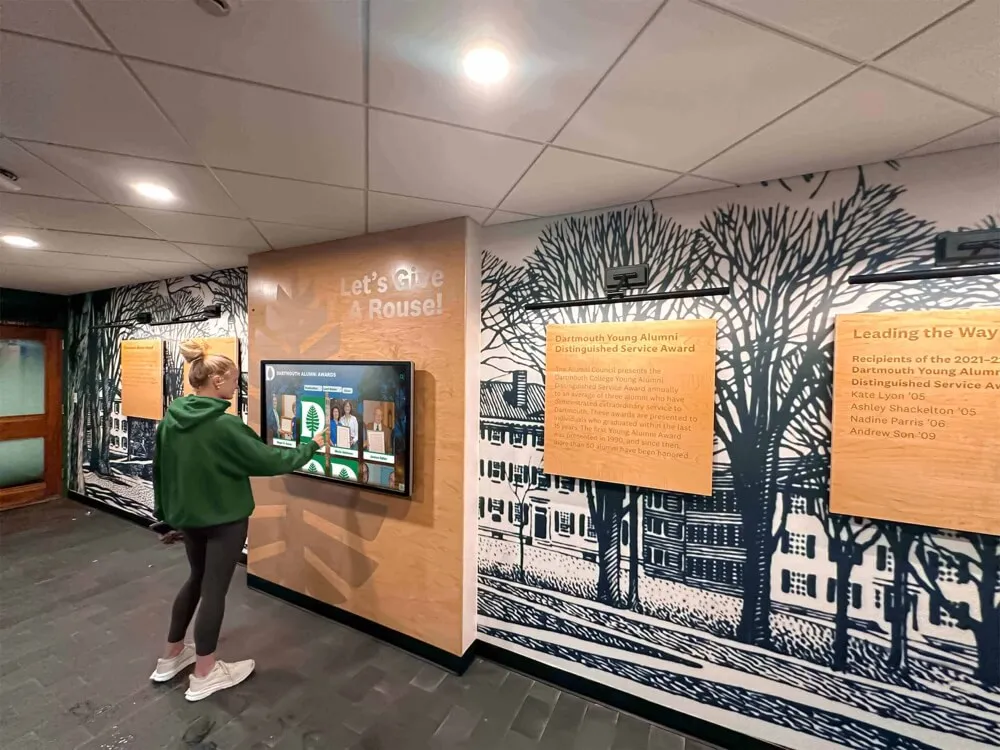
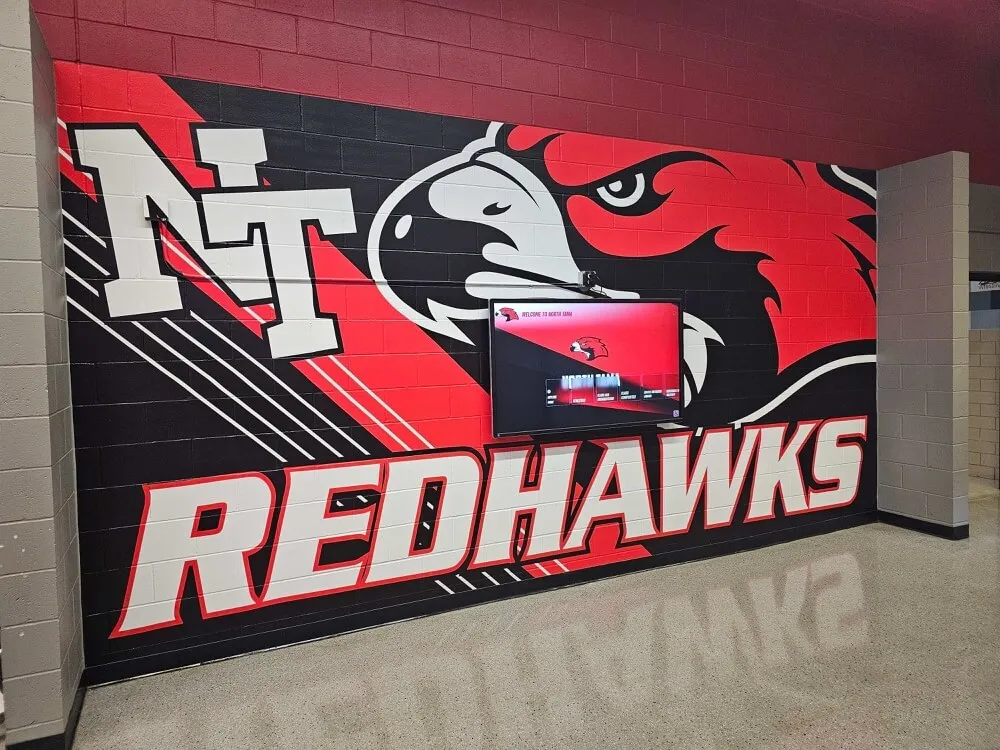
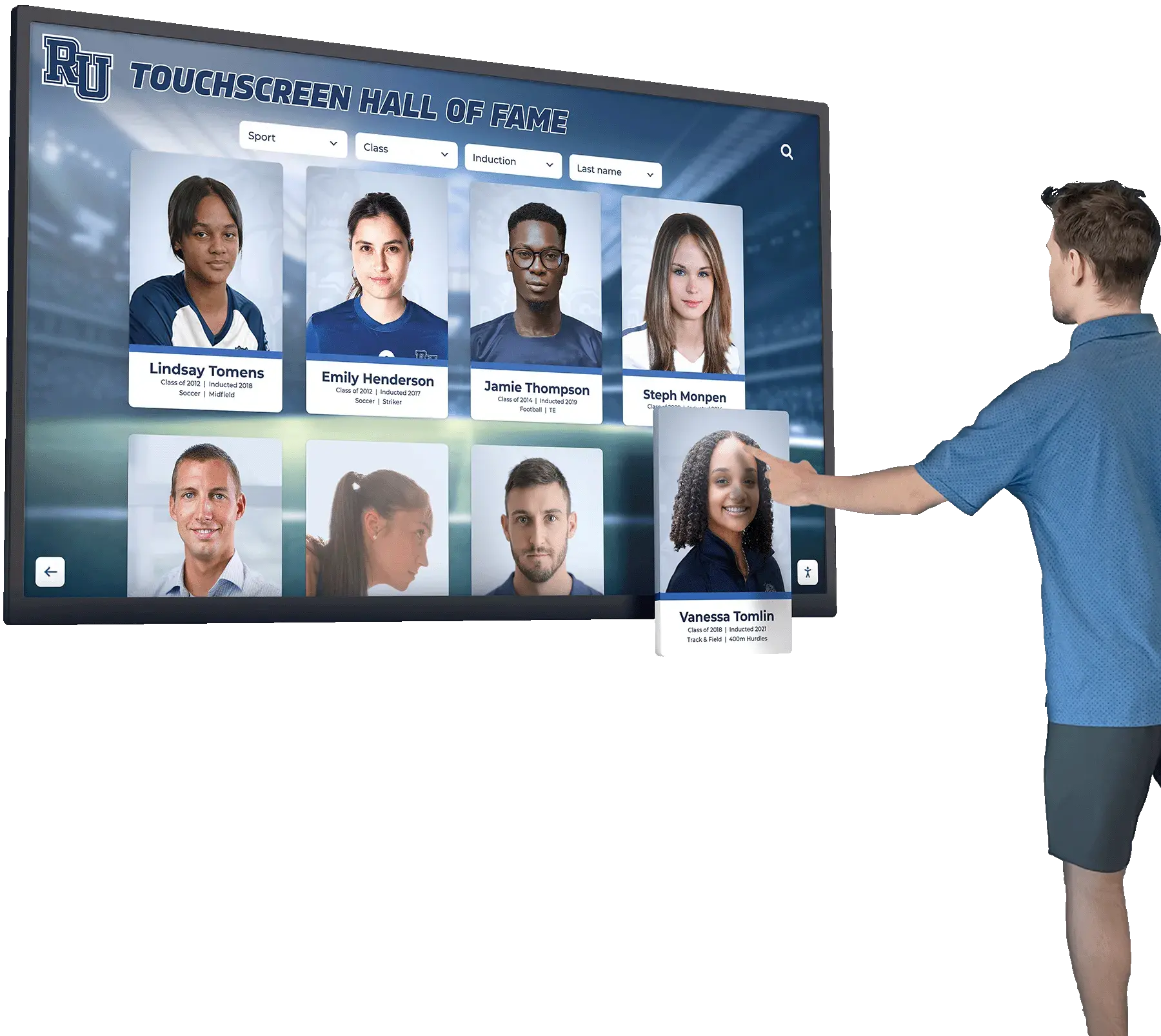
Each athlete card on a recognition touchscreen represents a committed database record — a LISTEN/NOTIFY policy that reconciles on reconnection ensures that corrections and additions appear without waiting for a manual refresh
Inductee Record Quality and the Notification Layer
Award display accuracy is downstream from award record quality. A notification-and-reconciliation policy that works correctly will faithfully display whatever is in the authoritative table — which means record completeness, preferred naming, and profile accuracy are prerequisites, not substitutes, for a sound notification policy.
The digital hall of fame language-of-parts audit for inductee profiles at touchhalloffame.us covers a complementary layer: auditing the structural completeness of inductee profile records — names, achievement labels, dates, and supporting media — before those records appear on a public display. A reconciliation policy that surfaces a profile missing its graduation year or sport classification is doing its job correctly; the fix belongs in the record, not in the notification layer.
For programs that maintain historical photo archives alongside award records, the athletic archive photo negative scanning workflow at digitalyearbook.org describes how digitized historical images are structured for integration with digital recognition systems — a relevant consideration when photo assets are stored alongside award records and subject to the same notification-and-reconciliation update cycle.
Managed Platforms and the Notification Policy Question
Athletic recognition programs that run their own PostgreSQL database and display software take on full responsibility for implementing this policy. Programs using a managed recognition platform shift that responsibility to the vendor, but the audit questions remain valid:
- Does the platform’s display layer treat database notifications as wake-up signals and always re-read from the authoritative record table?
- Does the platform define and document what the display shows during a listener gap or reconnection event?
- Does the platform perform scheduled reconciliation reads independent of notification delivery?
- What is the platform’s documented behavior when the listener misses notifications during a maintenance window?
For programs also evaluating the physical environment their recognition displays operate in — LED lighting upgrades, electrical load planning, inrush current — the trophy case LED inrush current check guide at digital-trophy-case.com covers the infrastructure-side checklist that often runs parallel to a software deployment. Power events that trigger LED controller restarts can also cause display application restarts — which is exactly the class of event this LISTEN/NOTIFY reconciliation policy is designed to recover from automatically.
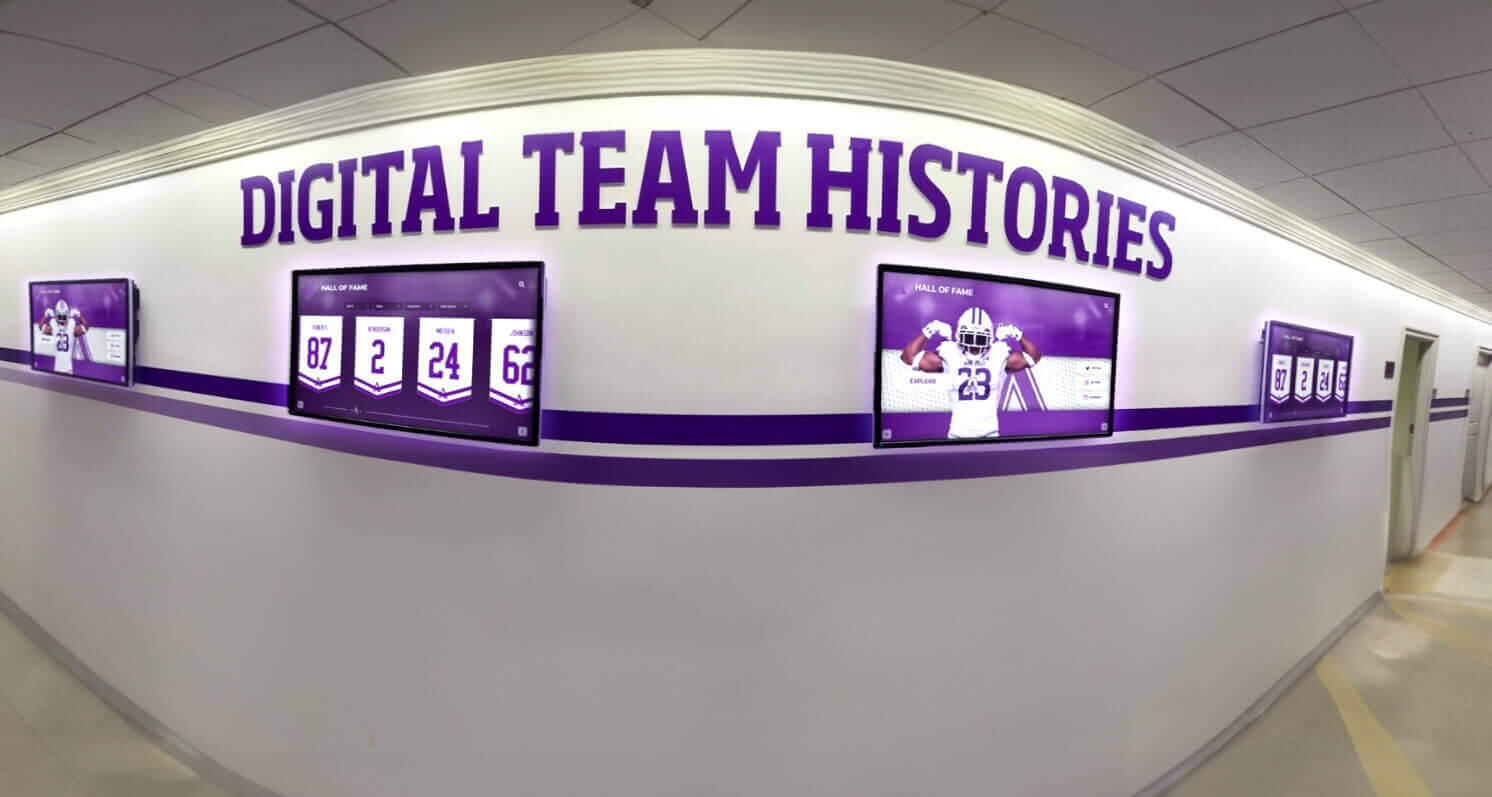
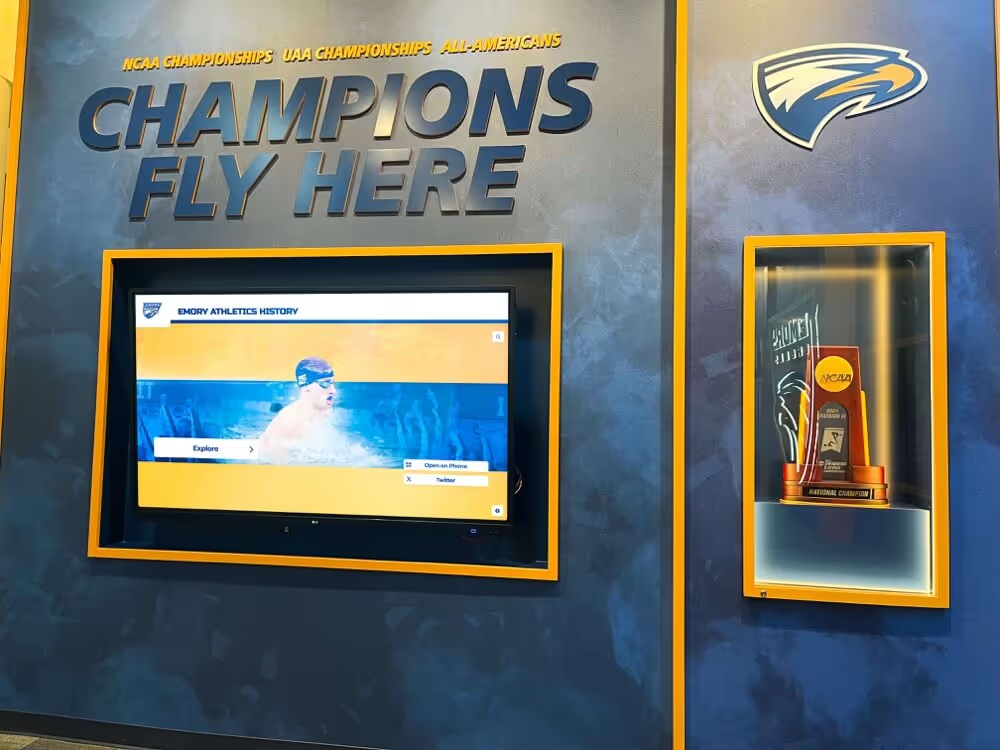
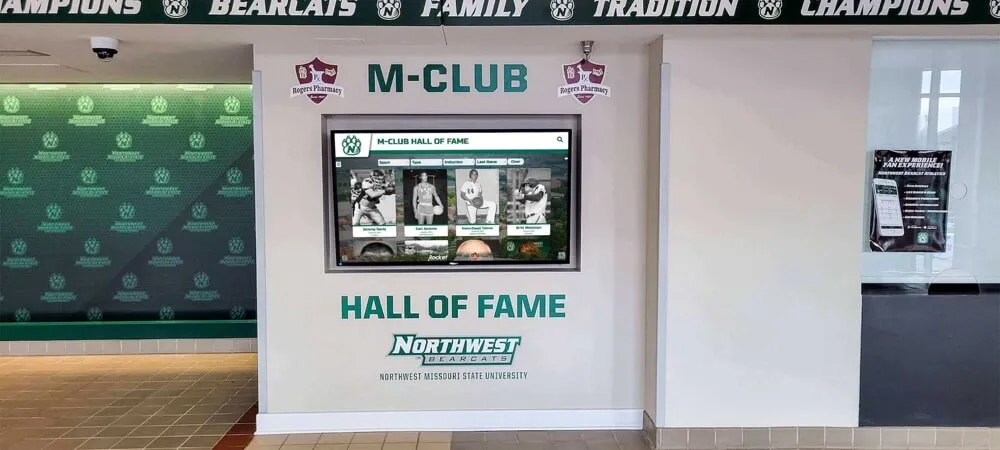
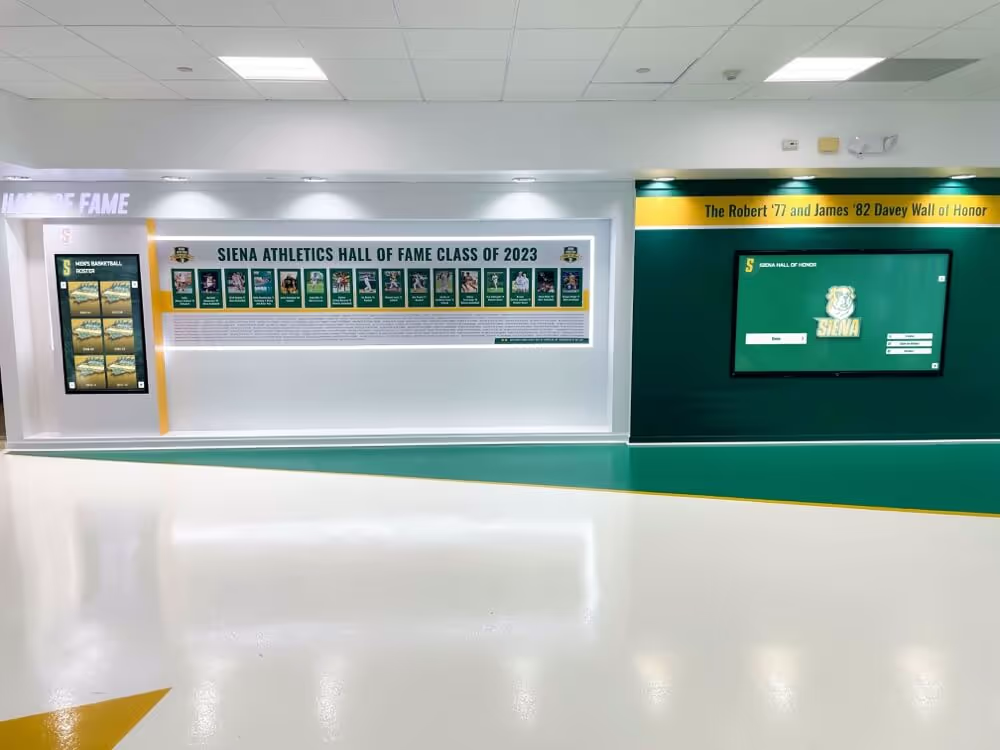
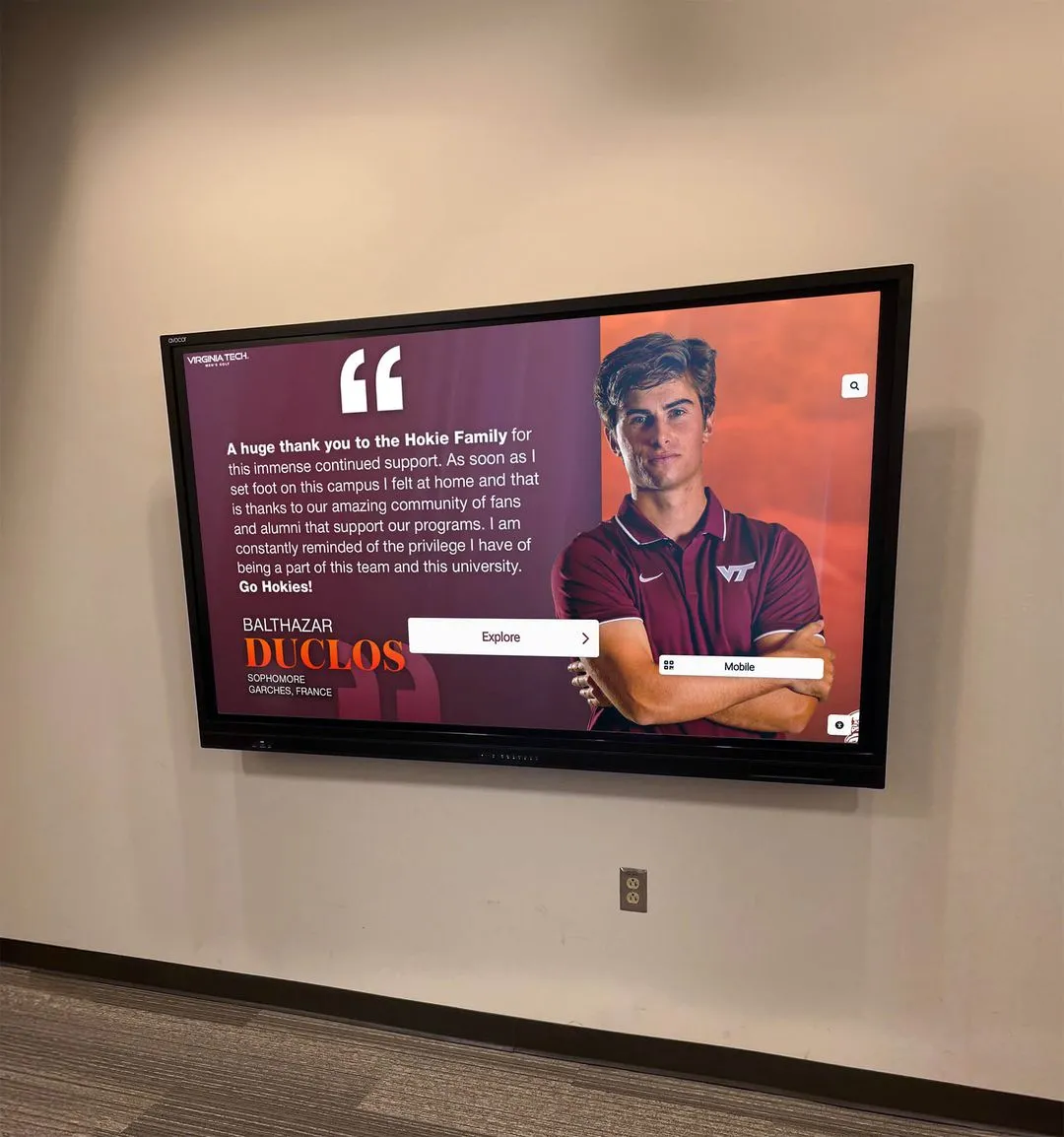
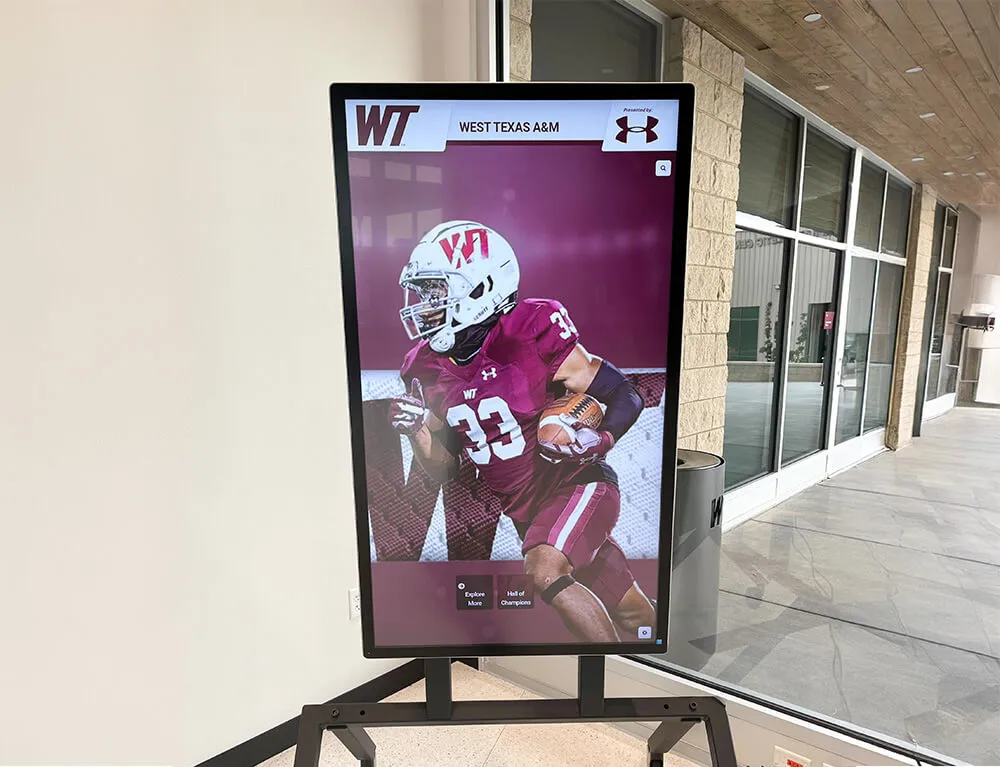
Team history displays in school hallways are read by athletes, families, and alumni throughout the year — a LISTEN/NOTIFY reconciliation policy ensures that a listener gap during a late-night maintenance window does not leave outdated records visible the following morning
Accessibility and Display Accuracy Together
Recognition displays that serve a broad school community — including students, families, and community members with disabilities — depend on data accuracy as a prerequisite to accessibility. A display that is technically WCAG-compliant but shows outdated award records fails the recognition mission even if it passes an accessibility audit.
For programs conducting or preparing for accessibility audits of their recognition interfaces, the digital hall of fame accessible name audit for icon buttons and search filters at halloffame-online.com addresses the interface layer — ensuring that interactive controls on recognition kiosks have correct accessible names that assistive technologies can read. Both the interface audit and the notification reconciliation policy are necessary; neither substitutes for the other.
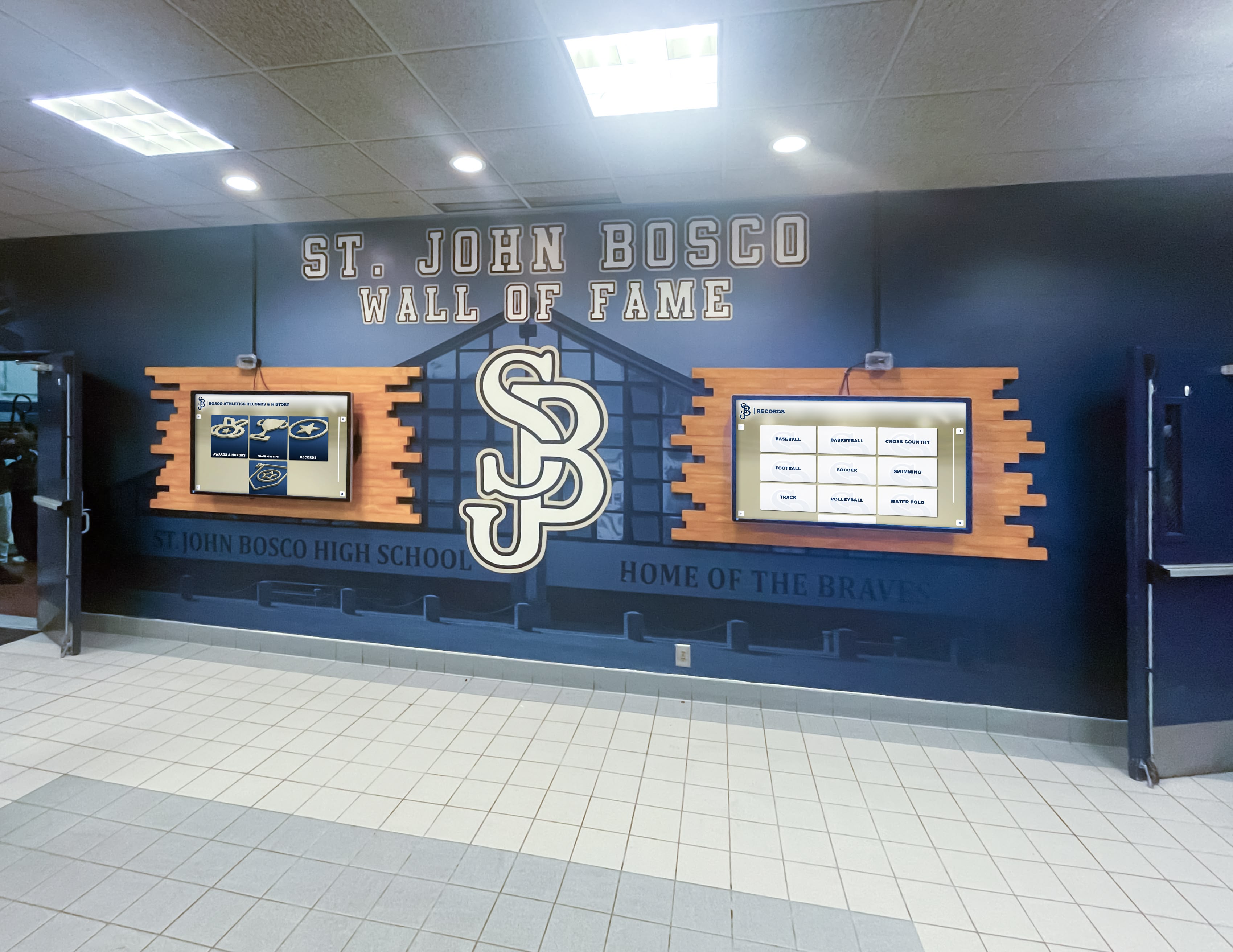
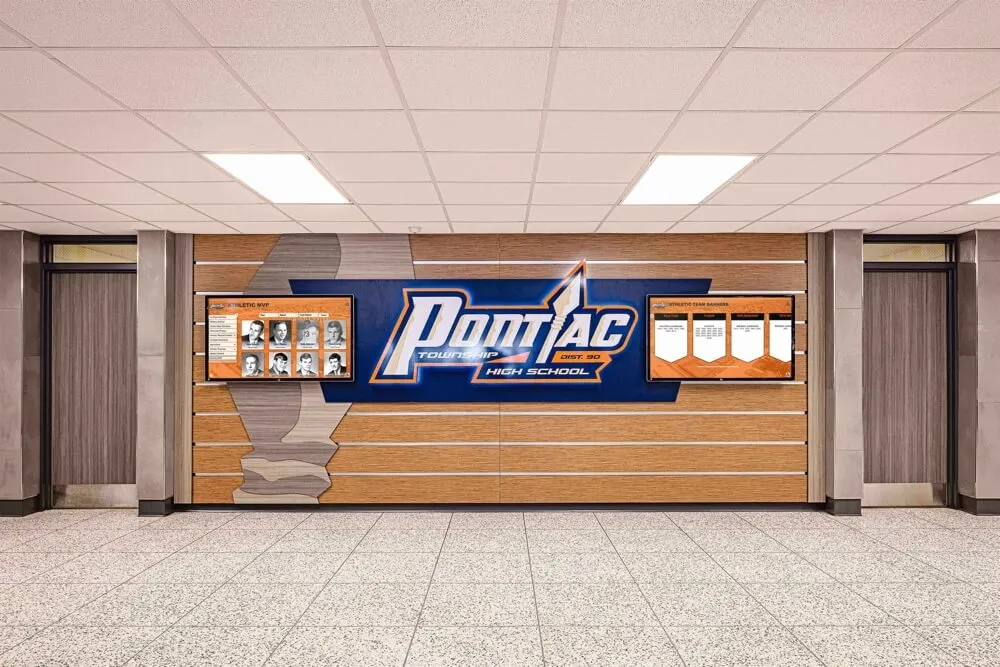
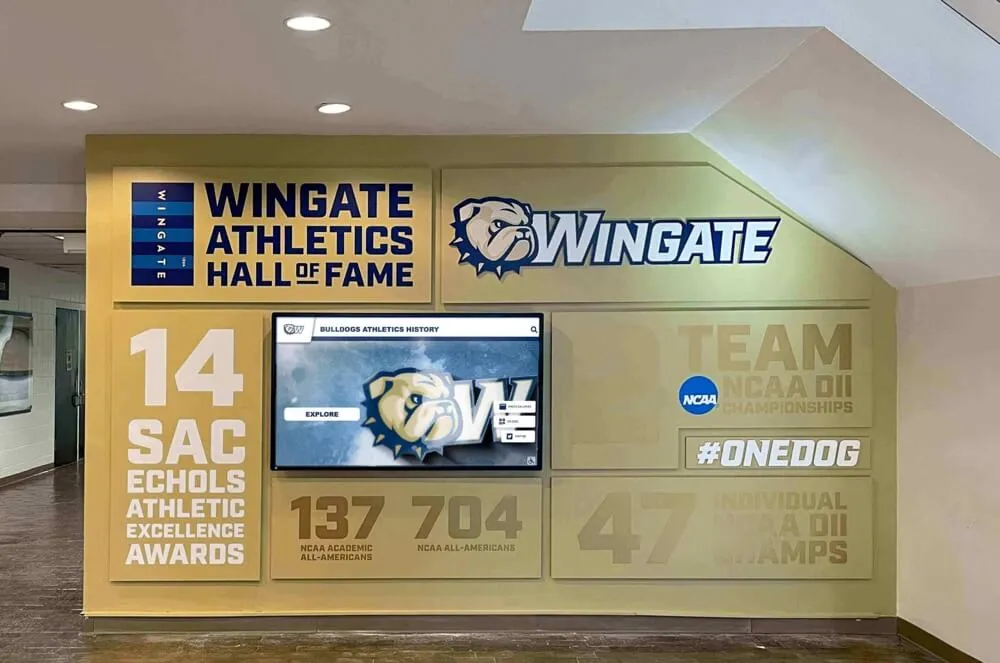
Side-by-side recognition screens in a school hallway must reflect the same current data — a reconciliation policy that runs on reconnection ensures consistency across display nodes after any network or application interruption
FAQ: Athletic Awards Database LISTEN/NOTIFY Policy
What is the difference between a notification and a reconciliation read in this policy?
A notification is a lightweight signal sent by PostgreSQL after a transaction commits — it tells the listener that something changed in the award database. A reconciliation read is a full or scoped query against the authoritative award table that retrieves the current state of the records. The policy treats notifications as triggers for reconciliation reads, not as data sources in themselves. The display always updates from the query result, never from the notification payload alone.
What happens to notifications sent while the listener is disconnected?
They are lost. PostgreSQL does not queue notifications for listeners that are not currently connected. The LISTEN documentation confirms that listen registrations are cleared when the session ends and that reconnecting clients receive no replay of missed events. This is the reason the reconnection procedure in this policy requires a full table reconciliation read before normal operation resumes — it is the only way to recover the changes that notifications did not deliver.
Can the notification payload be used to identify exactly which record changed?
A payload can carry a routing hint — a record key, a season year, an award category — that helps the listener scope its reconciliation read. It cannot be used as a reliable complete record. Payloads are subject to the 8,000-byte limit and to coalescing within a transaction. The authoritative source for what changed is always the award table, not the payload.
How often should a recognition display perform a scheduled reconciliation read, independent of notifications?
The appropriate interval depends on how frequently award records are updated and how quickly the display must reflect changes. During active import periods or ceremony preparation, a five-minute poll may be appropriate. During off-season, thirty minutes to an hour is typically sufficient. The scheduled poll is a safety net for listener gaps, not a replacement for notification-triggered reads. Document the chosen interval in the display system’s runbook and review it before each awards season.
Does this policy apply only to PostgreSQL, or to other databases that support similar event mechanisms?
The specific commands (LISTEN, NOTIFY, UNLISTEN), the commit semantics, and the behavior on disconnect are PostgreSQL-specific — as noted explicitly in the LISTEN documentation, LISTEN is not part of the SQL standard. Other databases that support publish/subscribe or event notification features have different delivery guarantees, persistence models, and reconnect behaviors. Any policy governing notification-driven display updates should be written against the specific mechanism used, not against a generic abstraction. The principle — treat notifications as wake-up signals and reconcile from the authoritative record — applies broadly, but the implementation details depend on the database in use.
What should the display show to staff during the reconciliation read after a listener gap?
This is a policy decision, not a technical constraint. Options include showing the last known display state with a visible “Last updated” timestamp, showing a neutral loading state until the reconciliation read completes, or — for displays running during active ceremonies — showing a static fallback derived from the most recent successful reconciliation. Document the chosen behavior before deployment and ensure that whoever monitors the display knows what to look for and who to contact if the last-updated timestamp stops advancing.
Building Reliable Recognition Displays on a Sound Data Foundation
An athletic awards database LISTEN/NOTIFY policy is, at its core, a commitment to treating the award table as the single source of truth and treating notifications as the mechanism that prompts a re-read of that truth. It is not a commitment to treating notifications as a durable, reliable, ordered stream of every change that ever occurred — because PostgreSQL does not provide that guarantee, and pretending it does creates exactly the listener-gap failures that leave displays showing outdated recognition records.
The numbered steps in this guide — scoped channels, commit-bundled notifications, listener registration before table read, notification-triggered reconciliation reads, scheduled polling, reconnection reconciliation, and pre-season gap tests — are the components of a policy that holds up in practice. Each step compensates for a specific failure mode. None of them is complex; together, they close the gap between “the database has the right data” and “the display shows the right data.”
Student athletes, coaches, and the families who come to see a hall of fame induction or end-of-season awards night deserve accurate recognition wherever they look. A database notification policy is not what they see — but it is what makes what they see correct.