



Intent: define. An athletic awards database partial unique index policy is a data-governance document that specifies how a partial unique index—a uniqueness constraint applied only to rows that match a defined filter condition—should be used in a school’s recognition database to prevent two or more active award records from representing the same honor for the same athlete in the same season, while still allowing corrected, retired, or soft-deleted records to coexist in the underlying table without triggering a constraint violation.
The short answer: a partial unique index enforces the rule “no two active records may claim the same athlete–sport–season–award-category combination” without preventing the database from retaining prior versions of a corrected entry or archived versions of a retired honor. The policy defines which tables carry a partial unique index, which filter condition identifies an “active” row for each table, what the indexed columns are, who may request an exception, and what migration steps apply when a partial unique index is added to a table that already contains historical data.
This guide defines the concept in plain language for athletic directors, school administrators, IT teams, and recognition-program owners; presents the core uniqueness rule with a concrete example; provides a decision table comparing partial and full unique indexes; and closes with a migration checklist for programs adding a partial unique index to an existing athletic award database.
A school’s athletic recognition database may contain two records labeled “First-Team All-Conference – Men’s Basketball – 2023–24” for the same athlete. One was entered in error during an end-of-season import and later corrected. The other is the accurate, verified entry that the athletic department intends to display. If the database uses a standard full unique index on the athlete–sport–season–category combination, the corrected entry cannot coexist with the original—the uniqueness constraint treats both records as the same honor and blocks the correction workflow entirely.
A partial unique index solves this problem. It enforces uniqueness only among records that are currently active—records that have not been soft-deleted, corrected and retired, or marked inactive through the program’s normal data governance workflow. Inactive records are excluded from the uniqueness check, which means corrected versions of an honor can coexist with their predecessors in the same table without triggering a violation.

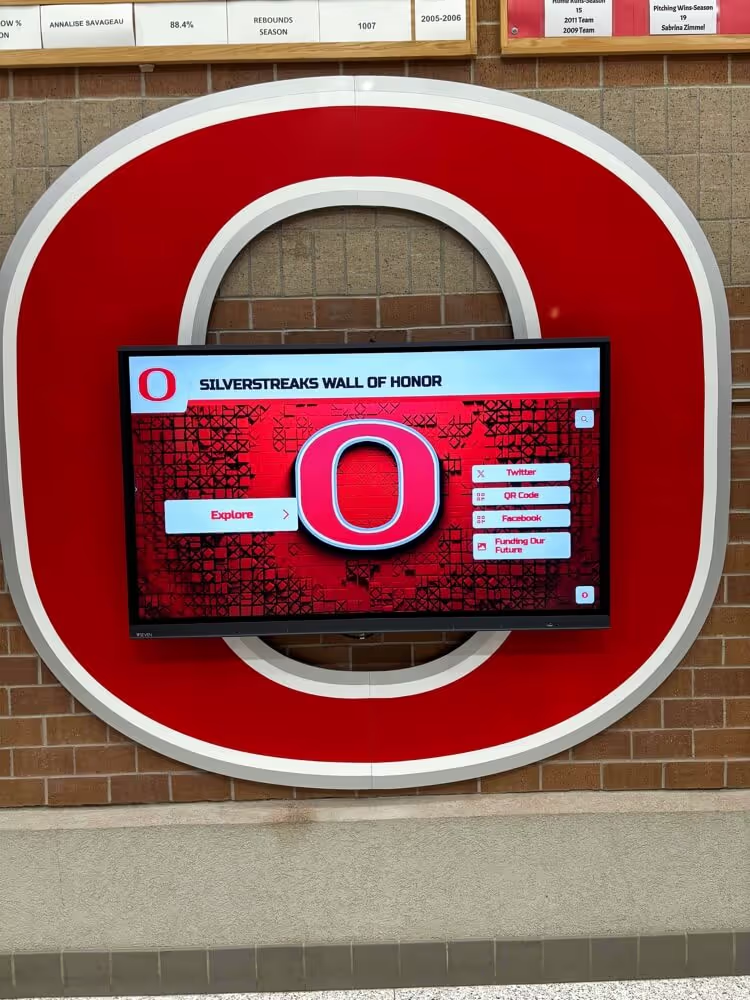
Athletic hall of fame displays surface the active, verified version of each recognition record—a partial unique index ensures the database enforces that only one active record exists per honor, per athlete, per season
What Is an Athletic Awards Database Partial Unique Index?
A partial unique index is a database index that enforces a uniqueness constraint over a filtered subset of rows in a table, rather than over every row. The filter is a WHERE clause embedded in the index definition itself. Rows that do not satisfy the filter condition are entirely excluded from the index—they are invisible to the uniqueness check and cannot cause a violation regardless of their column values.
In a relational database that supports partial indexes natively—PostgreSQL is the most widely used example—the syntax for creating a partial unique index on an award-recipients table looks like this:
CREATE UNIQUE INDEX uix_active_award_per_athlete_season_category
ON award_recipients (athlete_id, sport_id, season_year, award_category_id, division_level)
WHERE deleted_at IS NULL;
This index enforces uniqueness across the five columns—athlete_id, sport_id, season_year, award_category_id, and division_level—but only among rows where deleted_at IS NULL. Any row with a populated deleted_at timestamp (a soft-deleted record) is excluded from the index. Two soft-deleted records with identical column values can coexist without triggering a violation. Only among the active rows is uniqueness enforced.
For recognition administrators who are not database engineers, the practical meaning is this: the index guarantees that a live award display will never show two competing records for the same honor. At the same time, it allows the database to retain the complete correction history—the original erroneous record, the corrected record it was superseded by, and any intermediate versions—without the constraint blocking that history from being stored.
This is a meaningful advancement over a full unique index, which enforces uniqueness across all rows and makes it impossible to retain the original record when a correction is applied. It is also meaningfully different from removing the uniqueness constraint entirely, which provides no protection against duplicate active records at all.
Why Duplicate Active Award Records Harm Athletic Recognition Programs
Duplicate active award records are not a minor data quality nuisance. They create compounding problems at every point where the recognition database feeds a public-facing output.
Honor board and hallway display errors. A digital display or kiosk that pulls from the recognition database and encounters two active records for the same honor will either display both—showing the athlete’s name twice in the same award category—or surface an unpredictably selected record, potentially showing the erroneous original rather than the corrected version. Either outcome damages the credibility of the recognition program in front of alumni, families, and the school community.
Athletic recognition programs that publish their records through interactive kiosks and wall displays—like those evaluated in the 10 best hall of fame tools guide at touchwall.tv—rely on database queries that assume one active record per honor. When the uniqueness assumption is violated, display logic designed for the normal case produces unpredictable outputs.
Ceremony program errors. Award ceremony programs printed from a recognition database that contains duplicate active records will list an athlete twice in the same category—an error that is visible to every attendee and impossible to correct once printed.
Leaderboard and ranking errors. Athletic programs that use recognition databases to power auto-ranked record boards and achievement leaderboards will produce inflated rankings for any athlete whose record appears twice. A sprinter who holds one school record appears to hold two. A basketball player with one all-conference selection appears with two. Ranking logic cannot distinguish between legitimate multiple-season records and duplicate active entries for the same honor.
Alumni and search errors. Recognition programs that surface award data through web portals or QR-code-accessible mobile views return duplicated results when an alumnus searches for their own name. Duplicate entries create confusion about the authoritative record and erode confidence in the archive’s accuracy—particularly among alumni who know the correct version of their recognition history.
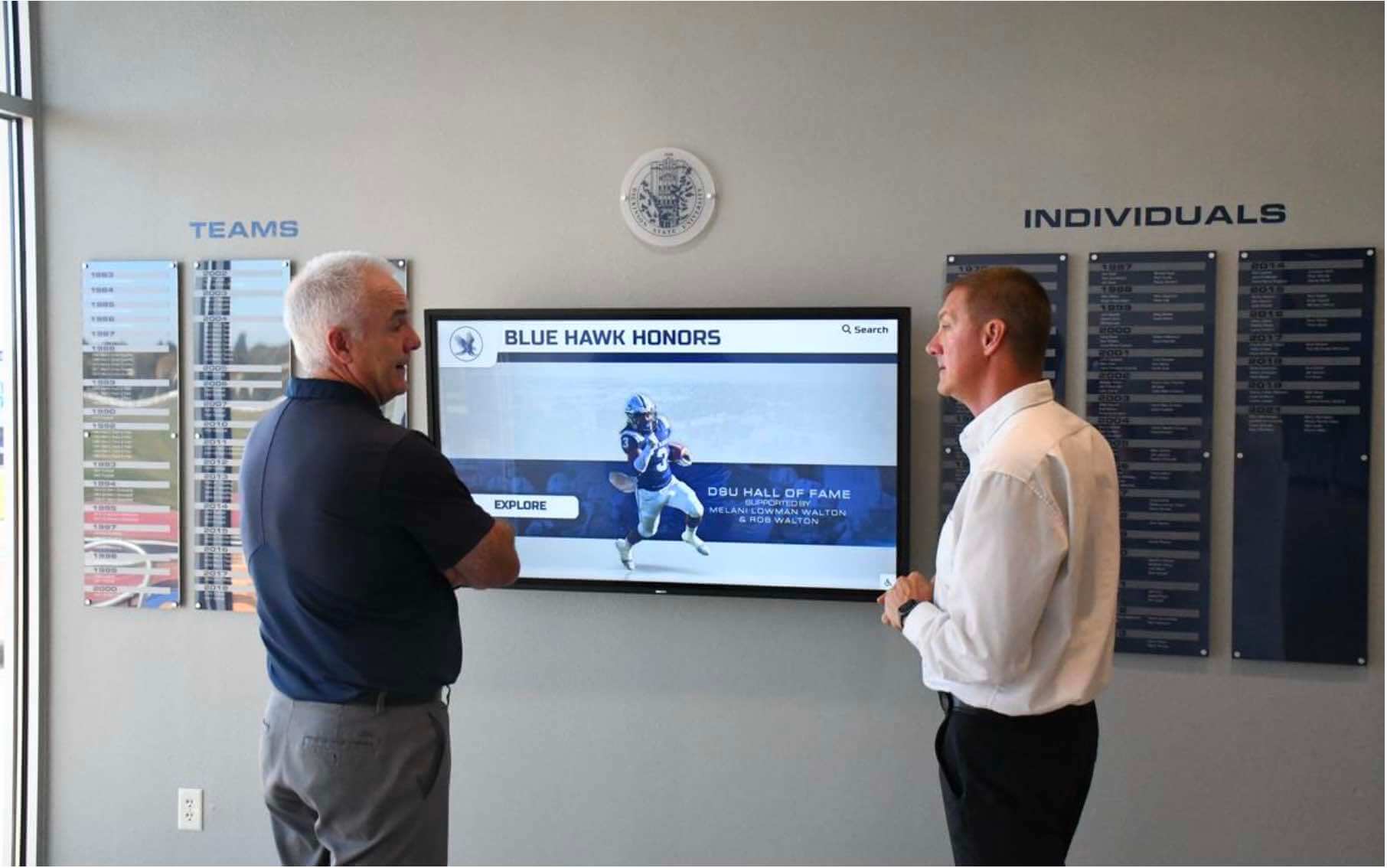
Visitors and alumni reviewing recognition displays expect one authoritative record per honor—duplicate active entries undermine that expectation and create contradictory information on the same screen
The Example Uniqueness Rule
The core uniqueness rule for an athletic awards partial unique index can be stated in plain language before it is formalized in a database schema:
No two rows in the award-recipients table may share the same combination of athlete identifier, sport, season year, award category, and division level, unless at least one of those rows has been soft-deleted (marked inactive).
This rule has four components that each require definition in the policy document.
1. The Indexed Columns
These are the fields whose combination must be unique among active records. The minimum recommended set for athletic recognition databases is:
| Column | Purpose in the Uniqueness Rule |
|---|---|
athlete_id | Unique identifier for the recognized individual |
sport_id | Identifies the sport in which the honor was earned |
season_year | Academic year or season identifier (e.g., “2023-24”) |
award_category_id | Foreign key to the award category definition table |
division_level | Distinguishes Varsity from JV from Freshman designations |
Programs that issue sport-agnostic awards—honors given once per season regardless of sport, such as a school-wide Scholar-Athlete designation—should omit sport_id from the indexed columns and use a standardized NULL sport identifier for those award categories.
2. The Filter Condition
The filter defines which rows are considered “active” for the purpose of the uniqueness check. The standard filter condition is WHERE deleted_at IS NULL, consistent with the soft-delete implementation described in the companion athletic awards database soft delete policy. Programs that use a boolean active flag (such as an is_active column) rather than a timestamp should adapt the filter accordingly: WHERE is_active = TRUE.
3. The Exception Rule
The policy must specify what happens when a legitimate duplicate is proposed—for example, when a governing body confirms that two athletes co-received the same honor in the same season. The standard exception process requires written approval from the athletic director, a source document confirming the legitimate dual award, and the addition of a disambiguation field (typically an award_rank column that defaults to 1 for the primary recipient and increments for verified co-recipients at the same tier). The partial unique index definition is then expanded to include award_rank as an indexed column.
4. The Enforcement Mechanism
The policy must specify that the partial unique index is enforced at the database level, not solely through application-layer validation. Application-layer checks can be bypassed by bulk imports, direct database access, or scripted corrections run outside the normal CMS. The database-level index fires on every insert and update regardless of the access path, providing enforcement that cannot be circumvented by process shortcuts.
Decision Table: Partial Unique Index vs. Full Unique Index vs. No Uniqueness Constraint
Choosing the right enforcement mechanism depends on whether the recognition database uses soft delete and whether historical record preservation is a governance requirement.
| Scenario | Recommended Enforcement | Reason |
|---|---|---|
| Database uses soft delete; correction history must be retained | Partial unique index (filter: WHERE deleted_at IS NULL) | Prevents duplicate active records while allowing inactive records to coexist |
| Database does not use soft delete; records are either live or permanently deleted | Full unique index | All rows are active; no filter needed; simpler implementation |
Database uses a boolean active flag (is_active) instead of a timestamp | Partial unique index (filter: WHERE is_active = TRUE) | Same logic as soft delete; adapt filter to the flag column |
| Database tracks multiple versions in a separate version-history table | Partial unique index on the current-version table | Current-version table exposes only the latest active version; uniqueness enforced there |
| Program requires no correction history; erroneous records are hard-deleted | Full unique index | Hard delete removes the erroneous record entirely; no historical version remains to conflict |
| No deduplication needed (read-only historical archive) | No uniqueness constraint | Historical archives may legitimately contain duplicates from multiple source systems; forcing uniqueness retroactively destroys information |
| Multi-school or federated recognition database | Partial unique index with school_id column added | Include school_id in the indexed columns to scope uniqueness to each institution separately |
The decision point is straightforward: if your recognition database retains any historical or inactive records in the same table as active records—through soft delete, record versioning, or any other retention mechanism—a partial unique index is the correct tool. A full unique index in a soft-delete environment blocks corrections from being stored alongside their predecessors, forcing the program to choose between losing correction history and losing uniqueness enforcement. A partial unique index eliminates that tradeoff.
Programs designing recognition data governance that spans both athletic and academic honor categories will find practical context in the academic recognition programs guide at touchscreenrecognition.com, which covers how schools structure recognition across both domains—a useful frame for understanding the full scope of data a partial unique index policy must cover.

Recognition programs covering athletic and academic honors in a single database benefit from a unified partial unique index policy—the same deduplication logic applies to every award category maintained in a structured table
Migration Checklist: Adding a Partial Unique Index to an Existing Recognition Database
Adding a partial unique index to a database that already contains recognition records requires completing a pre-migration audit before the index can be created. An index creation command will fail if the existing data contains active rows that already violate the uniqueness rule the index would enforce. The following checklist guides IT administrators and database owners through the migration safely.
Step 1: Export all active records to an audit query.
Pull every record where the filter condition is satisfied—WHERE deleted_at IS NULL for soft-delete databases—into a working query or spreadsheet. This is the complete set of rows that the partial unique index will govern.
Step 2: Identify all uniqueness violations in the active record set.
Run a duplicate-detection query against the indexed columns in the active record set. Group by the indexed columns and return only combinations with a count greater than one:
SELECT athlete_id, sport_id, season_year, award_category_id, division_level,
       COUNT(*) AS duplicate_count
FROM award_recipients
WHERE deleted_at IS NULL
GROUP BY athlete_id, sport_id, season_year, award_category_id, division_level
HAVING COUNT(*) > 1;
Each row returned represents a set of active records that would violate the constraint. Record the full list—every identified violation requires a resolution decision before the index can be created.
Step 3: Classify each violation as error, correction, or legitimate duplicate.
For each duplicate group identified in Step 2, review the underlying records to determine the cause:
- Error: One record is demonstrably wrong (incorrect athlete ID, wrong season, data entry mistake). Resolution: soft-delete the erroneous record.
- Correction pending: One record supersedes another as part of a documented correction workflow that was not completed. Resolution: soft-delete the superseded record; verify the surviving record is accurate.
- Legitimate co-award: A governing body confirms that two athletes legitimately co-received the same honor in the same season. Resolution: add an
award_rankdisambiguation column and expand the index definition to include it.
Document each classification and resolution in a migration log. This log becomes part of the program’s audit history.
Step 4: Apply all resolutions before creating the index.
Execute the soft-delete operations, corrections, and disambiguation field updates identified in Step 3. After each batch of changes, re-run the duplicate-detection query from Step 2 to verify that the remaining active record set contains no violations. Do not attempt to create the partial unique index until the duplicate-detection query returns zero rows.
Step 5: Create the partial unique index in a test environment first.
Before applying the index to production, run the CREATE UNIQUE INDEX statement against a copy of the database containing the resolved records. Verify that the statement completes without error. Run a sample of the application’s core read queries—award recipient lists, athlete profiles, season summaries—against the test database to confirm that the index does not alter query behavior.
Step 6: Apply the index to the production database during a low-traffic window.
Index creation on large tables can briefly lock the table against writes depending on the database engine. Schedule the production index creation during a period of low write activity—overnight or during a school break. In PostgreSQL, use CREATE UNIQUE INDEX CONCURRENTLY to avoid blocking concurrent writes during index creation.
Step 7: Update the policy document and notify all data entry staff.
After the index is live, update the program’s data governance documentation to note the index’s existence, the filter condition, the indexed columns, and the exception process for co-awards. Notify all staff who perform award data entry that duplicate active entries will now be rejected at the database level with a constraint error, and provide the process for requesting an exception when a legitimate dual award is being recorded.
Step 8: Schedule a post-migration audit at 30 days.
Thirty days after the index is created, re-run the duplicate-detection query to confirm that no new violations have been introduced. Review the database’s constraint violation log (if the engine exposes one) to identify any insert attempts that were blocked by the index—each blocked attempt represents a duplicate that the index successfully prevented and a data entry workflow that may need process reinforcement.
Schools managing recognition data across academic competitions, arts programs, and community service alongside athletics will find relevant context in the academic decathlon recognition resource at digitalwalloffame.com, which covers how institutions structure recognition across multiple achievement domains—a useful reference for programs building a uniqueness policy that must span more than athletic categories.

Championship recognition displays require the underlying database to correctly identify one authoritative record per honor—a partial unique index is the mechanism that guarantees that accuracy at the database layer, before any record reaches a public-facing display
How Partial Unique Indexes Interact with Recognition Platform Workflows
Most commercial school recognition platforms do not expose direct database index configuration to their users. For athletic programs using a managed recognition platform, the partial unique index concept translates into platform-level governance decisions: which duplicate-prevention rules the platform enforces by default, whether the platform supports correction workflows that preserve prior versions, and how the platform handles import attempts that would create duplicate active records.
When evaluating whether a recognition platform implements effective duplicate prevention for active records, ask these questions:
- Does the platform allow a corrected award record to coexist with the original erroneous record in an archived or inactive state?
- Does the platform block import rows that would create a duplicate active entry for the same athlete–sport–season–category combination, rather than silently accepting the duplicate or silently overwriting the existing record?
- Does the platform provide an audit log that records who created, corrected, or inactivated each award record, and when?
- Does the platform provide a duplicate-detection report that can be run before a public display is updated or an end-of-season import is committed?
Platforms that satisfy all four criteria are implementing the functional equivalent of a partial unique index at the application layer, even if they do not expose the underlying database mechanism. Platforms that fail on any criterion create a governance gap that must be addressed through additional manual audits.
Programs covering multiple recognition domains—athletics, donor recognition, arts, and institutional history—benefit from evaluating platforms against the full scope of their recognition needs. The 10 best hall of fame tools comparison at best-touchscreen.com evaluates recognition platforms across these categories, which is useful context for programs building a governance policy that must span more than athletics.
Rocket Alumni Solutions provides a managed recognition platform trusted by more than 600 schools and institutions. The platform’s CMS enforces record-level rules that prevent duplicate active entries from reaching public display surfaces, supports soft-delete workflows that preserve corrected records for audit review, and provides import validation that identifies potential duplicates before batch award data is committed. For school administrators who are not managing a self-hosted relational database, the platform operationalizes the governance goals of a partial unique index policy through a managed, cloud-based workflow accessible to staff without database engineering expertise.
If your recognition program is evaluating how a digital display platform can enforce data quality at the point of entry—before a duplicate active record ever reaches a hallway screen or ceremony program—schedule a platform demo with Rocket Alumni Solutions to see how the platform manages recognition data integrity for institutions ranging from small K–12 schools to large university athletic departments.

Programs that surface team histories and award records across multiple seasons on digital displays depend on governance policies—including partial unique index enforcement—that guarantee exactly one active record represents each honor
Database Engine Support for Partial Unique Indexes
Partial unique indexes are not universally supported across relational database engines. IT administrators must verify support in their specific environment before defining a policy that relies on them.
| Database Engine | Partial Unique Index Support | Notes |
|---|---|---|
| PostgreSQL | Native support | CREATE UNIQUE INDEX ... WHERE <condition> |
| SQLite | Native support | Same WHERE clause syntax as PostgreSQL |
| MySQL / MariaDB | Not supported natively | Use a filtered view with a unique index plus application-layer enforcement as an alternative |
| Microsoft SQL Server | Supported via filtered indexes | CREATE UNIQUE INDEX ... WHERE <filter_predicate> available since SQL Server 2008 |
| Oracle Database | Not natively supported | Use function-based indexes or conditional unique constraints as alternatives |
| IBM Db2 | Limited support | Partial index behavior varies by version; consult vendor documentation |
For programs running on MySQL or MariaDB—common choices for hosted school information systems—the closest alternative is a unique index on a filtered view combined with BEFORE INSERT and BEFORE UPDATE trigger logic that enforces the same deduplication check against active rows. The policy document should note the specific alternative mechanism used when native partial unique index support is unavailable, so that future administrators understand why the implementation deviates from the standard approach.
Programs exploring how digital recognition infrastructure handles data governance at scale will find the 10 best hall of fame tools guide at digitalwarming.net a useful survey of platform options—including hosted recognition solutions that manage underlying database governance so administrators do not need to configure individual database indexes manually.
FAQ: Athletic Awards Database Partial Unique Index Policy
What is the difference between a partial unique index and a full unique index in an athletic award database?
A full unique index enforces uniqueness across every row in the table, regardless of whether a row is active or inactive. A partial unique index enforces uniqueness only among rows that satisfy a specified filter condition—typically the set of active, non-deleted records. In a database that uses soft delete to retain corrected or retired award records, a full unique index blocks corrections from being stored alongside their predecessors. A partial unique index allows the inactive record to coexist with the new active record because the inactive row does not participate in the uniqueness check.
Can a partial unique index prevent duplicate entries during a bulk import of historical award records?
Yes, and this is one of its most valuable applications. When a school imports historical award records from a spreadsheet or legacy system, the partial unique index will reject any row that would create a second active record for the same athlete–sport–season–award-category combination. Import tools that perform bulk inserts will receive a constraint violation error for each duplicate row, allowing IT staff to review and resolve each conflict before the data is committed. This pre-commitment rejection is significantly safer than discovering duplicate records after the import has already populated the database and, potentially, the display system.
What happens to the partial unique index when a soft-deleted record is restored?
When a soft-deleted record is restored—its deleted_at field is set back to NULL—the record re-enters the active set and becomes subject to the partial unique index. If an active record already exists with the same indexed column values as the record being restored, the restoration will fail with a constraint violation. This is the correct behavior: the database is preventing two active records from representing the same honor simultaneously. The resolution is to review which of the two records is the accurate version, soft-delete the other, and then proceed with the restoration.
How does a partial unique index handle multi-sport athletes who receive the same named award in different sports?
If the indexed columns include sport_id as a distinct field, multi-sport athletes are handled correctly. A student who receives the “Scholar-Athlete Award” in basketball and the same-named award in track will have two active records with different sport_id values, which the index treats as distinct combinations. Only if the same athlete received the same award in the same sport in the same season at the same division level would the index block the second record. Programs that use sport-agnostic award categories should omit sport_id from the index and use a standardized NULL sport identifier for those categories.
Does implementing a partial unique index require database administrator access?
Creating a partial unique index on a database table typically requires database administrator credentials or equivalent schema-modification privileges. However, defining and documenting the policy—specifying which tables, which indexed columns, which filter condition, and which exception process applies—is a data-governance task that does not require technical access. Athletic directors and recognition-program administrators can define the policy in plain language; IT staff or database administrators then translate the policy into the specific index creation commands appropriate for the database engine in use.
A partial unique index policy addresses one of the most persistent problems in athletic recognition data management: the gap between what a program intends to display—one verified, authoritative record per honor—and what a database without targeted uniqueness enforcement will eventually contain, given the realities of bulk imports, multi-staff data entry, and correction workflows that must preserve history. The policy closes that gap with a mechanism that is precise, database-enforced, and compatible with the retention practices that institutional accountability requires.
Athletic programs managing recognition across multiple sports, seasons, and award categories—and increasingly, across academic and community achievement categories alongside athletics—benefit from governance frameworks that apply the same rigor to data uniqueness that they apply to display accuracy. For programs exploring how a digital recognition platform can enforce data quality at the point of entry while also delivering engaging, accessible public displays for alumni and visitors, request a custom platform demo from Rocket Alumni Solutions to see how the system manages recognition data integrity for institutions of every size.