



An athletic awards database pg_checksums audit is a read-only verification pass — performed offline with the PostgreSQL server shut down cleanly — that checks every data-file block in a school’s recognition cluster against the checksum value stored in that block when it was last written by PostgreSQL. The utility reports any block whose computed checksum no longer matches the stored value and exits with a non-zero code if it finds any. A passing run exits with code zero and confirms that no checksum mismatches were detected in the scanned data files during that pass.
This guide is written for school IT administrators, database administrators, and athletic records custodians who own and operate a self-hosted PostgreSQL cluster containing athletic award records, hall-of-fame inductee profiles, letter-winner histories, and season-by-season recognition data. It covers what pg_checksums checks and what it does not, how the tool differs from backup_manifest file checksums and from the logical heap-and-index checks performed by amcheck, the five prerequisites that must be confirmed before the maintenance window is scheduled, a step-by-step shutdown-and-check procedure, how to read and log the output, a proposed acceptance-criteria table for school IT documentation, and the scenarios where managed-service installations may not expose utility access.
Your school’s athletic awards database holds something that cannot be easily reconstructed: the names of every student who earned a letter, earned a season award, or was inducted into the hall of fame over decades of program history. If your team operates a self-hosted PostgreSQL cluster for that data, storage-layer integrity verification belongs on your annual maintenance calendar alongside backup testing and index maintenance. A checksum failure in a PostgreSQL data block means that what is currently on disk no longer matches what PostgreSQL wrote — a discrepancy that silent hardware error, firmware defects, or storage-subsystem misbehavior can introduce at any point after a block was last written and before it is next read and verified.
PostgreSQL verifies data-page checksums at runtime on every read from disk — but only for blocks that active queries actually touch. An offline pg_checksums –check pass scans every data file in the cluster directory on demand, reaching blocks that may not have been read in months. A recognition archive holding induction records from ceremonies ten or fifteen years ago may contain blocks that routine query activity never touches. The offline pass is the only mechanism that verifies those dormant blocks against their stored checksums. The athletic archive bit rot detection checklist at digitalyearbook.org covers the adjacent problem of file-level fixity for scanned documents and media assets stored outside the relational database — both represent the same category of silent corruption risk that proactive offline verification addresses.

Athletic recognition archives spanning multiple decades hold blocks that active queries may not touch for years — an offline pg_checksums audit reaches every data file, including dormant historical records, and verifies each block against its stored checksum
Three Distinct Integrity Layers: pg_checksums, backup_manifest, and amcheck
Administering a school PostgreSQL recognition cluster involves three separate integrity-checking tools, each operating at a different layer. They are not substitutes for each other, and conflating them leads to gaps in the maintenance program.
pg_checksums: Storage-Level Block Integrity (Offline)
The pg_checksums documentation describes the utility as enabling, disabling, or checking data checksums in a PostgreSQL database cluster. In check mode (--check or -c), it scans every relation file in the data directory and verifies that each 8 KB block’s stored checksum matches the checksum computed from the block’s current bytes. This operates below any row or index abstraction — at the raw file level. A pg_checksums finding indicates that bytes on disk have diverged from what PostgreSQL originally wrote, pointing to storage-layer corruption. The cluster must be shut down before the check runs.
backup_manifest Checksums: Backup Archive File Integrity
When pg_basebackup produces a backup, it writes a backup_manifest file listing each file in the archive with its expected size and checksum. The pg_verifybackup tool reads that manifest and verifies each archived file against the recorded checksum. backup_manifest checksums verify the integrity of the backup copy — they say nothing about the live data files in the running cluster. A clean pg_verifybackup result confirms the backup archive is intact; it does not confirm that the source cluster’s data files are free of checksum errors.
amcheck: Logical Structure Integrity (Online)
The amcheck extension’s functions — called via the pg_amcheck command-line utility — verify the logical correctness of B-tree indexes and heap tables: key ordering, parent-to-child downlink validity, heap-to-index tuple membership, and transaction-ID consistency in heap pages. The PostgreSQL checksums documentation notes that data-page checksums cover data pages only, not internal structures. amcheck addresses the logical layer — whether the database’s own data structures are internally consistent — rather than whether the raw bytes on disk match a stored fingerprint. amcheck can run while the server is online and does not require a shutdown. The two tools detect different failure modes and are both part of a complete integrity program for a recognition cluster.
Audit Prerequisites: What Must Be True Before the Maintenance Window
Five conditions must be verified before scheduling the server shutdown for an athletic awards database pg_checksums audit. Checking these in advance prevents discovering a blocking problem after the maintenance window has already begun and recognition displays are already offline.
Prerequisite 1: Data checksums must be enabled on the cluster.
According to the PostgreSQL checksums documentation, data checksums are disabled by default and are enabled most reliably at cluster initialization with initdb --data-checksums. If checksums were never enabled — or were subsequently disabled — pg_checksums –check will report zero bad blocks regardless of the physical state of the data files. There are no stored checksums to compare against, so the pass produces no actionable result.
While the server is still running, confirm checksum status:
SHOW data_checksums;
This returns on or off. If the result is off, stop: the pg_checksums –check audit in this guide does not apply, and a check pass would not provide meaningful integrity information. Enabling checksums on a running cluster is a separate offline operation outside the read-only scope of this guide.
After server shutdown, the same information is available without the server:
pg_controldata -D /path/to/pgdata | grep "Data page checksum version"
A value of 1 confirms checksums are enabled. A value of 0 means they are disabled.
Prerequisite 2: Know and document the data directory path.
The data directory is the cluster root — the directory containing postgresql.conf, pg_hba.conf, PG_VERSION, and the base/ subdirectory holding relation files. While the server is still online, verify and record it:
SHOW data_directory;
Note the exact path before shutdown. On common Linux installations it may appear at /var/lib/postgresql/16/main/, /var/lib/pgsql/16/data/, or a custom path specified at installation time. Passing the wrong path to pg_checksums produces an error; passing no path causes the tool to read the PGDATA environment variable, which may not be set in the maintenance shell session.
Prerequisite 3: Verify the pg_checksums binary version matches the cluster.
The pg_checksums binary must be the same major version as the cluster it inspects. A version mismatch produces an error and prevents the check from completing. Confirm before shutdown:
pg_checksums --version
cat /path/to/pgdata/PG_VERSION
The major version number in the pg_checksums output (for example, 16 in pg_checksums (PostgreSQL) 16.x) must match the number in PG_VERSION. On systems with multiple PostgreSQL installations, confirm which binary will be on the PATH during the maintenance session.
Prerequisite 4: A current, protected backup must exist before the window opens.
The pg_checksums –check mode is read-only — it does not modify any data file in the cluster. However, if the audit discovers checksum failures, the documented recovery path is restoration from backup. Discovering storage-layer corruption without a recovery-tested backup available leaves the institution with no documented path to restore the affected athletic award records. Verify the most recent backup, confirm it completed without errors, and confirm it is stored on separate physical media or a separate storage system from the live cluster before the shutdown is scheduled.
Prerequisite 5: Confirm and communicate the maintenance window.
The duration of a pg_checksums –check pass scales with the total data directory size. A recognition database storing primarily relational award records, without large binary attachments, may complete in seconds on solid-state storage or in a few minutes on a mechanical disk. A cluster that has grown to include large bytea columns or file storage extensions may take considerably longer. Schedule a window that accommodates the full check plus server restart and a brief post-start connectivity verification. Athletic department staff, facilities teams using live recognition kiosk displays, and any automated import jobs that run against the database must all be informed before the server shuts down.

A pg_checksums --check audit requires shutting down the PostgreSQL server for the duration of the scan — planning the maintenance window so recognition displays, import jobs, and staff access are all accounted for prevents surprises when the server goes offline
Step-by-Step: The pg_checksums Read-Only Audit Procedure
Work through the following eight steps in order. Document each step in a maintenance log so that future audit runs can be compared against the same baseline.
Step 1: Record server version, checksum status, and data directory path while the server is online.
Before the maintenance window, gather all the information the check run will need:
SHOW server_version;
SHOW data_checksums;
SHOW data_directory;
Record all three values. If data_checksums returns off, stop: the cluster does not have data-page checksums enabled and this audit procedure does not apply.
Step 2: Verify the pg_checksums binary version on the operating system.
pg_checksums --version
Confirm the major version matches the server version recorded in Step 1. If they do not match, resolve the version discrepancy before proceeding.
Step 3: Shut down the PostgreSQL server cleanly.
Use the service management method appropriate to the installation. On systemd-managed Linux systems:
sudo systemctl stop postgresql
Or, using pg_ctl with the fast mode (which completes in-progress checkpoints and then shuts down, rather than waiting for all client connections to close voluntarily):
pg_ctl stop -D /path/to/pgdata -m fast
Allow the shutdown to complete fully before proceeding.
Step 4: Confirm the cluster is in a clean shutdown state.
pg_controldata -D /path/to/pgdata | grep "Database cluster state"
The result must read shut down. A state of in production means the server process is still running or was not stopped cleanly. A state of in crash recovery means the cluster shut down uncleanly and may need a startup-and-shutdown cycle to write a clean checkpoint before the check runs. Do not proceed with the pg_checksums audit until the state is shut down.
Step 5: Run pg_checksums in check mode, capturing output to a timestamped log file.
pg_checksums --check -D /path/to/pgdata --progress 2>&1 | tee /var/log/pg_checksums_$(date +%Y%m%d).log
The --check flag (or -c) directs the utility to verify checksums rather than enable or disable them. The --progress flag (-P) displays a running progress indicator showing files and bytes scanned. Redirecting both stdout and stderr to a timestamped log file preserves the full output for the maintenance record. Add --verbose (-v) to list every file as it is checked — useful for very large clusters where knowing which files were scanned is operationally important.
Do not use --enable or --disable during this audit. This is a read-only pass.
Step 6: Record the exit code immediately after the run completes.
echo "pg_checksums exit code: $?"
Capture this in the maintenance log immediately after the command completes. According to the pg_checksums documentation, the tool exits with code 0 if no checksum errors were detected, and with a non-zero code if at least one checksum failure was found or if another problem (version mismatch, permission error, or invalid data directory) prevented the check from completing normally.
Step 7: Restart the server and verify it starts cleanly.
sudo systemctl start postgresql
Confirm the server started and is accepting connections before closing the maintenance window. A brief connection test from the maintenance host is sufficient:
psql -U postgres -c "SELECT version();"
Step 8: Document the complete audit record in the maintenance log.
Record the run date and time, the data directory checked, the pg_checksums and server versions, the total files and blocks scanned (from the progress or verbose output), the exit code, and any bad-block findings. A clean run with exit code 0 is a meaningful maintenance record — it confirms no checksum mismatches were detected in the checked data files during that pass. A non-zero exit code requires escalation before the next scheduled award import or public display refresh.
Proposed Acceptance Criteria and Audit Evidence Table
The table below presents a proposed set of acceptance criteria for an athletic awards database pg_checksums audit. These criteria represent a suggested school maintenance standard. They are not defined in PostgreSQL’s official documentation and do not represent compliance with any external certification or regulatory standard.
| Audit Checkpoint | Proposed School Acceptance Criterion | Documentation Field |
|---|---|---|
| Data checksums enabled | SHOW data_checksums returns on | Pre-audit server query output |
| pg_checksums binary version | Matches cluster major version | pg_checksums --version and PG_VERSION file |
| Cluster state at check time | shut down from pg_controldata | pg_controldata output captured in log |
| pg_checksums exit code | 0 | Shell exit code logged immediately post-run |
| Bad checksum blocks reported | 0 (none found) | pg_checksums stdout captured in log file |
| Verbose or progress output captured | Yes — full log file retained | Timestamped log file path recorded |
| Protected backup confirmed pre-run | Yes — backup date and location documented | Backup verification record |
| Maintenance window duration logged | Yes — start and end timestamps recorded | Maintenance window log |
A non-zero exit code, or any bad-block report in the pg_checksums output, does not mean the database is immediately unrecoverable — it means the finding must be investigated before additional writes or imports are scheduled against the affected cluster.

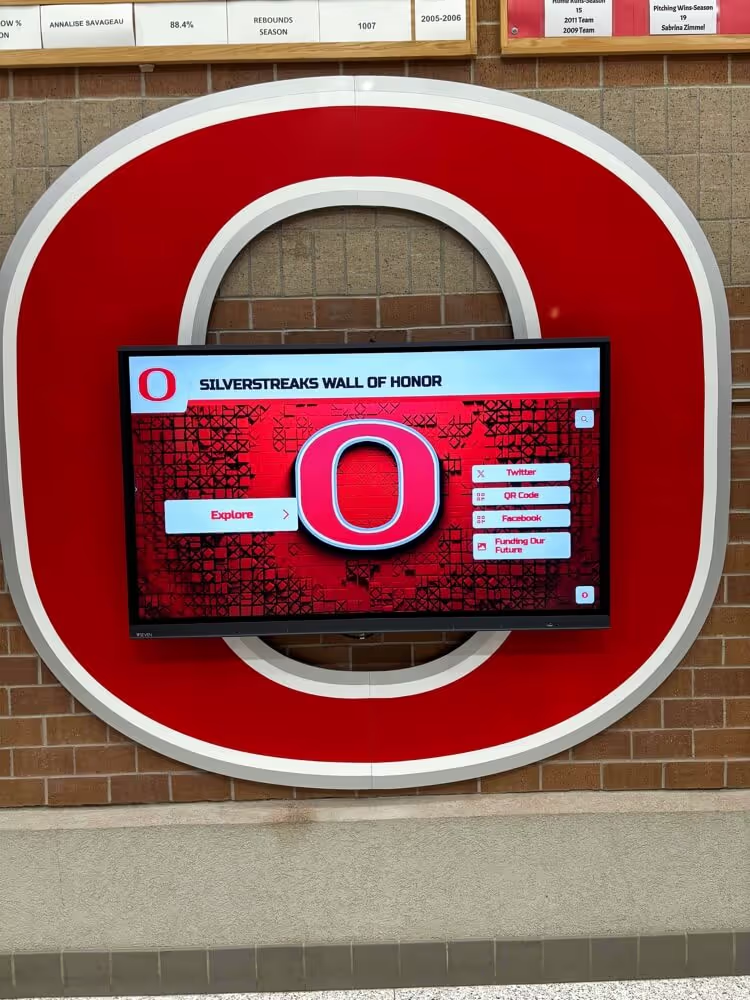
Self-hosted recognition databases powering hallway displays like this one place full storage-level integrity responsibility on the institution's IT team — the pg_checksums audit checklist documents that responsibility in a repeatable, verifiable format
Interpreting pg_checksums Output
A pg_checksums –check run that finds no checksum errors prints summary information about the files and blocks it verified and exits with code 0. The output identifies the total number of data files checked and the total number of blocks scanned. No bad-block report lines appear. This is the expected outcome for a cluster with healthy storage and is the result that should be logged and filed after each scheduled audit.
When pg_checksums finds a mismatch, it prints information identifying the file in which the bad block appears and the block number within that file. Because pg_checksums operates at the file level below PostgreSQL’s own catalog, the output identifies files by their on-disk path within the data directory rather than by table or index name. Mapping a data file path to the corresponding relation requires looking up the filenode in pg_class — something that can be done once the server has been restarted:
SELECT relname, relkind
FROM pg_class
WHERE relfilenode = <filenode_from_path>;
This query translates the numeric filenode portion of the reported file path into the relation name, allowing the DBA to identify which athletic award table or index is affected.
A non-zero exit code from pg_checksums –check should be treated as an incident. Do not attempt to resolve checksum failures by rewriting blocks, dropping and rebuilding indexes, or running VACUUM. The PostgreSQL checksums documentation does not define a self-repair path for block-level checksum failures. The documented recovery approach is restoration from a verified backup. Preserve the full pg_checksums output log before any recovery operation changes the cluster state. When a hall-of-fame inductee’s record falls in a block affected by a checksum failure, the recovery is not only a database restore — it is the restoration of a recognized athlete’s permanent record in the institution’s archive. Hall of fame press release templates at halloffame-online.com illustrate how publicly significant each inductee record is: a missing or corrupted profile can affect a ceremony program, a public announcement, and a family’s connection to their athlete’s recognition history.
Managed Platforms and Hosted Services
The pg_checksums audit procedure in this guide applies only to self-hosted, institution-owned PostgreSQL clusters where the IT team has direct access to the operating system and the data directory. Two categories of installation do not fall under this guide’s scope.
Managed PostgreSQL cloud services — such as hosted database services offered by major cloud providers — run the PostgreSQL engine on infrastructure managed entirely by the provider. The institution does not have operating system access to the host running the cluster, the data directory is not directly accessible, and pg_checksums cannot be invoked by the institution’s administrators. Storage integrity at the block level is a provider responsibility, implemented through the platform’s own storage redundancy and integrity mechanisms. Schools using managed cloud database services should direct storage integrity questions to their provider’s documentation and support channel rather than attempting to run pg_checksums.
Managed recognition platforms handle award record storage, backup, replication, and integrity verification at the platform layer. A school using a fully managed digital recognition platform does not administer the underlying database infrastructure, and this guide does not apply to records stored in that platform. The institution’s responsibility on a managed platform shifts from database administration to content management: ensuring that athlete names, award details, and recognition histories are entered accurately and that the platform is used to maintain complete, current records. The survey of recognition platform tools at digitalwarming.net covers options across the spectrum from fully self-hosted to fully managed, useful context for institutions evaluating which path fits their IT team’s capacity.
For institutions running their own PostgreSQL cluster and evaluating whether to transition to a managed platform, the distinction is directly relevant to how maintenance effort is allocated. What the transition from static to digital recognition involves at touchhalloffame.us provides context on what that shift means operationally for school recognition programs. Rocket Alumni Solutions operates as a managed platform; schools that use it for digital recognition do not manage the underlying infrastructure, and the pg_checksums procedure in this guide does not apply to Rocket-hosted data.

A school's path from self-hosted recognition databases to managed platforms shifts storage integrity responsibility from internal IT to the platform provider — the pg_checksums audit applies only to the self-hosted side of that distinction
When to Schedule a pg_checksums Audit
There is no universally mandated frequency for a pg_checksums audit. The appropriate cadence depends on the age and reliability history of the storage hardware, the volume of data in the cluster, and the institution’s tolerance for undetected storage-layer errors.
Triggers that justify scheduling an audit immediately, regardless of the routine cadence:
- A storage hardware event occurred: disk replacement, RAID rebuild, SAN migration, or filesystem repair utility run
- The server experienced an unexpected power loss or abrupt shutdown (crash recovery state in pg_controldata)
- The underlying storage device or firmware received an update
- A backup restore was performed and the restored cluster is now the primary
- A large data migration or cluster version upgrade completed and the cluster moved to new storage
Routine periodic scheduling as a baseline for programs without recent storage events: a semi-annual or annual pg_checksums audit provides a documented integrity record for recognition clusters that operate on stable, modern storage without recent hardware events. Programs that have experienced any of the triggers above should not rely solely on routine scheduling — an ad hoc run immediately after the triggering event is the appropriate response.
The physical integrity of the database storage is one part of a broader preservation discipline for school recognition archives. Trophy case humidity control guidance at digital-trophy-case.com covers the preservation risks that apply to physical award materials alongside the digital records — the same institutional commitment to protecting athletic recognition extends to both the physical and the digital layer.

Establishing a routine pg_checksums audit schedule — and running an unscheduled check after any storage hardware event — gives IT staff a documented, repeatable record of storage-layer integrity for the recognition archive behind a hall of fame program
Frequently Asked Questions
Can pg_checksums –check run while the PostgreSQL server is running?
No. The pg_checksums documentation requires the server to be shut down before running any pg_checksums operation. Running pg_checksums against an active cluster produces an error and the check does not complete. This offline requirement is the primary scheduling constraint for athletic records administrators and the reason the audit must be planned as a formal maintenance window with a server shutdown.
If pg_checksums exits with code 0, does that mean the database is entirely corruption-free?
No. A zero exit code from pg_checksums –check means no data-page checksum mismatches were detected in the files it scanned during that pass. According to the PostgreSQL checksums documentation, data-page checksums cover data pages only — not WAL files, temporary files, or internal structures. The tool also does not detect logical corruption within those pages, for which amcheck is the appropriate tool. A clean pg_checksums result is a meaningful audit record for the storage layer; it is not a comprehensive certification of database correctness.
What if data checksums were never enabled on the athletic awards cluster?
If SHOW data_checksums returns off, data-page checksums were not enabled at cluster initialization or were subsequently disabled. The pg_checksums –check audit in this guide does not apply — there are no stored checksums to verify against, and the tool will report zero mismatches even on a physically corrupt cluster. Enabling checksums on an existing cluster requires a separate offline operation with pg_checksums. Consult a qualified PostgreSQL professional before enabling checksums on a production recognition cluster.
How does pg_checksums differ from amcheck for an athletic recognition database?
pg_checksums verifies storage-level block integrity: bytes on disk vs. the checksum stored in each block when it was last written. It requires the server to be offline. amcheck verifies the logical integrity of B-tree indexes and heap tables — correct key ordering, valid parent-to-child pointers, toast pointer consistency — and can run while the server is online. Both tools detect different failure modes and serve complementary roles in a complete integrity program for a recognition cluster.
What is the correct response when pg_checksums reports bad checksum blocks?
Do not attempt to repair checksum failures by rewriting blocks, dropping and rebuilding indexes, or running speculative DDL. The documented recovery approach for block-level checksum failures is restoration from a verified backup. Preserve the complete pg_checksums output log before any recovery operation alters the cluster state, and contact a qualified PostgreSQL professional to scope the affected objects and evaluate the recovery options from the most recent backup.
Protecting Every Block Behind Every Name
An athletic awards database pg_checksums audit anchors the storage-level layer of a self-hosted recognition cluster’s integrity program. The eight-step procedure in this guide — from pre-shutdown version verification and checksum status confirmation through the offline check pass, exit-code recording, server restart, and maintenance log completion — gives IT staff a documented, repeatable process for confirming that the data blocks holding athlete names, hall-of-fame inductee profiles, letter-winner records, and championship-season histories remain physically intact between maintenance windows.
Paired with a periodic amcheck routine for logical heap-and-index integrity and a regularly tested backup-restore cadence for recovery readiness, the pg_checksums –check audit gives the school’s athletic records custodian a layered, evidence-based integrity posture. The five prerequisites — checksums enabled, data directory documented, binary version confirmed, backup protected, maintenance window communicated — are the administrative scaffolding that turns a technical utility into a repeatable institutional control.
See How Schools Keep Award Records Accurate and Display-Ready
Rocket Alumni Solutions' cloud-based digital recognition platform manages award records, display publishing, and data access in a fully maintained environment — so your athletic department focuses on honoring students, not managing database infrastructure. WCAG 2.1 AA compliant displays work on any screen from 32" to 100"+, with unlimited inductees, categories, and multimedia content. Remote CMS access lets staff update and publish recognition records from anywhere.
Request a Custom Demo