



An athletic awards database pg_stat_slru review is the practice of querying PostgreSQL’s pg_stat_slru system view immediately before and immediately after a seasonal award import, then computing the difference between each cumulative counter in the two snapshots to characterize the cache activity the import generated across the database’s named Simple Least-Recently-Used (SLRU) caches. Because all counters accumulate since the last stats_reset, both snapshots must share the same reset baseline for the delta to be meaningful — a change in stats_reset between captures voids the comparison. The counters are cluster-wide: they reflect the combined activity of every database and session in the PostgreSQL instance, not the activity attributable to a single sport, table, or import batch in isolation.
When a school IT administrator loads end-of-season award records — letter-winner batches, conference honors, or a new cohort of hall-of-fame inductees — into a self-hosted PostgreSQL recognition database, the pg_stat_slru view offers a window into the database engine’s internal cache layer that no application log or import-script output provides. Each named SLRU cache in the view tracks a specific category of PostgreSQL internal bookkeeping: transaction status, commit timestamps, multi-transaction lock records, subtransaction chains, notification queues, and serializable conflict detection. A seasonal import of award data exercises several of these caches in predictable ways, and capturing the delta across the import window documents that activity for the maintenance record.
The review is not a pass/fail test. The pg_stat_slru view does not expose a metric that directly indicates import success or data integrity. What it provides is quantitative context: how many transaction-status pages the database engine read from disk versus found already in cache during the import window, how many flush operations occurred across each named cache, and whether any cache showed activity that warrants cross-referencing against other diagnostic sources. A school IT team that captures pg_stat_slru snapshots before and after several consecutive seasonal imports builds a documented comparison baseline — a record that makes anomalies visible across seasons without requiring universal thresholds that do not apply uniformly to all deployments.

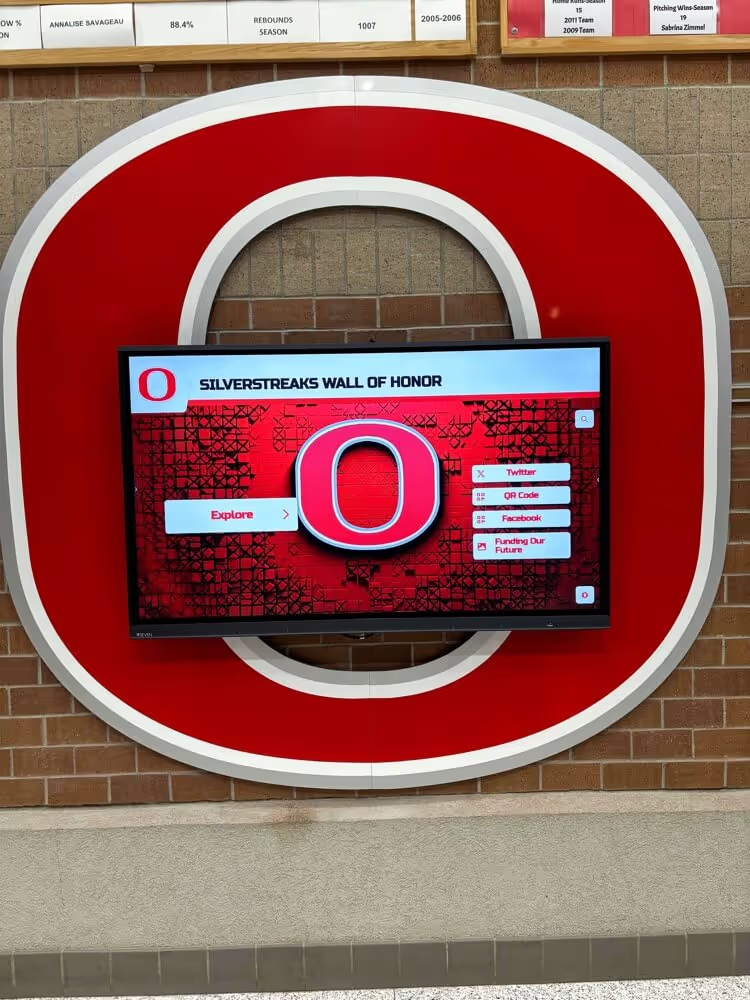
A school athletic hall of fame wall — each induction cohort and letter-winner batch loaded by a seasonal import exercises PostgreSQL SLRU caches whose activity the pg_stat_slru view captures
What pg_stat_slru Reports
According to the PostgreSQL 17 documentation for the pg_stat_slru view, PostgreSQL uses SLRU caches — Simple Least-Recently-Used caches — to store and access certain categories of on-disk information. The pg_stat_slru view contains one row for each tracked SLRU cache and is available while the server is running; no shutdown is required. Each row reports cumulative counts that have been incrementing since the last time pg_stat_reset_slru() or pg_stat_reset() was called.
The named SLRU caches visible in a standard PostgreSQL installation include:
- Xact: Tracks the commit and abort status of every transaction ID. The
Xactcache is exercised during every transactional operation and is typically the most active SLRU during a large award import. - CommitTs: Tracks commit timestamp records. Active only when the
track_commit_timestampserver parameter is set toon. If that parameter is off, this cache shows little or no activity during any import. - MultiXactMember and MultiXactOffset: Track membership and offset records for multi-transaction IDs, used when multiple transactions hold locks on the same row simultaneously. In single-session award imports that do not produce shared-row locks, these caches typically show minimal delta.
- Subtrans: Tracks subtransaction parent-child relationships. Active when imports use explicit savepoints, which add subtransaction IDs to this cache as the batch progresses.
- Notify: Services PostgreSQL’s
LISTEN/NOTIFYpub-sub mechanism. If the import or concurrent application sessions triggerNOTIFYsignals — for example, a recognition platform that uses them to push display-refresh events — this cache may show activity during the import window. - Serial: Used by the serializable snapshot isolation implementation for write-read conflict detection. Relevant only when the import or concurrent sessions run under the
SERIALIZABLEisolation level.
The view columns for each named cache:
| Column | Type | What it counts |
|---|---|---|
name | text | Name of the SLRU cache |
blks_zeroed | bigint | Blocks initialized to zero (new cache entries) |
blks_hit | bigint | Blocks found already in the SLRU memory — no disk read required |
blks_read | bigint | Blocks read from disk into the SLRU |
blks_written | bigint | Blocks written back to disk from the SLRU |
blks_exists | bigint | Blocks found to exist before being read or initialized |
flushes | bigint | Number of flush-to-disk operations |
truncates | bigint | Number of truncations of the SLRU file |
stats_reset | timestamptz | When these counters were last reset |
The Xact cache typically shows the highest blks_read and blks_hit activity during a seasonal award import because every row committed or rolled back in the import touches transaction status records that may be read back during visibility checks. The CommitTs cache only appears active when commit timestamps are enabled. All other caches reflect auxiliary database functions whose activity depends on import structure and concurrent session behavior.
Why Interval Deltas Are the Unit of Analysis
A single snapshot of pg_stat_slru at an arbitrary moment tells you only the totals since the last reset — it cannot identify what any specific import batch contributed. Two snapshots that bracket the import window produce a delta: the difference between corresponding counter values in the post-import snapshot and the pre-import snapshot. That delta represents the cumulative SLRU activity that occurred during the import window, including any background processes — autovacuum workers, checkpoint activity, other sessions — that ran concurrently.
The cluster-wide scope of the counters is the most important constraint on interpretation. If autovacuum was processing unrelated recognition tables during the import, the Xact cache delta includes both import-driven and autovacuum-driven reads. If another application was writing records to a different database in the same PostgreSQL instance simultaneously, that transaction activity is also captured in the same delta. The pg_stat_slru view has no per-database or per-table granularity. A review that ignores concurrent activity may incorrectly attribute high blks_read counts to the import when the driver was something else entirely.
Before any delta analysis, compare the stats_reset timestamp in the pre-import snapshot against the stats_reset timestamp in the post-import snapshot. If they differ, the counters were reset between captures and the delta is meaningless. This is distinct from a reset that occurred before both snapshots: if stats_reset is identical in both snapshots, the cumulative counters share a consistent baseline and the delta is valid.
The pg_stat_slru view is also distinct from pg_stat_io, which tracks I/O operations at the relation-block level by backend type, and from the transaction ID freeze horizon tracked through VACUUM-related statistics views. Those views answer different questions about relation-level data I/O and bloat; pg_stat_slru specifically addresses PostgreSQL’s internal shared-memory caches for its own transaction bookkeeping structures.

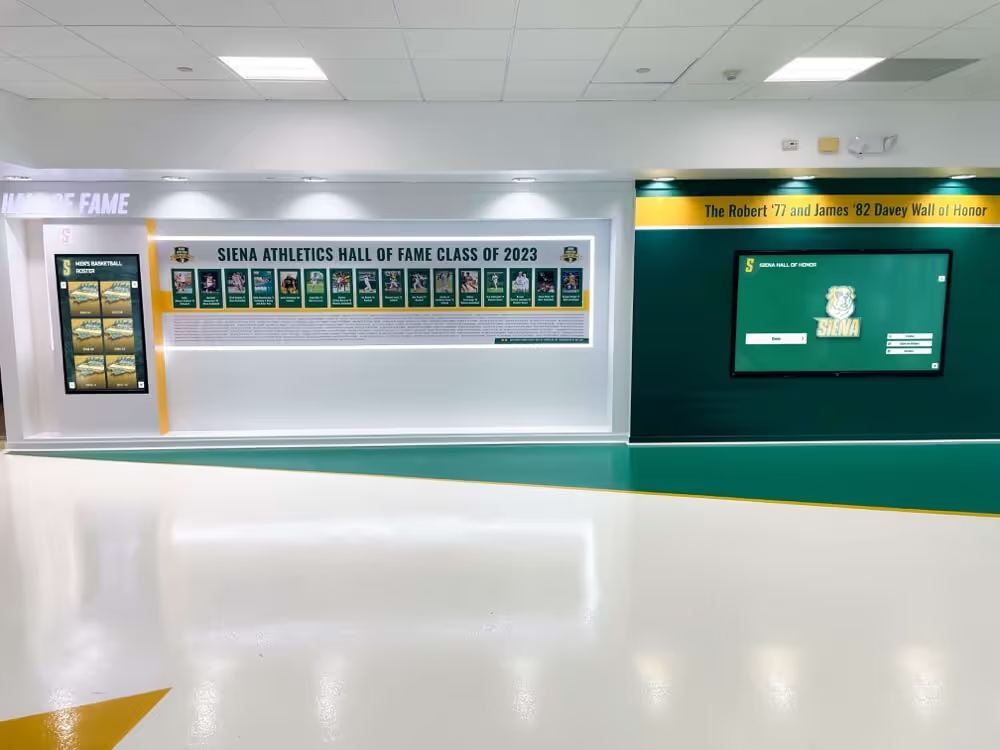
Athletic honor board installations represent years of award data loaded by seasonal imports — a pg_stat_slru review documents the SLRU cache activity each import season generates, building a comparison baseline over time
Seven-Step Workflow for a Seasonal Import Review
Work through the following steps for each major award import — any batch that adds new letter-winner records, conference honors, or hall-of-fame induction entries to the recognition database.
Step 1: Record the pre-import stats_reset baseline.
Before the import begins, confirm the current stats_reset value for each SLRU cache:
SELECT name, stats_reset
FROM pg_stat_slru
ORDER BY name;
Record all rows. This is the reset baseline against which the post-import snapshot will be validated. If stats_reset values differ across caches — which can occur when pg_stat_reset_slru() was called with a specific cache name argument — document the per-cache values individually.
Step 2: Capture the pre-import pg_stat_slru snapshot.
SELECT
  name,
  blks_zeroed,
  blks_hit,
  blks_read,
  blks_written,
  blks_exists,
  flushes,
  truncates,
  stats_reset
FROM pg_stat_slru
ORDER BY name;
Paste the complete output into the import maintenance log with the query timestamp. The timestamp defines the start boundary of the import window.
Step 3: Note any expected concurrent activity during the import window.
Before the import starts, check pg_stat_activity for active sessions and autovacuum workers:
SELECT pid, application_name, state, wait_event_type, query_start
FROM pg_stat_activity
WHERE state != 'idle'
ORDER BY query_start;
Concurrent autovacuum workers or other application sessions contribute to the pg_stat_slru delta independently of the import batch. Documenting active sessions before the import begins supports a more accurate interpretation of the delta afterward.
Step 4: Run the seasonal award import.
Proceed with the import as planned. The pg_stat_slru review requires no changes to the import process itself. If the import uses explicit savepoints in its batch loop, the Subtrans cache delta will reflect that use; if it does not, Subtrans will likely show little activity.
Step 5: Capture the post-import pg_stat_slru snapshot immediately after the import completes.
SELECT
  name,
  blks_zeroed,
  blks_hit,
  blks_read,
  blks_written,
  blks_exists,
  flushes,
  truncates,
  stats_reset
FROM pg_stat_slru
ORDER BY name;
Record the query timestamp. The interval between the pre-import timestamp and this timestamp defines the import window for the delta.
Step 6: Validate stats_reset values and compute deltas.
Compare the stats_reset values in the post-import snapshot to those recorded in Step 1. If any value changed, the delta for that cache is void — document the reset and note that those caches’ activity cannot be attributed to the import window. If all values match, compute the delta for each counter:
delta_blks_hit     = post.blks_hit     - pre.blks_hit
delta_blks_read    = post.blks_read    - pre.blks_read
delta_blks_written = post.blks_written - pre.blks_written
delta_flushes      = post.flushes      - pre.flushes
Record the delta for each named cache in the import maintenance log.
Step 7: Interpret the deltas and document findings.
Apply the interpretation table in the next section to each named cache’s delta. Document any cache that showed activity inconsistent with the import’s expected structure — for example, significant MultiXactMember delta during a single-session import with no shared-row locks, or Notify activity in an environment where the recognition platform does not use PostgreSQL’s pub-sub mechanism. Those findings are candidates for cross-referencing with application logs and concurrent process documentation from Step 3. They are not definitive diagnoses, but they are documented signals that inform investigation if a related problem surfaces later.
Interpreting Delta Counters: Evidence and Decision Table
The table below describes what each type of delta activity in pg_stat_slru caches means for a seasonal award import. Because these are cluster-wide counts, high values in any cell may reflect concurrent activity unrelated to the import batch. These descriptions are contextual guides, not universal pass/fail criteria — the appropriate comparison point is prior import seasons on the same cluster, not a fixed numerical standard.
| SLRU Cache | Typical activity during an award import | delta_blks_read | delta_blks_hit | delta_flushes |
|---|---|---|---|---|
| Xact | High — every committed or aborted transaction touches transaction status pages | Expected; scales with number of transactions in the batch | A higher hit-to-read ratio indicates status pages were found in cache more often; a lower ratio indicates more disk reads — compare across import seasons | Flushes during import are normal; a much higher count than comparable prior imports may indicate memory pressure on the Xact SLRU buffer |
| CommitTs | Only active when track_commit_timestamp = on | Zero expected if the parameter is off; nonzero warrants confirming the parameter value | Same pattern as Xact at smaller scale | Same as Xact |
| MultiXactMember / MultiXactOffset | Low for single-session imports; higher when multiple sessions lock the same rows | Significant delta during a single-session import not expected to generate shared-row locks is worth cross-referencing with application logs | Not a primary signal for single-session imports | Same |
| Subtrans | Low unless the import uses explicit savepoints | Delta scales with savepoint depth and batch count when savepoints are used | Not significant for imports without savepoints | Not significant |
| Notify | Active only when LISTEN/NOTIFY is in use | Zero expected if the recognition platform does not use PostgreSQL pub-sub | Not a primary signal | Not significant |
| Serial | Active only under SERIALIZABLE isolation | Zero expected when the import runs under READ COMMITTED (the PostgreSQL default) | Not a primary signal | Not significant |
No value in this table represents a threshold that mandates action. A school that captures pg_stat_slru snapshots across multiple consecutive import seasons accumulates the baseline context needed to recognize when a delta departs from prior patterns in a way that warrants investigation.
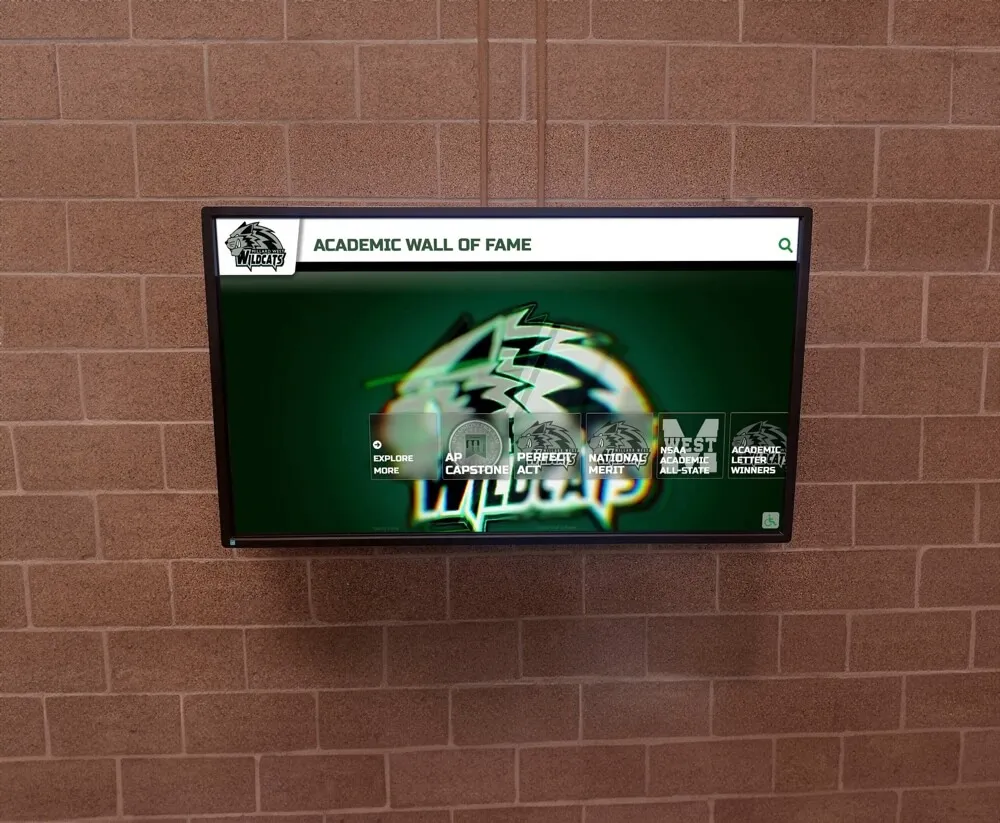
Digital recognition walls display results of seasonal imports — a pg_stat_slru review captures the SLRU cache activity each import generated and provides a documented baseline for comparing across future import seasons
Pre-Import and Post-Import Checklist
Use this checklist to ensure both snapshots are captured consistently and the delta is recorded completely in the import maintenance log. A checklist completed for each seasonal import builds the comparison baseline over time.
Before the import:
- Query
pg_stat_slruand recordstats_resetfor all named caches - Capture and timestamp the complete pre-import snapshot
- Query
pg_stat_activityand document active sessions and autovacuum workers - Confirm whether
track_commit_timestampisonoroff(sets expectations for CommitTs delta) - Confirm whether the import uses explicit savepoints (sets expectations for Subtrans delta)
- Confirm whether the recognition platform uses PostgreSQL
NOTIFY(sets expectations for Notify delta)
After the import:
- Capture and timestamp the complete post-import snapshot
- Compare
stats_resetvalues — document any that changed and mark those caches’ deltas void - Compute and record deltas:
blks_hit,blks_read,blks_written,flushesper named cache - Cross-reference unexpected deltas with concurrent activity documented before the import
- File snapshot pair, delta calculations, and interpretation notes in the import maintenance log
The pg_stat_slru review fits within a broader pre-import and post-import governance practice. The athletic awards database prepared transaction audit at digitalawardsdisplay.com covers the complementary check of confirming that no in-doubt two-phase commit transactions are holding locks on recognition tables before new season data arrives — a check that belongs in the same pre-import window as the pg_stat_slru baseline snapshot capture.
Schools that maintain physical recognition artifacts alongside digital records face a parallel periodic assessment responsibility: just as the historic school glass trophy crizzling triage guide at digital-trophy-case.com describes how to recognize when a deteriorating glass award requires professional conservation before its condition worsens, the IT team’s pg_stat_slru review documents whether the database’s internal cache layer showed any patterns during an import that warrant further investigation before the next import season.
Caching Layers: What pg_stat_slru Does Not Cover
Schools running recognition displays through a web-based platform interact with several distinct caching layers between the PostgreSQL database and the visitor’s browser. The pg_stat_slru review covers only one of them: the SLRU caches internal to the PostgreSQL process.
Above PostgreSQL’s SLRU layer, the application server typically maintains its own query-result or object caches. Above that, HTTP caching governs what CDN edges and browsers retain from each server response — the school recognition display HTTP cache-control audit at best-touchscreen.com describes how to audit those headers to confirm display pages carry correct freshness directives for returning visitors. Further up the stack, the browser’s back-forward cache operates on complete rendered page snapshots — the school recognition display back-forward cache test at touchscreenwebsite.com covers how to verify that athletic profile pages restore correctly when visitors use browser navigation controls to return to previously viewed records.
At the network layer, IT teams sometimes encounter connectivity problems related to stale ARP table entries that prevent the database server or display server from being reached — the school recognition display ARP cache timeout troubleshooting guide at digitalwarming.net addresses that distinct network-layer problem. None of these layers surface in pg_stat_slru counters. When a display page fails to update after an import, the diagnostic path runs through all applicable layers; the pg_stat_slru delta documents only what happened inside PostgreSQL’s SLRU memory during the import window.
For self-hosted PostgreSQL recognition databases, the complete import monitoring toolset spans pg_stat_activity for live session state, pg_stat_slru for SLRU cache activity, pg_stat_io for relation-level block I/O by backend type, and the VACUUM-related statistics views for table bloat and freeze horizon tracking. Each view answers a different question; none substitutes for the others.
Managed Platforms and Self-Hosted Scope
The pg_stat_slru review described in this guide applies only to self-hosted, institution-owned PostgreSQL clusters where the IT team has direct database access and can query system views. Schools using a managed recognition platform — whether a cloud-hosted database service or a fully managed software platform — do not administer the underlying database infrastructure and cannot access pg_stat_slru directly. On a managed platform, SLRU cache behavior is part of the platform’s own infrastructure layer, not the institution’s operational responsibility.
For self-hosted installations operating without a managed platform, maintaining a pg_stat_slru review record alongside other import documentation — backup verification, schema version confirmation, prepared transaction audit, post-import data validation — creates a layered evidence base that supports incident diagnosis if a future import produces unexpected results. A school running its own cluster carries the full responsibility for this diagnostic discipline; a school on a managed platform delegates it to the provider.

Self-hosted recognition database programs carry full responsibility for import diagnostic practices — pg_stat_slru review is one component of the layered evidence base that supports incident response when an import season produces unexpected results
Building an Import Baseline Over Time
The value of the pg_stat_slru review compounds across seasons. A single import’s delta is a data point; a collection of deltas from several consecutive end-of-season imports is a baseline. When an import season’s delta departs noticeably from prior seasons — for example, the Xact cache showing substantially more blks_read relative to the import’s batch size than comparable prior imports — that departure is worth cross-referencing against other sources: import row count, concurrent session activity, database memory settings, and application logs. No single counter reading mandates action; the pattern across seasons is the context that makes any individual reading interpretable.
A school that runs seasonal imports without capturing pg_stat_slru snapshots operates with no documented record of internal cache behavior across its recognition database’s history. Static or manual import workflows that rely solely on application-level success/failure messages miss the database-internal dimension that pg_stat_slru documents. The snapshot pairs require no additional tooling — only the discipline to run two queries before and after each import window and log the results alongside the import record.
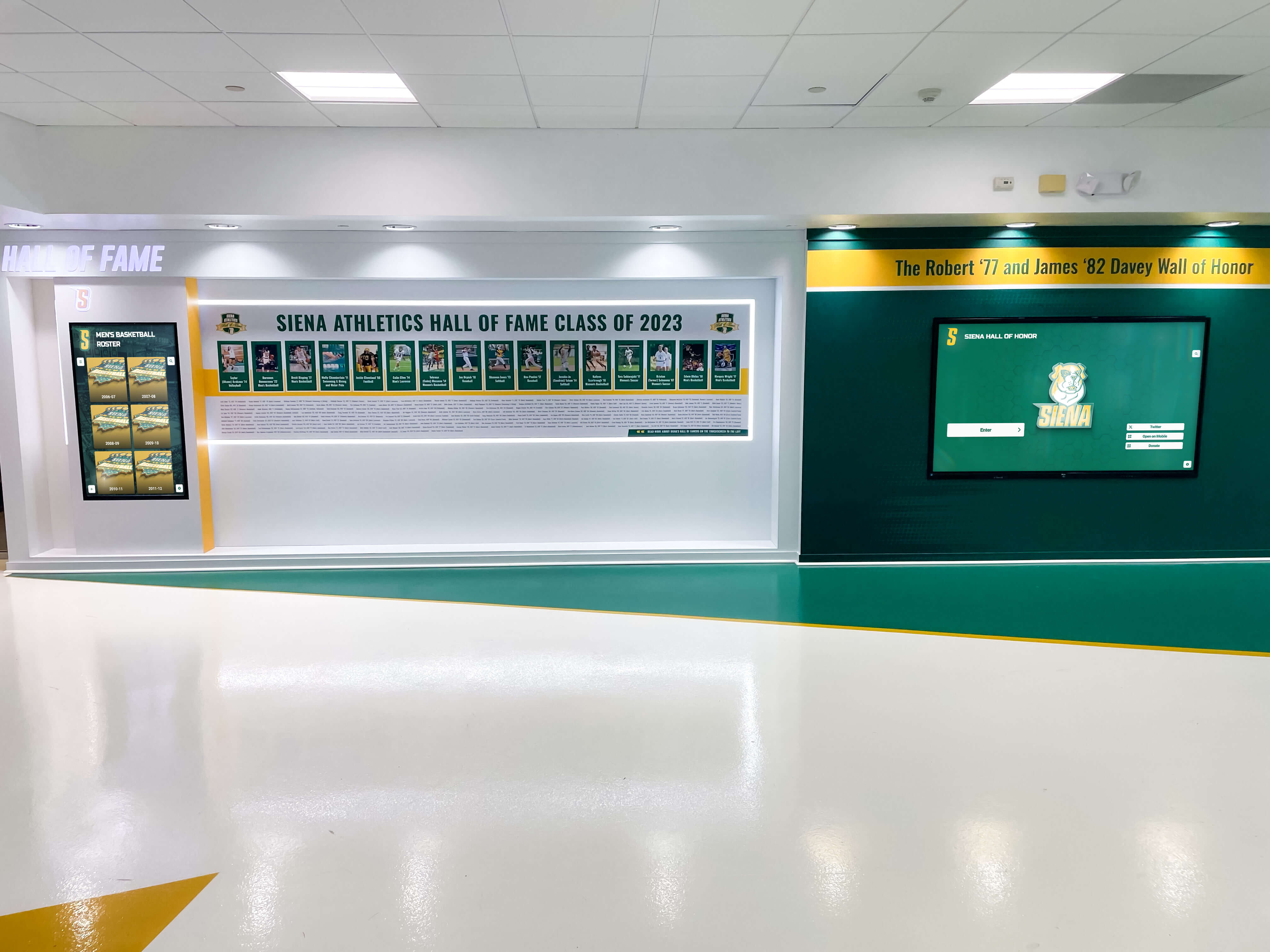
A school hall of fame wall represents inductee records loaded through seasonal imports — capturing pg_stat_slru snapshots before and after each import window documents the SLRU cache activity the import generated and supports cross-season comparison
Frequently Asked Questions
What is an athletic awards database pg_stat_slru review?
An athletic awards database pg_stat_slru review is the practice of querying PostgreSQL’s pg_stat_slru system view before and after a seasonal award import, then computing the difference between each cumulative counter in the two snapshots. The delta documents the SLRU cache activity the import window generated across named caches including Xact, CommitTs, MultiXactMember, Subtrans, Notify, and Serial. Because the counters are cluster-wide and cumulative since the last stats_reset, the review requires validating that stats_reset did not change between snapshots before interpreting any delta.
Which SLRU cache is most active during a seasonal award import?
The Xact cache is typically the most active during any transactional import because it tracks the commit and abort status of every transaction ID. Every row committed or aborted in the import batch reads and writes Xact cache pages. The CommitTs cache is only active when track_commit_timestamp is on. MultiXactMember and MultiXactOffset caches see significant activity only when multiple transactions hold locks on the same rows simultaneously, which is uncommon in single-session award imports.
Why do pg_stat_slru counters not directly attribute activity to a specific sport or award table?
The pg_stat_slru view reports cluster-wide counters for PostgreSQL’s internal bookkeeping caches. These caches operate below the table and row level — they track transaction status pages, commit timestamps, and multi-transaction records without recording which specific table, database, or import batch generated the access. A delta computed across an import window includes all SLRU activity during that interval from all sessions and background processes in the PostgreSQL instance, including autovacuum workers and other concurrent application sessions.
What should a school IT team do if stats_reset changes between pre- and post-import snapshots?
If the stats_reset timestamp for any named SLRU cache changes between the pre-import and post-import snapshots, pg_stat_reset_slru() or pg_stat_reset() was called during the import window. The delta for that cache is meaningless because the post-import values no longer share a consistent baseline. Document the reset occurrence in the import maintenance log, note which caches were affected, and treat those caches’ deltas as void for that import season. The next import season establishes a new baseline.
How does pg_stat_slru differ from pg_stat_io for import monitoring?
pg_stat_io tracks block-level I/O operations for relation files — the tables and indexes holding actual award records — reported by backend type and object type. pg_stat_slru tracks I/O operations for PostgreSQL’s own internal bookkeeping caches that support the MVCC and concurrency control machinery. Both capture I/O activity during an import, but at different layers: pg_stat_io shows what happened to your data files; pg_stat_slru shows what happened to the database engine’s internal support structures.
See How Schools Keep Award Records Accurate and Display-Ready Without Managing Database Infrastructure
Rocket Alumni Solutions' cloud-based digital recognition platform manages award record storage, import workflows, and display publishing in a fully maintained environment — so your athletic department focuses on honoring student athletes, not monitoring SLRU cache counters. WCAG 2.1 AA compliant displays work on any screen from 32" to 100"+, with unlimited inductees, categories, and multimedia content. Remote CMS access lets staff update and publish recognition records from anywhere.
Request a Custom Demo