



Intent: define. An athletic awards database postgres expression index is an index built on the computed result of a function or expression applied to one or more columns — rather than on the raw column value — so that queries filtering by EXTRACT(year FROM award_date) or lower(award_category) can resolve against the index directly rather than scanning every row in the table.
This guide is written for school athletic directors, recognition coordinators, and the IT administrators who manage the databases behind athletic hall-of-fame kiosks, season-record boards, and award-management platforms. It explains what expression indexes are, identifies the season and award-category query patterns that require them, provides an eight-step procedure for planning and deploying them in a school-maintained PostgreSQL database, includes a verification checklist, and answers the questions school IT teams and recognition staff most commonly ask.
When a coach or recognition coordinator queries an athletic awards database to list every “Most Valuable Player” award given during the 2023 fall season, the database must find matching rows quickly. If the query wraps the award_date column in an EXTRACT(year FROM award_date) call — or converts award_category to lowercase before comparing — a standard B-tree index on the raw column provides no benefit. The query planner cannot use an index built on award_date to resolve a filter on EXTRACT(year FROM award_date), because the index stores column values as-is, not the transformed results.
This is the gap an athletic awards database postgres expression index fills. By indexing the expression itself rather than the underlying column, the database resolves season-year and category-filter queries in milliseconds on tables holding tens of thousands of records — the same speed whether the award archive covers three seasons or thirty.

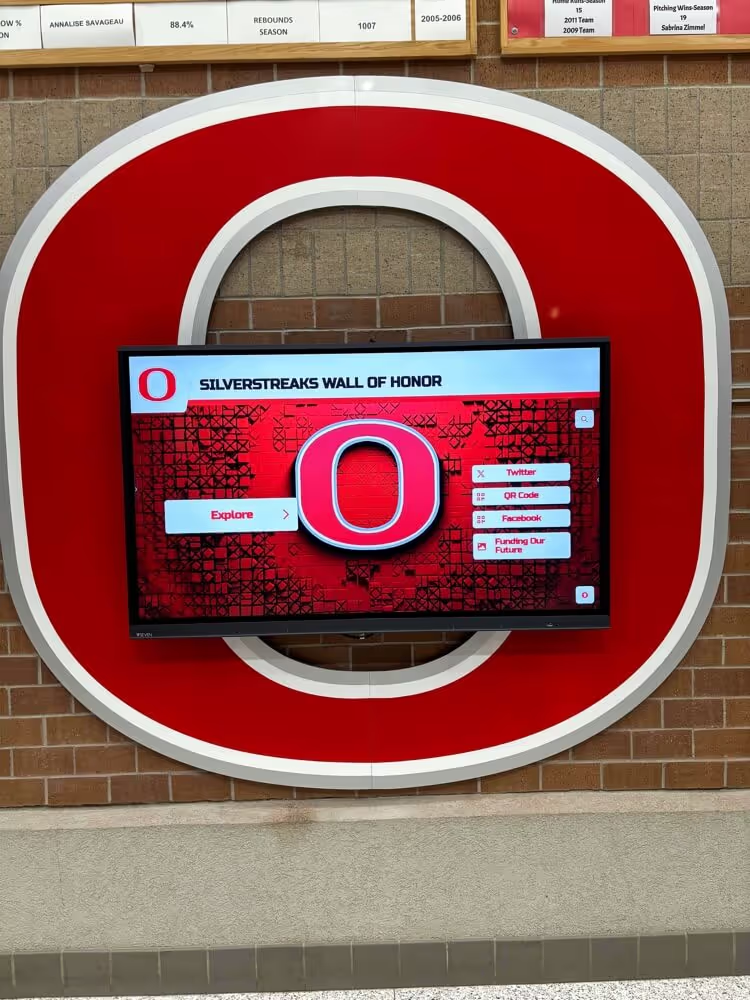
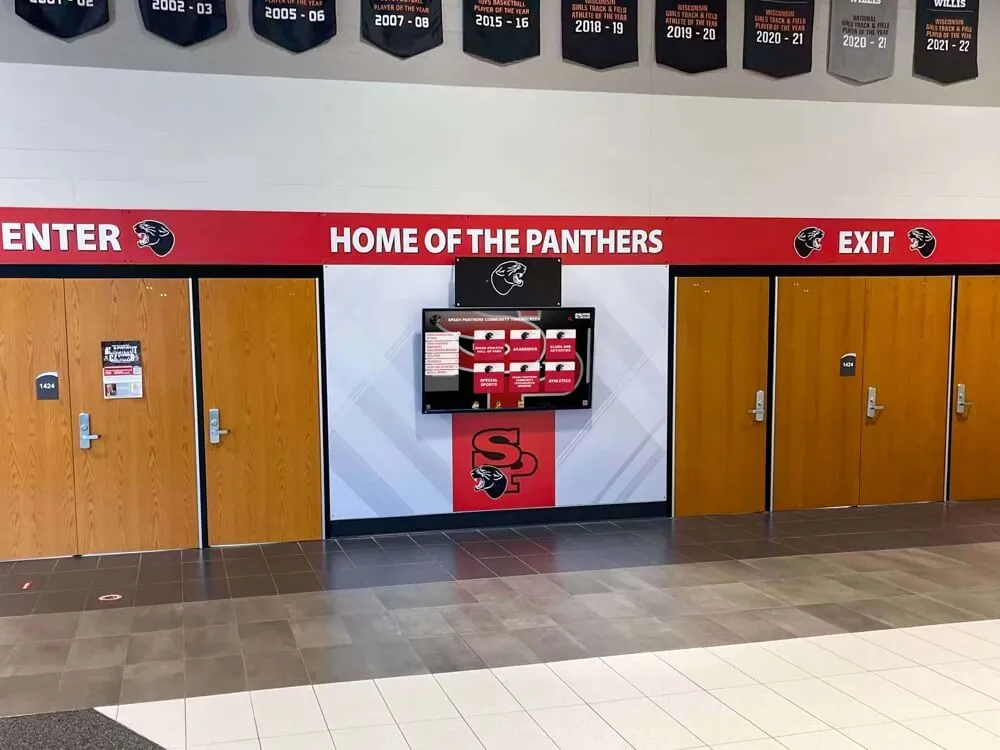
Digital athletic records boards in school hallways depend on database queries that resolve quickly — expression indexes on season-year and award-category expressions keep filtered views fast for coaches, staff, and visitors
What a PostgreSQL Expression Index Is and When to Use One
A PostgreSQL expression index — sometimes called a functional index — stores the computed result of an arbitrary expression on each row and makes that precomputed result available to the query planner when a query’s WHERE clause contains the same expression. The syntax is direct: where a standard index names a column, an expression index wraps that column in a function call:
-- Standard B-tree index on a column
CREATE INDEX idx_awards_date ON athletic_awards (award_date);

-- Expression index on the year extracted from that column
CREATE INDEX idx_awards_season_year
    ON athletic_awards (EXTRACT(year FROM award_date));
The critical rule is that the query’s WHERE clause must use the same expression as the index definition, character for character. A query filtering on EXTRACT(year FROM award_date) = 2024 will use the second index above. A query filtering on award_date BETWEEN '2024-01-01' AND '2024-12-31' uses a standard range index on award_date — a completely different access path.
Expression indexes are the right choice when:
- A consistent transformation is applied to a column before every filter or sort — season year via
EXTRACT, case normalization vialower, date truncation viadate_trunc - The transformation cannot be eliminated by restructuring the schema (for example, when adding a precomputed column would require application code changes across multiple systems)
- The table is large enough that a sequential scan is noticeably slow — generally several thousand rows or more for recognition archives that grow across decades of athletic programs
They are not a substitute for well-structured data. A season_year column that stores the integer year directly, indexed with a plain B-tree index, is simpler and equally fast. The expression index approach serves databases where the transformation is embedded in query patterns and changing those patterns requires coordinated updates across application code, reports, and scheduled jobs.
Why Season and Category Queries in Award Databases Need Expression Indexes
School athletic award databases typically store two pieces of information that drive the most common filtering queries: when an award was given and what category the award falls into.
Season-year filtering. Award dates are most naturally stored as full dates — the ceremony date, the final game of the season, or the end of the academic year. Queries that filter by season, however, nearly always operate on just the year component: “show all 2022 awards,” “how many athletes were recognized in the fall season,” “what records were set before 2019.” If the application consistently derives the season year by extracting the year component from a stored date, an expression index on that extraction eliminates the full-table scan for every season-filtered query.
Award-category filtering. Award category labels in school databases accumulate inconsistencies over time: “Most Valuable Player,” “most valuable player,” “Most Valuable Player (Offense),” “MVP.” Recognition coordinators who query by category often normalize to lowercase to capture all variants: WHERE lower(award_category) = 'most valuable player'. Without an expression index on lower(award_category), every such query performs a sequential scan — examining every row regardless of table size.
The two query patterns are also frequently combined: “list all Most Valuable Player awards given in the 2023–2024 school year.” A compound expression index on both expressions supports this combined filter efficiently:
CREATE INDEX CONCURRENTLY idx_awards_category_season
    ON athletic_awards (lower(award_category), EXTRACT(year FROM award_date));
The order of columns in a compound index matters. Placing the higher-selectivity column first — typically lower(award_category) when the database has many distinct categories — allows the planner to narrow the result set aggressively before applying the secondary filter.
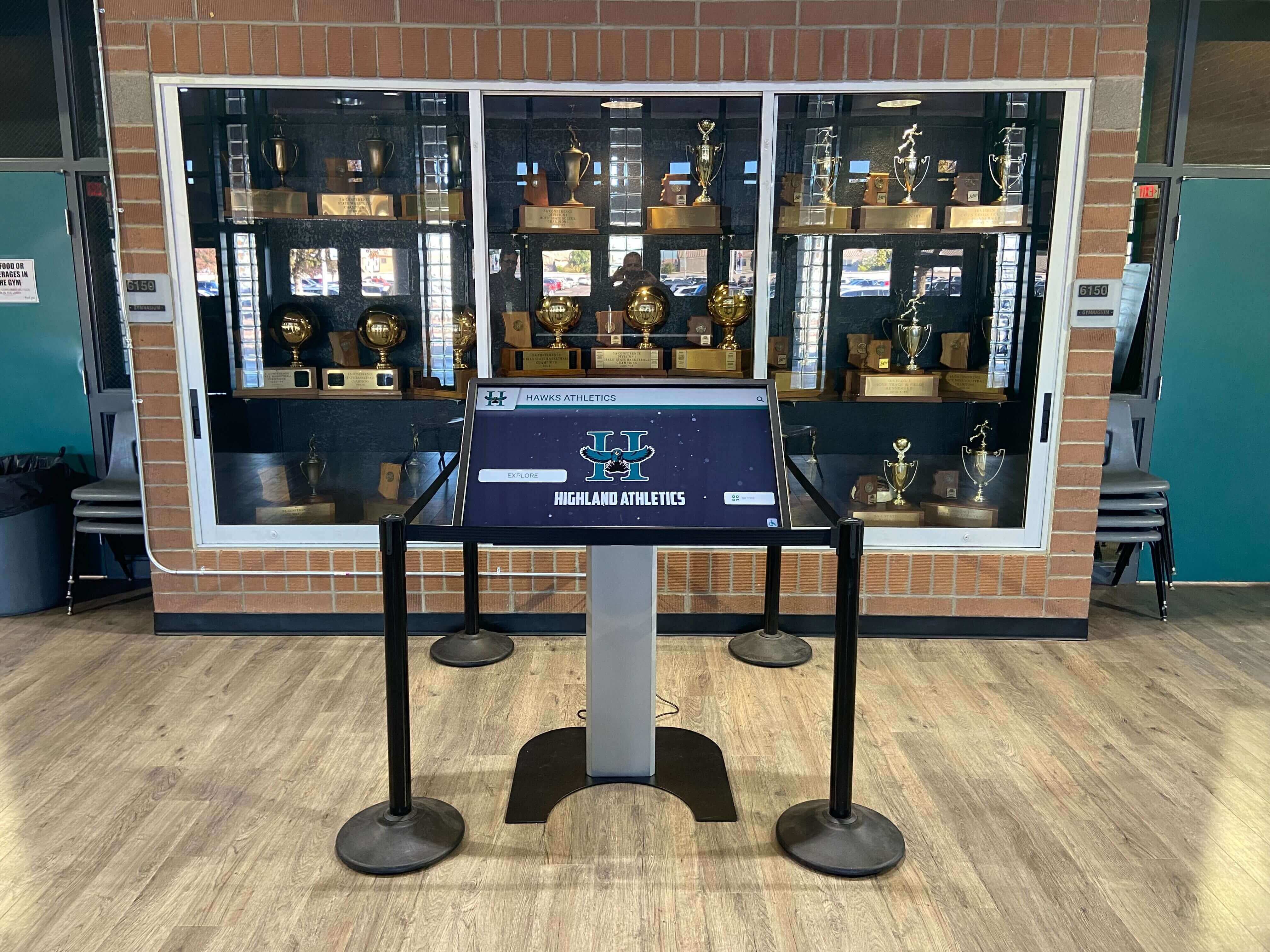
Award kiosks in trophy cases and lobbies rely on fast category and season filters — expression indexes on transformed columns keep those filters returning results instantly rather than waiting on a full-table scan
Athletic Awards Database Expression Index Plan: Eight-Step Procedure
The following procedure is designed for a school database administrator or technically capable IT staff member managing a school-maintained PostgreSQL awards database. It covers expression identification, immutability verification, index creation, statistics updates, and query plan validation.
Step 1: Audit the queries that filter award records by season and category.
Before creating any index, document the exact WHERE clause expressions used in every query that filters by season or award category. Check application code, reporting queries, and any scheduled queries that feed recognition displays. Record the exact function calls: is the season derived from EXTRACT(year FROM award_date), from date_trunc('year', award_date), from a stored season_label column, or from a separate integer season_year column? Is category comparison done with lower(award_category), with ILIKE, or as a direct equality check on the stored value?
This audit prevents a common mistake: creating an expression index that does not match the actual query pattern and is therefore never used by the planner.
Step 2: Document the exact expression for each planned index.
Write down the expression each index will use — not a general description, but the exact SQL expression that will appear in both the index definition and the application query. For example:
| Filter purpose | Expression to index |
|---|---|
| Season year from stored date | EXTRACT(year FROM award_date) |
| Case-insensitive category lookup | lower(award_category) |
| Case-insensitive sport name | lower(sport_name) |
| Combined season and category filter | lower(award_category), EXTRACT(year FROM award_date) |
Precision at this step prevents mismatches between the index definition and the query, which nullify the index entirely.
Step 3: Verify that each expression is immutable.
PostgreSQL permits only immutable expressions in index definitions — expressions that always return the same result for the same input, regardless of session settings, current time, or database state. Non-immutable expressions such as now(), current_date, or user-defined functions that read from other tables cannot be indexed.
Built-in immutable expressions commonly used in award database indexes include:
EXTRACT(year FROM date_column)— immutable forDATEandTIMESTAMPinputsEXTRACT(year FROM timestamptz_column)— immutablelower(text_column)— immutableupper(text_column)— immutabledate_trunc('year', date_column)— immutabletrim(text_column)— immutable
If an expression calls a user-defined function, confirm that function is declared IMMUTABLE in its CREATE FUNCTION statement. PostgreSQL will reject an attempt to create an index on a function not declared immutable. Marking a non-immutable function as immutable to work around this check creates a data integrity risk and should not be done.
Step 4: Create each expression index using CONCURRENTLY.
Build indexes with CONCURRENTLY to avoid locking the award table for writes during the build. On a table with thousands or tens of thousands of rows, index creation may take several seconds to a few minutes; CONCURRENTLY allows award record imports and edits to proceed during that window.
-- Season-year expression index
CREATE INDEX CONCURRENTLY IF NOT EXISTS idx_awards_season_year
    ON athletic_awards (EXTRACT(year FROM award_date));

-- Case-insensitive category expression index
CREATE INDEX CONCURRENTLY IF NOT EXISTS idx_awards_category_lower
    ON athletic_awards (lower(award_category));

-- Compound expression index for combined season-category queries
CREATE INDEX CONCURRENTLY IF NOT EXISTS idx_awards_category_season
    ON athletic_awards (lower(award_category), EXTRACT(year FROM award_date));
The IF NOT EXISTS clause makes each statement safe to include in migration scripts and environment setup procedures — it is a no-op if the index already exists. Note that CONCURRENTLY cannot run inside a transaction block; execute these statements outside of explicit BEGIN/COMMIT wrappers.
Step 5: Run ANALYZE to update table statistics.
After index creation, update the planner statistics for the award table so the query planner has accurate row counts and data distribution information:
ANALYZE athletic_awards;
Without updated statistics, the planner may underestimate the benefit of using the new index and choose a sequential scan instead. On tables with recent large imports, stale statistics are a common cause of unexpectedly slow queries immediately after an index is created.
Step 6: Validate index usage with EXPLAIN (ANALYZE, BUFFERS).
Run EXPLAIN (ANALYZE, BUFFERS) on a representative query for each expression index to confirm the planner is using the index rather than a sequential scan:
-- Validate season-year index
EXPLAIN (ANALYZE, BUFFERS)
SELECT award_id, athlete_name, award_category
FROM athletic_awards
WHERE EXTRACT(year FROM award_date) = 2024
ORDER BY award_date;

-- Validate category index
EXPLAIN (ANALYZE, BUFFERS)
SELECT award_id, athlete_name, award_date
FROM athletic_awards
WHERE lower(award_category) = 'most valuable player'
ORDER BY award_date DESC;

-- Validate compound index
EXPLAIN (ANALYZE, BUFFERS)
SELECT award_id, athlete_name, award_date
FROM athletic_awards
WHERE lower(award_category) = 'most valuable player'
  AND EXTRACT(year FROM award_date) = 2024;
For each query, look for Index Scan or Bitmap Index Scan referencing the newly created index in the execution plan output. A Seq Scan on a large table indicates the planner is not using the index — either because the query expression does not match the index expression exactly, because statistics are stale, or because the table is small enough that a sequential scan is the cheaper path.
One common mismatch to check: the index is on EXTRACT(year FROM award_date) but the query uses DATE_PART('year', award_date). These two expressions return the same value but are not syntactically identical, and the planner treats them as different expressions for index-matching purposes. The query must use the same expression as the index definition exactly.
Step 7: Document the index definitions, query patterns, and ownership.
Add each expression index to the database’s written policy documentation. Record:
- The index name and full
CREATE INDEXstatement - The query pattern the index supports with an example query
- The staff role responsible for maintaining the index through schema changes and upgrades
- The date the index was created and the PostgreSQL version in use at creation time
Without documentation, the connection between the index definition and the application query pattern is easily lost. A future schema change that renames a column or modifies a data type may silently break the index — or break the query — without anyone noticing until recognition display queries begin to slow down.
Step 8: Plan post-import and post-upgrade maintenance.
Expression indexes require the same maintenance as standard indexes: they accumulate dead tuples after bulk inserts, updates, and deletes, and must be verified after PostgreSQL version upgrades that may include changes to expression evaluation.
Schedule these steps after every seasonal bulk import of award records:
-- Reclaim bloat after a large import
REINDEX INDEX CONCURRENTLY idx_awards_season_year;
REINDEX INDEX CONCURRENTLY idx_awards_category_lower;
REINDEX INDEX CONCURRENTLY idx_awards_category_season;

-- Refresh statistics after reindex
ANALYZE athletic_awards;
After a PostgreSQL major version upgrade, verify that each expression index is intact and used correctly by repeating Step 6. Major version upgrades that include changes to how built-in functions are evaluated — rare but possible — can silently invalidate expression indexes built on those functions.

Hall of fame recognition displays that filter records by season year and award category depend on expression indexes that keep those queries fast as the archive grows across decades of recognition data
Expression Index Verification Checklist
Run this checklist before every major recognition display update, seasonal data import, and PostgreSQL version upgrade to confirm that expression indexes are functioning as intended.
| Check | SQL to Run | Expected Result | Action If Not Met |
|---|---|---|---|
| Season-year index exists | SELECT indexname FROM pg_indexes WHERE tablename = 'athletic_awards' AND indexdef LIKE '%EXTRACT%year%award_date%'; | Row returned | Run CREATE INDEX CONCURRENTLY per Step 4 |
| Category index exists | SELECT indexname FROM pg_indexes WHERE tablename = 'athletic_awards' AND indexdef LIKE '%lower%award_category%'; | Row returned | Run CREATE INDEX CONCURRENTLY per Step 4 |
| Statistics are current post-import | SELECT last_analyze FROM pg_stat_user_tables WHERE relname = 'athletic_awards'; | Timestamp within 24 hours of last import | Run ANALYZE athletic_awards; |
| Season query uses index | EXPLAIN ... WHERE EXTRACT(year FROM award_date) = <year> | Index Scan or Bitmap Index Scan on season index | Run ANALYZE; verify expression matches exactly; rebuild index |
| Category query uses index | EXPLAIN ... WHERE lower(award_category) = '<value>' | Index Scan or Bitmap Index Scan on category index | Run ANALYZE; verify expression matches exactly; rebuild index |
| No index bloat post-import | SELECT pg_size_pretty(pg_relation_size('idx_awards_season_year')); | Within 20% of pre-import baseline | Run REINDEX INDEX CONCURRENTLY per Step 8 |
| Compound query uses compound index | EXPLAIN ... WHERE lower(award_category) = '<cat>' AND EXTRACT(year FROM award_date) = <year> | Index Scan on compound index | Verify column order matches compound index definition; rebuild if needed |
Document the results of each check with a date, the name of the staff member who ran it, and the import batch or upgrade event that prompted the check. Keep completed checklists in the policy document as an audit record.
How Expression Indexes Connect to Athletic Recognition Displays
The practical effect of a well-planned expression index is visible to every person who interacts with a recognition system. Coaches who pull a season report for an end-of-year ceremony program see results immediately rather than waiting through a slow query. Recognition coordinators who filter the award archive by category during a nomination review do not encounter timeout errors that interrupt their workflow. Visitors who use a lobby kiosk to browse awards from a specific year see results load without delay.
For programs that maintain a digital athletic display — a touchscreen recognition wall, a lobby kiosk, or a web-accessible archive — season and category filtering are the two most common search interactions. Every visitor who searches for “basketball awards” or “2019 season” is executing a category or season filter query against the underlying database. The speed of that query determines whether the search interaction feels responsive or feels broken.
The BRIN index policy for athletic awards databases covers a complementary indexing approach — Block Range INdexes — that works well on large, naturally ordered date columns when expression indexes are not required but sequential range scans on raw award_date values are common. The two index types address different query patterns and can coexist on the same table without conflict.
For programs planning to export award records to an external system or recognition platform, well-indexed databases produce export queries that complete faster and place less load on the server during the export window. The athletic archive database export checklist at digitalyearbook.org covers the pre-export steps that intersect with indexing decisions — including whether to drop and rebuild indexes around a large export operation.
Schools that surface athletic recognition data through digital displays also benefit from understanding how the underlying data infrastructure connects to the visitor experience. The guide to showcasing athletic achievement awards digitally at halloffame-online.com explores how schools translate structured award data into engaging recognition content — a process that depends on the database being able to serve filtered queries reliably and quickly.
The guide to recognizing student athletes through school athletic programs at touchscreenwebsite.com covers how schools build recognition programs that work for athletes, families, and the broader school community — a goal that depends equally on recognition design and the data infrastructure behind it.

Recognition kiosks display individual athlete records filtered by sport, season, and award category — expression indexes behind these displays keep each filtered view loading immediately regardless of archive size
Maintaining Expression Indexes Through Schema Changes
Expression indexes are sensitive to schema changes in a way that standard column indexes are not. A column-level index on award_date survives a column rename without requiring a rebuild — the index automatically follows the renamed column. An expression index on EXTRACT(year FROM award_date) does not survive a rename: if award_date is renamed to recognition_date, the expression index definition becomes invalid and must be recreated with the new column name.
Four schema change scenarios require explicit expression index review:
Column renames. Any column referenced in an expression index must be verified and the index potentially recreated after a rename. Check whether a column rename invalidates existing expression index definitions before applying the change to a production database.
Data type changes. Changing the data type of a column referenced in an expression index may change the return type of the expression. Changing award_date from DATE to TIMESTAMP WITH TIME ZONE requires the expression index to be rebuilt to reflect the new input type. Test with EXPLAIN after the type change to verify the index is still selected by the planner.
Application query changes. If the application is updated to use a different expression — switching from EXTRACT(year FROM award_date) to DATE_PART('year', award_date), or adding a precomputed season_year column — the existing expression index for the old pattern becomes unused overhead. Update the index definition to match the new query pattern, or drop the old index and create the new one.
New award categories added to the data model. Expression indexes on lower(award_category) continue to function correctly as new category values are inserted — the index covers all values in the column, not a static list. No index change is required when new award types are added to the program.
The connection between index definitions and query patterns should be documented in the database policy so that staff reviewing a schema change can identify which expression indexes require review before the change is applied.

Award archives displayed in school hallways are only as searchable as the indexes behind them — maintaining expression indexes through schema changes prevents filtered queries from silently degrading after a column rename or type change
How Digital Recognition Platforms Reduce Database Maintenance Burden
Schools that manage athletic award records through a cloud-based recognition platform rather than a self-maintained database avoid the expression index planning and maintenance described in this guide. A purpose-built recognition platform handles the underlying data storage, query optimization, and index management internally — recognition coordinators and athletic directors interact through a content management interface rather than a database console.
For schools that operate their own award database — whether as a standalone system or as the backend for a custom kiosk application — the expression index plan in this guide provides a structured, maintainable approach to keeping season and category queries fast as the archive grows.
The practical question for most schools is whether the operational cost of database index planning and maintenance — the staff time, technical expertise, and ongoing upgrade coordination required — is the best use of limited IT resources, or whether a managed recognition platform offers the same search performance with a fraction of the administrative overhead.
Schools that recognize athletes, students, donors, and community members across multiple categories — athletics, academics, arts, community service — through a unified recognition system benefit from platforms designed for that breadth of scope. Rocket Alumni Solutions is trusted by 600+ institutions to power digital recognition across touchscreen kiosks, lobby walls, and mobile-accessible displays. The platform is WCAG 2.1 AA compliant and works on any screen from 32" to 100"+, with a remote CMS accessible from anywhere, unlimited award categories, scheduled publishing, and auto-ranking for record boards.
FAQ
What is a PostgreSQL expression index and how does it differ from a standard index?
A PostgreSQL expression index stores the precomputed result of a function or expression applied to column values, rather than the raw column values themselves. A standard index on award_date stores date values and supports range queries on those dates. An expression index on EXTRACT(year FROM award_date) stores the extracted year values and supports equality filters on the year. The planner uses the expression index when the WHERE clause contains the same expression, character-for-character, as the index definition.
Why won’t a regular index on award_date help when filtering by season year?
A standard index on award_date supports queries like WHERE award_date BETWEEN '2024-01-01' AND '2024-12-31'. When a query filters by EXTRACT(year FROM award_date) = 2024, the planner cannot use the raw-column index because the filter operates on the transformed value — the extracted year integer — not the stored date. An expression index on EXTRACT(year FROM award_date) solves this by precomputing and storing the year for each row.
What does it mean for an expression to be immutable, and why does it matter?
An immutable expression always returns the same result for the same input, regardless of time or session state. PostgreSQL requires immutability in index expressions because the index stores values that must remain accurate indefinitely. EXTRACT(year FROM award_date) and lower(award_category) are both immutable. Functions that depend on the current time or session parameters are not immutable and cannot be used in expression indexes.
Can a single compound expression index support both season and category filters?
Yes. A compound expression index — for example, CREATE INDEX ON athletic_awards (lower(award_category), EXTRACT(year FROM award_date)) — supports queries filtering on both expressions simultaneously, and also supports category-only queries. For season-only queries, a separate single-expression index on EXTRACT(year FROM award_date) is more efficient.
Do expression indexes slow down award record inserts and updates?
Yes, but the overhead is small for typical school award databases. Every insert or update that changes a referenced column requires recomputing the expression and updating the index entry. For databases handling hundreds to a few thousand records per import cycle, this overhead is negligible. For very large bulk imports, consider dropping and recreating expression indexes around the import window to maintain import throughput.
Building a Recognition Database That Stays Fast as the Archive Grows
An athletic awards database postgres expression index plan is not a one-time setup step — it is an ongoing maintenance discipline that keeps season-year and award-category queries fast through schema changes, seasonal data imports, and PostgreSQL version upgrades. Schools that document their expression indexes clearly, verify them after every major change, and align their query patterns with their index definitions maintain recognition databases that serve coaches, staff, and visitors without slowdowns regardless of archive size.
The eight-step procedure and verification checklist in this guide are designed to be adopted directly by a school IT administrator or database-capable recognition coordinator, or adapted to fit a specific award schema. The core principle applies at any scale: when a query consistently applies a function to a column before filtering, an expression index on that function eliminates the sequential scan and makes the filter as fast as a direct column lookup.
Schools that want the filtering speed and search reliability described here — without managing the underlying database infrastructure — can achieve the same result through a managed digital recognition platform built for school athletic programs.
See How 600+ Schools Power Fast, Searchable Athletic Recognition
Rocket Alumni Solutions builds cloud-based digital recognition platforms with fast category and season filtering built in — no expression index planning required. WCAG 2.1 AA compliant displays work on any touchscreen from 32" to 100"+, with remote CMS access, unlimited award categories, scheduled publishing, and auto-ranking for record boards.
Request a Custom Demo