



Intent: define. An athletic awards database postgres not valid constraint is a PostgreSQL feature that lets you attach a CHECK or foreign key constraint to an awards table so that only new and updated rows are checked immediately—while existing historical rows are exempted until you explicitly run VALIDATE CONSTRAINT. This staged approach protects incoming recognition records right away without requiring that every historical row already meet the constraint, which is essential when years of legacy award data contain inconsistencies that need systematic cleaning before full enforcement is possible.
This guide is written for athletic directors, records administrators, and IT staff who manage the PostgreSQL databases behind digital hall-of-fame kiosks, seasonal record boards, and recognition archives. It defines NOT VALID constraints in plain language, explains why athletic records databases are a strong match for staged validation, walks through a numbered rollout procedure, provides a comparison table against alternative approaches, and answers the questions school database teams most commonly ask.
When a school’s athletic recognition program spans decades, the historical award records it contains are rarely clean. Athlete names stored in multiple formats, foreign key references pointing to renamed sport categories, season-year fields mixing academic-year and calendar-year conventions—these are structural realities of any program that has grown through spreadsheets, staff turnover, and multiple generations of database software. Adding a strict database constraint to a table carrying thousands of those legacy rows will fail the moment PostgreSQL encounters the first violation, blocking the entire operation.
The athletic awards database postgres not valid constraint approach solves this by separating two distinct concerns: protecting new records from the moment the constraint is added, and validating historical records only after they have been cleaned. This distinction is what makes staged constraint rollout practical for school athletic departments.

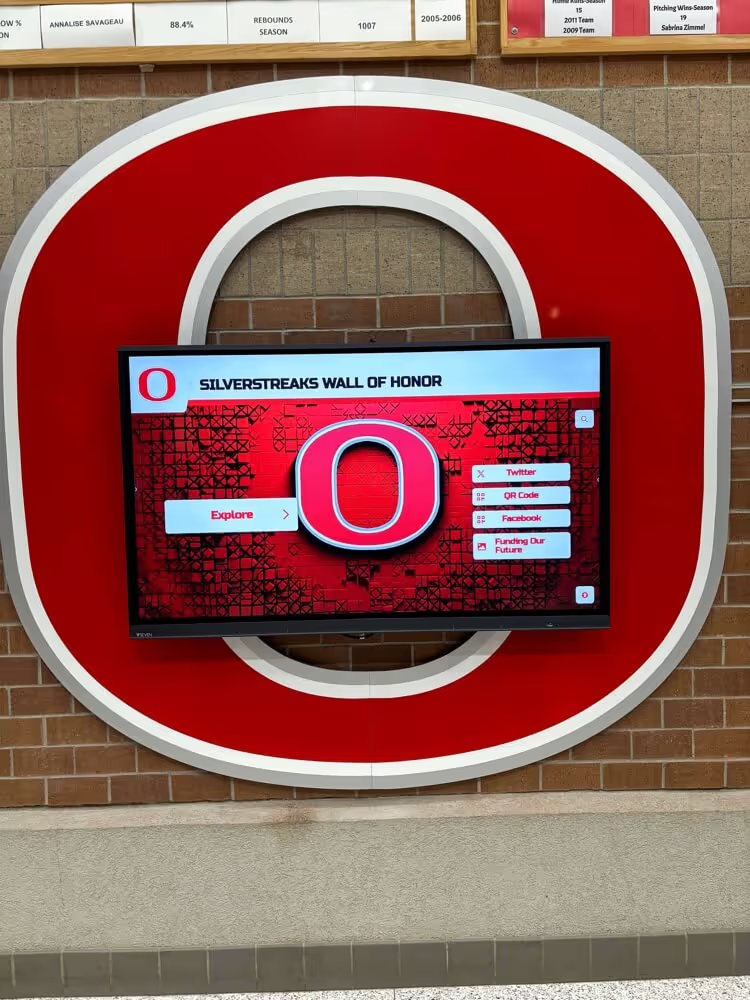
Athletic recognition walls represent decades of institutional history—the records behind them often carry the data inconsistencies that staged constraint rollout is designed to address
What Is a PostgreSQL NOT VALID Constraint?
A NOT VALID constraint is a constraint added with the NOT VALID clause that skips checking existing rows at creation time. It applies only to rows inserted or updated after the constraint is created. Once the constraint exists, no new record can violate it—but rows that were already in the table before the constraint was added are not verified until you run ALTER TABLE ... VALIDATE CONSTRAINT.
In standard PostgreSQL constraint terms:
- Standard constraint (full validation): When you run
ALTER TABLE awards ADD CONSTRAINT fk_athlete FOREIGN KEY (athlete_id) REFERENCES athletes(id), PostgreSQL scans every row in the table immediately and rejects the entire operation if any row violates the constraint. On a large historical awards table, this acquires anACCESS EXCLUSIVElock that blocks all reads and writes during the full scan. - NOT VALID constraint:
ALTER TABLE awards ADD CONSTRAINT fk_athlete FOREIGN KEY (athlete_id) REFERENCES athletes(id) NOT VALIDcompletes immediately—no scan of existing rows, no long lock. New inserts and updates are checked from this point forward. Existing rows remain unchecked untilVALIDATE CONSTRAINTis run separately. - VALIDATE CONSTRAINT: Running
ALTER TABLE awards VALIDATE CONSTRAINT fk_athletescans existing rows to find violations. Critically, this step uses only aSHARE UPDATE EXCLUSIVElock—a much lighter lock that allows concurrent reads and many writes to proceed during validation. If violations are found, VALIDATE reports which rows fail and does not change the constraint’s existing enforcement of new records.
The practical outcome: your recognition database gains immediate protection for new award entries the day the constraint is added, without any requirement that historical records are already clean.
Why Athletic Awards Records Need Staged Constraint Rollout
Athletic recognition databases accumulate data inconsistencies in predictable ways. Understanding those patterns explains why NOT VALID is frequently the only viable path to full constraint enforcement in a running school program.
Staff turnover and inconsistent data entry. Every time athletic office personnel change, new staff members enter data differently than their predecessors. A sport category field that one coordinator stored as “Boys Varsity Basketball” becomes “BVB” under the next and “Basketball - Varsity (M)” under the one after that. A foreign key constraint on sport category fails the moment it encounters any of these variants if they point to a canonical category table that uses only one of those formats.
Multi-decade historical archives. Schools that digitize printed programs, yearbooks, and newspaper clippings from the 1980s and earlier bring records into the database that were never designed for relational structure. Athlete IDs, which may be the target of a foreign key constraint, did not exist for students enrolled forty years ago. A NOT VALID foreign key constraint acknowledges this reality: protect today’s entries with a referential integrity check, while the archives team works through historical records methodically.
Migrated spreadsheet data. When an athletic program moves off spreadsheets into a purpose-built recognition platform or a custom PostgreSQL schema, the migrated data is a direct export of whatever the spreadsheet contained. Duplicate rows, blank required fields, and mismatched category labels are routine migration findings. Attempting to add full constraints before cleaning migrated data blocks the migration entirely.
Season-year format inconsistencies. Awards entered during a calendar year (2024) and those entered under an academic year convention (2023–24) are incompatible for date-range queries unless normalized to a single format. A check constraint that enforces the required format fails on every row using the deprecated format.
For school programs that have already standardized their uniqueness constraints in athletic awards databases, NOT VALID is the natural next step: you enforce uniqueness first, then layer in referential and check constraints using staged validation.

Trophy walls and digital recognition displays draw on the same underlying database—constraint rollout protects the data quality that makes both accurate
The Eight-Step NOT VALID Constraint Rollout Procedure
This procedure covers the full lifecycle from planning through full enforcement. Work through all eight steps in sequence; skipping ahead to VALIDATE CONSTRAINT before completing the cleaning steps produces the violations VALIDATE is designed to surface.
Step 1: Identify the Target Constraint and Affected Column
Define the constraint before writing any SQL. Document the constraint’s purpose (referential integrity, format enforcement, null exclusion), the table and column it will govern, and the business rule it implements. For athletic awards databases, common candidates include:
- Foreign key from
athlete_idin the awards table to the athletes reference table - Foreign key from
season_idto the seasons reference table - CHECK constraint enforcing that
award_categorymatches a controlled vocabulary - CHECK constraint requiring
award_dateto fall within a valid range
Write down the SQL for both the NOT VALID addition and the eventual VALIDATE CONSTRAINT call before beginning. Having both statements prepared prevents mistakes during the rollout window.
Step 2: Count Violations Before Adding the Constraint
Run a query that counts how many existing rows would violate the proposed constraint. For a foreign key constraint, this means identifying rows where the referenced value does not exist in the parent table:
SELECT COUNT(*)
FROM awards a
WHERE NOT EXISTS (
    SELECT 1 FROM athletes ath WHERE ath.id = a.athlete_id
);
For a CHECK constraint, query rows that fail the check condition directly. This count gives you the scope of the cleaning work that must occur before VALIDATE CONSTRAINT can succeed. If the count is zero, you can add the constraint in full (without NOT VALID) because no existing rows violate it. If the count is nonzero, proceed with the NOT VALID approach.
Step 3: Add the Constraint with NOT VALID
Add the constraint to the table using the NOT VALID clause:
ALTER TABLE awards
ADD CONSTRAINT fk_awards_athlete
FOREIGN KEY (athlete_id)
REFERENCES athletes(id)
NOT VALID;
This statement completes nearly instantly regardless of table size. PostgreSQL adds the constraint to the catalog without scanning existing rows. From this moment forward, any new award record that references a non-existent athlete_id is rejected by the database engine before it is written.
Confirm the constraint exists but is marked not valid:
SELECT conname, convalidated
FROM pg_constraint
WHERE conrelid = 'awards'::regclass
  AND conname = 'fk_awards_athlete';
The convalidated column returns f (false) for a NOT VALID constraint and t (true) once VALIDATE CONSTRAINT has completed successfully.
Step 4: Pause New Imports of Historical Data
While the cleaning work is underway, pause any bulk imports of historical records into the awards table. New records entered through normal award-management workflows are already protected by the constraint. The risk is that a legacy import job pushes additional uncleaned rows that expand the violation count during the cleaning window. Notify the athletic office and any IT staff who manage batch loads that historical imports are paused until validation is complete.
Step 5: Clean Historical Violations in Batches
Work through the violation rows identified in Step 2. For athletic award records, cleaning typically takes one of four forms:
| Violation Type | Cleaning Approach |
|---|---|
athlete_id references a deleted or never-imported athlete record | Create the missing athlete record in the reference table, or link the award to the correct existing athlete record after verifying identity |
season_id references a season not in the seasons table | Create the missing season record with the correct academic-year or calendar-year format |
award_category value is not in the controlled vocabulary | Normalize the value to the closest canonical category, document the mapping, and update the row |
athlete_id is NULL where not permitted | Source the athlete identity from original documentation and populate the field, or mark the record as unresolvable and move it to an audit table |
Clean in batches of 500 to 1,000 rows, committing each batch. This prevents long-running transactions that hold locks, and it allows you to verify the running violation count decreases after each batch. Re-run the Step 2 query after each batch to track progress.
A structured foreign key constraint audit for recognition records documents which parent tables each foreign key references, which is the starting point for knowing which reference tables to check when violations involve missing parent records.
Step 6: Verify Zero Violations Remain
Before running VALIDATE CONSTRAINT, confirm the violation count has reached zero:
SELECT COUNT(*)
FROM awards a
WHERE NOT EXISTS (
    SELECT 1 FROM athletes ath WHERE ath.id = a.athlete_id
);
If the count is not zero, do not proceed to Step 7. Return to Step 5 and continue cleaning. Running VALIDATE CONSTRAINT against remaining violations reports errors and leaves the constraint in the not-valid state—it does not partially validate.
Step 7: Run VALIDATE CONSTRAINT
Once violations are confirmed at zero, run the validation step:
ALTER TABLE awards
VALIDATE CONSTRAINT fk_awards_athlete;
This statement acquires a SHARE UPDATE EXCLUSIVE lock—lighter than the ACCESS EXCLUSIVE lock used by standard constraint addition—which means concurrent reads and most writes continue during validation. On a large historical awards table with many rows, this step may take several minutes. Plan it during a low-activity period, but it does not require a maintenance window.
After completion, re-run the pg_constraint query from Step 3. The convalidated column now returns t. The constraint is fully active for both new records and all historical records.
Step 8: Document the Constraint in Your Data Governance Record
Add the constraint to whatever data governance documentation your program maintains: the schema data dictionary, the recognition platform’s technical runbook, or the athletic department’s data management policy. Record the constraint name, table, column, purpose, the date it was added as NOT VALID, the date validation completed, and the violation count at each cleaning checkpoint. This documentation is the audit trail that demonstrates due diligence when the constraint is ever questioned.
For programs managing team alumni databases and tracking former athletes for recognition outreach, the constraint audit trail becomes part of the broader data governance record that governs how alumni records are linked to their historical award entries.

Individual athlete profiles on recognition kiosks depend on referentially correct database records—NOT VALID constraint rollout ensures new entries are clean while historical records are systematically corrected
Decision Table: NOT VALID vs. Full Constraint vs. Deferrable Constraint
School database teams managing recognition records frequently face a choice between three constraint strategies. This table summarizes when each approach fits.
| Scenario | Best Approach | Why |
|---|---|---|
| All existing rows already pass the constraint | Full constraint (immediate validation) | No violations to clean; full constraint is simpler and takes effect in one step |
| Historical records have known violations; new records must be protected immediately | NOT VALID + VALIDATE CONSTRAINT | Protects new records now; provides time to clean historical rows before full enforcement |
| Multi-record import batch where child records arrive before parent records in the same transaction | Deferrable constraint | Allows constraint check to be deferred to end of transaction rather than row-by-row; see the deferrable constraint policy guide for this use case |
| Large table where full-scan lock would disrupt the live recognition platform | NOT VALID + VALIDATE CONSTRAINT | VALIDATE uses a lighter lock than full constraint addition; recognition displays continue serving queries during validation |
| Fresh database with no historical data | Full constraint | No legacy violations possible; immediate validation is safe and correct |
| Constraint depends on a column that will be normalized in an upcoming migration | NOT VALID | Add the constraint now to protect new rows; validate after the migration normalizes historical values |
The overlap between NOT VALID and deferrable constraints matters: they address different problems. Deferrable constraints govern transaction-internal ordering (parent and child records arriving in the same transaction). NOT VALID constraints govern the pre-existing state of historical data at constraint creation time. A recognition database may legitimately use both.
How to Handle VALIDATE CONSTRAINT Failures
When VALIDATE CONSTRAINT fails—because the violation count was not actually zero, or because a concurrent process inserted a violating row between Step 6 and Step 7—PostgreSQL reports the first offending row and rolls back the VALIDATE statement. The constraint remains in the not-valid state; no data is altered.
The response steps are the same regardless of failure cause:
- Re-run the violation count query to determine the current violation count.
- Identify and clean the specific offending rows. The error message from VALIDATE typically includes the constraint name and the key value that failed.
- If a concurrent process is inserting uncleaned historical records, pause that process as described in Step 4 before repeating VALIDATE.
- Re-run VALIDATE CONSTRAINT after confirming violations are resolved.
PostgreSQL allows VALIDATE CONSTRAINT to be re-run as many times as needed. Each attempt is independent; partial progress is not preserved between runs, but previously cleaned rows do not regress.
For programs that maintain standardized sports roster templates to manage team data consistency, the same standardization discipline that prevents future award record violations also reduces the cleaning scope needed before VALIDATE CONSTRAINT can succeed.

Championship records displayed on recognition walls must link correctly to athlete and season data—validated constraints ensure those links are enforced at the database level
Platforms, Constraint Governance, and Recognition Display Quality
School athletic programs using purpose-built recognition platforms—rather than custom PostgreSQL schemas—benefit from constraint governance at the application layer rather than the database layer. Platforms like Rocket Alumni Solutions enforce referential integrity, controlled vocabularies for award categories, and uniqueness rules through their own data management layer, exposing those controls through a content management interface designed for athletic directors and office administrators rather than database engineers.
For programs managing their own PostgreSQL instances—whether as a backend for a custom recognition portal, a data warehouse for historical records, or a staging database for content managed before it is published to a display platform—NOT VALID constraints are a direct database-level tool for protecting record quality during the transition from legacy data.
The connection between database constraint governance and recognition display quality is direct. A complete guide to touch board athletic records illustrates how display-facing athletic records are organized for visitor interaction—when the underlying database has validated foreign key and check constraints, the records displayed on a touch board are guaranteed to reference valid athletes, seasons, and award categories rather than orphaned or malformed values.
Recognition platforms that provide touchscreen digital hall of fame interactive awards depend on clean, referentially consistent data to surface accurate results across search, browse, and season-filter interactions. A constraint rollout that ends with full VALIDATE CONSTRAINT success means every record in the database—historical and current—passes the referential and format checks that support those interactions.

Digital recognition screens in athletic hallways surface records that must be referentially correct—staged constraint rollout ensures historical data meets the same standards as new entries before it appears on any display
Comparing Recognition Platform Approaches to Data Integrity
Schools evaluating recognition platforms should understand how different providers approach data integrity for athletic award records. The following table summarizes the approaches of Rocket Alumni Solutions alongside common alternatives:
| Platform | Constraint Governance Approach | Historical Data Handling |
|---|---|---|
| Rocket Alumni Solutions | Application-layer validation with controlled vocabularies, uniqueness enforcement, and duplicate detection at point of entry; WCAG 2.1 AA accessible; works on 32"–100"+ screens | Bulk upload tools with validation reporting; records reviewed before publishing to display |
| Custom PostgreSQL schema | Database-layer constraints (including NOT VALID for staged rollout); full SQL control; requires DBA or IT staff for governance | Full access to constraint management; NOT VALID rollout procedure applies directly |
| Spreadsheet-based tracking | No enforcement; data quality depends entirely on staff discipline | No constraint mechanism; violations accumulate silently |
| Generic CMS with custom fields | Limited to field-level required/optional settings; no referential integrity between record types | No built-in mechanism for staged validation of historical data |
For programs on custom PostgreSQL backends, NOT VALID constraint rollout is the appropriate tool for achieving the data integrity that purpose-built platforms provide through application-layer controls.

Wall-of-honor digital screens serve real-time recognition queries—database constraints validated through staged rollout guarantee the underlying records are accurate before they appear on screen
Frequently Asked Questions
What is the difference between NOT VALID and DEFERRABLE in PostgreSQL constraint management? NOT VALID and DEFERRABLE address different problems. NOT VALID skips checking rows that existed before the constraint was added, allowing staged cleanup of historical data. DEFERRABLE allows a constraint check to be postponed to the end of a transaction rather than checked row-by-row, which solves ordering problems in multi-step imports where parent and child records arrive within the same transaction. An athletic awards database may use both: NOT VALID to add constraints without failing on legacy violations, and DEFERRABLE for import workflows that load related records in batches.
Does VALIDATE CONSTRAINT block reads from the recognition display during validation?
No. ALTER TABLE ... VALIDATE CONSTRAINT acquires a SHARE UPDATE EXCLUSIVE lock, which is compatible with concurrent SELECT queries. Recognition display kiosks and portals that read from the database can continue serving athlete profile and award history queries while validation runs. The lock does block other ALTER TABLE operations and certain DDL commands, but read and most write operations proceed normally.
Can NOT VALID be used with CHECK constraints as well as foreign key constraints?
Yes. NOT VALID works with both CHECK constraints and foreign key constraints in PostgreSQL. For athletic awards databases, CHECK constraints are commonly used to enforce controlled-vocabulary values for sport categories, season formats, and award tier classifications. Adding these as NOT VALID allows programs to enforce the controlled vocabulary on all new entries immediately while cleaning historical rows that predate the standardization.
What happens to existing rows during the period between adding the NOT VALID constraint and completing VALIDATE CONSTRAINT?
Existing rows that violate the constraint are not affected—they remain in the database unchanged during the cleaning period. They can still be read, updated, and referenced by application queries. The constraint only prevents new rows from violating it and prevents existing rows from being updated in a way that introduces a violation. An existing row with a missing athlete_id can be corrected through an UPDATE statement without triggering a constraint violation; the corrected value must satisfy the constraint, but the update process itself is the path to compliance.
How should an athletic department document NOT VALID constraints for staff handover? Document the constraint name, target table, constrained column, the business rule enforced, the date added as NOT VALID, the violation count at that date, and the date VALIDATE CONSTRAINT completed. Store this record in the data governance documentation that accompanies the recognition database schema. Include the SQL used for both the NOT VALID addition and the VALIDATE statement. This documentation ensures that incoming staff—whether a new IT coordinator or a new athletic director—can understand the constraint’s history without needing to reconstruct it from PostgreSQL system tables.
Build Recognition Records That Hold Up to Full Enforcement
An athletic awards database postgres not valid constraint rollout is the structured path from a historical database with known inconsistencies to a fully enforced, referentially correct recognition database. The process is methodical: count violations before adding the constraint, add it with NOT VALID to protect new records immediately, clean historical rows in auditable batches, and validate once violations reach zero.
Schools that complete this rollout end with a database where every record—from the most recent season’s award entries to the oldest archived championship—passes the same referential and format checks. That consistency is what allows recognition display platforms to serve accurate athlete profiles, season histories, and award records to every visitor who interacts with a touchscreen kiosk or a digital hall of fame wall.
Rocket Alumni Solutions provides schools and athletic programs with a fully managed recognition platform built to handle records across all award categories—athletic, academic, arts, STEM, and community service—with application-layer data validation, unlimited inductees and categories, WCAG 2.1 AA accessibility, and remote CMS access so recognition records can be updated from anywhere. The platform supports screens from 32 to 100 inches and includes bulk upload tools, duplicate detection, and scheduled publishing for programs that manage large historical archives alongside current-season recognition.
If your program is working through the data quality steps that make a reliable, public-facing recognition display possible, request a custom demo and see how Rocket Alumni Solutions handles the record integrity that supports a recognition program your athletes, families, and alumni can trust.