



Intent: define. An athletic awards database postgres skip locked pattern is a PostgreSQL queue technique where multiple concurrent worker processes each execute SELECT ... FOR UPDATE SKIP LOCKED against an import queue table, causing each worker to claim only rows that no other worker has locked—so that concurrent imports of athletic award records proceed in parallel without duplicate processing, without deadlocks, and without one worker blocking another while a recognition record is in flight.
This guide is written for school IT staff, athletic directors, and records administrators who manage the PostgreSQL databases behind digital hall-of-fame kiosks, seasonal record boards, and recognition archives. It defines SKIP LOCKED in plain language, explains why athletic award imports are a strong match for this queue pattern, walks through a numbered seven-step implementation procedure, presents a decision table against alternative approaches, and answers the questions database teams most commonly raise.
When an athletic program uploads a season’s full award roster—letter award recipients, all-conference selections, hall of fame inductees, and seasonal records—that import rarely arrives as a single clean file processed by a single process. In practice, multiple staff members, multiple import tools, or multiple automated connectors push award data into the recognition database at the same time. One coordinator uploads the varsity rosters. A records integration job pulls all-state designations from the conference system. An admin corrects a batch of retroactive inductees through the management interface.
If all three of those processes write to the same awards table simultaneously without coordination, the results are unpredictable: duplicate records, overwritten corrections, or blocked transactions waiting indefinitely for a lock held by one of the other processes. The athletic awards database postgres skip locked pattern is designed precisely for this scenario. It gives each concurrent worker a safe, exclusive claim on the records it processes—without any worker ever blocking another.

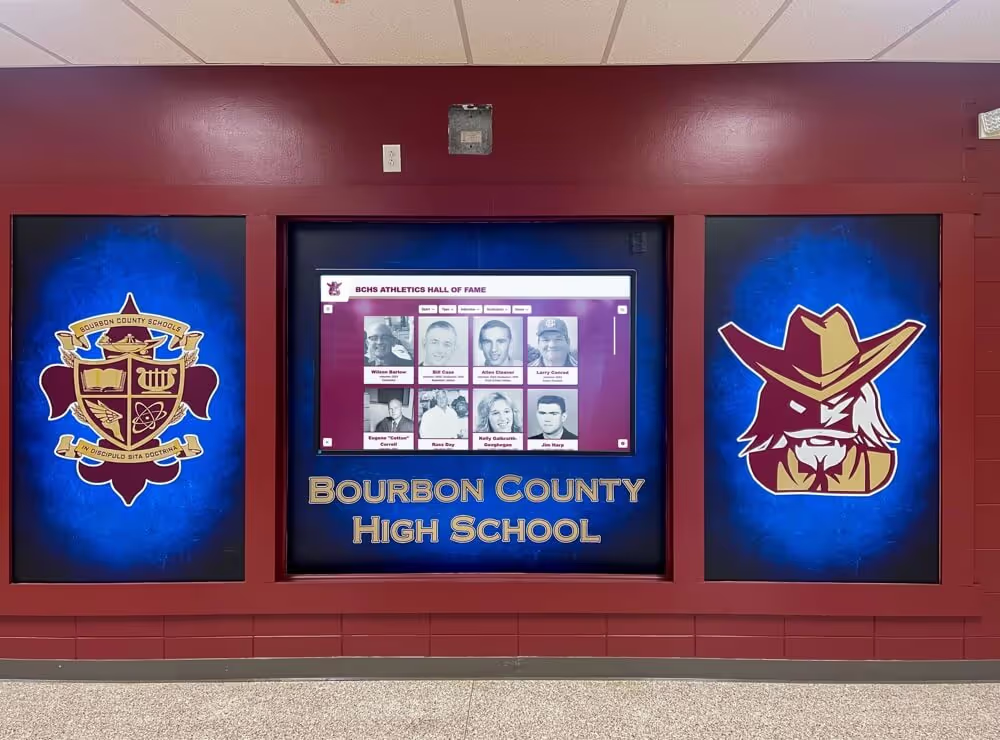
Recognition kiosks inside trophy cases draw from the same database that concurrent import workers write to—SKIP LOCKED queuing ensures those workers process records without blocking each other or producing duplicates on display
What Is PostgreSQL SKIP LOCKED?
SKIP LOCKED is a clause available in SELECT ... FOR UPDATE and SELECT ... FOR SHARE statements in PostgreSQL, introduced in PostgreSQL 9.5. When a query includes SKIP LOCKED, it retrieves only rows that are not currently locked by any other transaction—skipping rows it cannot immediately claim rather than waiting for those locks to be released.
The standard behavior without SKIP LOCKED: if transaction A holds a row lock and transaction B tries to lock the same row, transaction B waits until transaction A commits or rolls back. That is the correct, safe behavior for most database operations—but it is exactly wrong for a work queue. In a queue, waiting on a locked row means waiting on work that another worker is already handling. The waiting worker is idle when it could be processing the next available record.
With SKIP LOCKED, transaction B does not wait. It skips the row transaction A has locked and claims the next available row. Transaction A finishes its record. Transaction B finishes a different record. Both complete sooner, neither blocks the other, and no record is processed twice.
In SQL, the core pattern looks like this:
BEGIN;

SELECT id, athlete_id, award_type, season_year, import_status
FROM award_import_queue
WHERE import_status = 'pending'
ORDER BY queued_at
LIMIT 10
FOR UPDATE SKIP LOCKED;

-- worker processes the selected rows, then marks them complete:
UPDATE award_import_queue
SET import_status = 'completed', processed_at = NOW()
WHERE id = ANY(ARRAY[<selected_ids>]);

COMMIT;
Each worker that runs this transaction claims a batch of up to ten pending rows that no other worker currently holds a lock on. As long as transactions are kept short and committed promptly, multiple workers can run this loop concurrently with no overlap and no contention between them.
Why Athletic Awards Imports Are a Strong Match for SKIP LOCKED Queuing
Several characteristics of school athletic recognition programs make SKIP LOCKED a well-suited pattern for managing concurrent imports rather than a general-purpose technique applied without reason.
Multiple import sources with overlapping schedules. Athletic departments receive recognition data from several sources: the school’s student information system, conference governing bodies, coaches submitting sport-specific rosters, and administrative staff making retroactive corrections. These sources do not coordinate their timing. A conference all-state import job may run at the same moment a coach uploads the letter-award roster. Without a queue, both processes compete for the same destination table simultaneously.
End-of-season concentration of import volume. Award records accumulate throughout the year but are often submitted in bulk at season’s end—when import concurrency peaks and the tolerance for delay or data error is lowest. An awards banquet scheduled for Friday evening requires that all records are visible on the touchscreen display by the time guests arrive. A processing pattern that blocks on lock contention during the Thursday afternoon import window fails at exactly the wrong moment.
Intolerance for duplicate recognition records. A duplicate row in an awards table is not a neutral data artifact. A student recognized twice for the same award in the same season, or an inductee appearing twice in a hall of fame display, damages the credibility of the recognition program and requires manual correction in front of the families and alumni who are most likely to notice it. SKIP LOCKED prevents the duplicate processing that produces duplicate records by ensuring only one worker ever holds a lock on a given queue row.
Small, independent record units. Each athletic award record—one athlete, one award, one season—is a self-contained unit with no dependency on the adjacent records in the queue. This makes batched SKIP LOCKED processing efficient: workers claim batches of 10 to 50 records, process each independently, and commit without coordinating with other workers.
For programs that manage concurrent import coordination using advisory locks as a policy mechanism, SKIP LOCKED is a row-level alternative that removes the need for a separate locking table: the row lock on the queue record itself is the coordination mechanism.

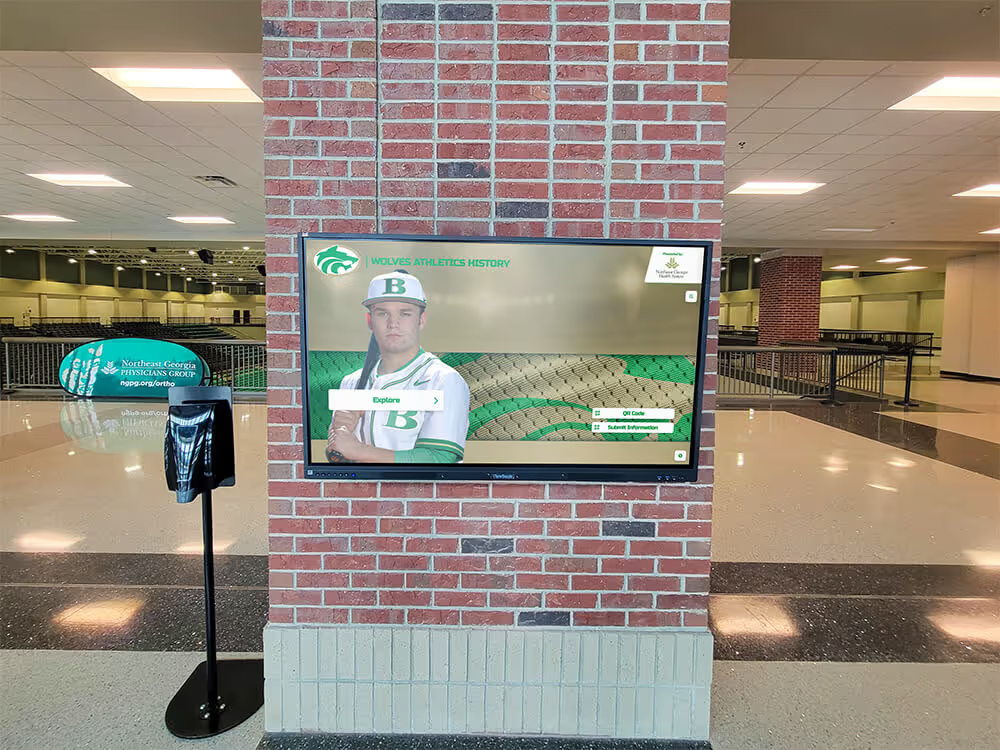
Hall of fame walls that pair traditional shields with digital displays depend on import pipelines that deliver complete, duplicate-free records—SKIP LOCKED queuing ensures concurrent workers process each award exactly once before it appears on screen
Seven-Step Implementation: Building a SKIP LOCKED Queue for Athletic Award Imports
Step 1: Create the Import Queue Table
A SKIP LOCKED queue for athletic award imports requires a dedicated staging table—separate from the primary awards table—that holds incoming records in a pending state until a worker claims and processes them.
CREATE TABLE award_import_queue (
    id            BIGSERIAL PRIMARY KEY,
    athlete_id    BIGINT,
    award_type    TEXT NOT NULL,
    award_category TEXT,
    season_year   TEXT NOT NULL,
    raw_data      JSONB,
    import_source TEXT NOT NULL,
    import_status TEXT NOT NULL DEFAULT 'pending'
                  CHECK (import_status IN ('pending', 'processing', 'completed', 'failed')),
    queued_at     TIMESTAMPTZ NOT NULL DEFAULT NOW(),
    processed_at  TIMESTAMPTZ,
    error_detail  TEXT
);

CREATE INDEX idx_award_import_queue_pending
    ON award_import_queue (queued_at)
    WHERE import_status = 'pending';
The partial index on queued_at WHERE import_status = 'pending' is critical for performance. Without it, every worker’s SKIP LOCKED query scans all rows in the queue table, including completed records that accumulate over time. The partial index keeps the scan focused on the rows workers actually need to claim.
Step 2: Route All Import Sources Through the Queue
Every import source—the student information system connector, the conference data integration, the coach upload interface, and the administrative correction tool—should insert records into the queue table rather than writing directly to the primary awards table.
INSERT INTO award_import_queue
    (athlete_id, award_type, award_category, season_year, raw_data, import_source)
VALUES
    (42, 'letter_award', 'Varsity Football', '2025-26',
     '{"jersey": 22, "grade": 12}', 'coach_upload'),
    (87, 'all_conference', 'Boys Swimming', '2025-26',
     '{"conference": "IHSA", "division": 1}', 'conference_api'),
    (13, 'hall_of_fame', NULL, '2025-26',
     '{"inducted_by": "athletic_director"}', 'admin_interface');
This separation—queue table for intake, awards table for final state—is the architectural decision that makes concurrent processing safe. Workers read from and write to the queue table using row-level locks; they write to the primary awards table only after claiming a record exclusively, one worker per row.
Step 3: Write the Worker Claim Loop
Each worker process runs a loop that claims a batch of pending rows, processes them, and marks them complete. The SKIP LOCKED clause ensures no two workers ever claim the same row.
BEGIN;

WITH claimed AS (
    SELECT id
    FROM award_import_queue
    WHERE import_status = 'pending'
    ORDER BY queued_at
    LIMIT 20
    FOR UPDATE SKIP LOCKED
)
UPDATE award_import_queue
SET import_status = 'processing'
WHERE id IN (SELECT id FROM claimed)
RETURNING *;

COMMIT;
After claiming the batch and setting status to 'processing', the worker applies each record to the primary awards table, then marks each queue row 'completed'. If a record fails validation—for example, because the referenced athlete does not exist in the athletes table—the worker marks it 'failed' and stores the error message in error_detail for staff review.
Step 4: Apply Records to the Awards Table with Upsert
Workers writing to the primary awards table should use INSERT ... ON CONFLICT DO UPDATE (upsert) rather than a plain INSERT. This provides a second line of defense against duplicates. Even if the same record entered the queue twice due to a duplicate upload from a source system, the upsert resolves the conflict without creating a duplicate row.
INSERT INTO athletic_awards
    (athlete_id, award_type, award_category, season_year, source_ref)
VALUES
    ($1, $2, $3, $4, $5)
ON CONFLICT (athlete_id, award_type, season_year)
DO UPDATE SET
    award_category = EXCLUDED.award_category,
    source_ref     = EXCLUDED.source_ref,
    updated_at     = NOW();
The ON CONFLICT clause relies on a unique index on (athlete_id, award_type, season_year). Confirm this index exists before deploying the worker loop. If it does not exist, the upsert falls back to a plain insert and the duplicate-prevention guarantee is lost.
Step 5: Recover from Worker Failures
A worker process can crash between claiming a batch (status 'processing') and completing it (status 'completed'). Without a recovery mechanism, those rows remain stuck in the 'processing' state indefinitely—invisible to other workers, which pass over locked-looking rows.
Add a recovery query that runs on a scheduled basis (every few minutes, or at each worker startup) to reset stuck rows back to 'pending':
UPDATE award_import_queue
SET import_status = 'pending',
    error_detail  = 'reset after processing timeout'
WHERE import_status = 'processing'
  AND queued_at < NOW() - INTERVAL '10 minutes';
The 10-minute threshold should comfortably exceed the maximum expected processing time for any single batch. Records stuck longer than this are almost certainly from a crashed worker rather than an actively running one. Adjust the interval to match observed processing times for the largest batches your program routinely imports.
Step 6: Archive Completed Records on a Schedule
The queue table must not accumulate completed records indefinitely. A growing queue table degrades the performance of the partial index and increases the scan cost for every SKIP LOCKED claim operation. Archive completed and failed records on a scheduled basis:
WITH archived AS (
    DELETE FROM award_import_queue
    WHERE import_status IN ('completed', 'failed')
      AND processed_at < NOW() - INTERVAL '7 days'
    RETURNING *
)
INSERT INTO award_import_queue_archive
SELECT * FROM archived;
The 7-day retention window gives staff time to review failed records before they are moved to the archive. Adjust the interval based on how frequently the recognition coordinator reviews the import error log and resolves outstanding failures.
Step 7: Monitor Queue Depth and Oldest Pending Record
At steady state, the count of rows with import_status = 'pending' should be near zero. A growing queue depth indicates that workers are not keeping pace with intake volume:
SELECT import_status,
       COUNT(*)      AS record_count,
       MIN(queued_at) AS oldest_record
FROM award_import_queue
GROUP BY import_status;
Alert the IT administrator when the pending count exceeds a defined threshold—500 records is a reasonable starting point for a school program—or when the oldest pending record is more than 15 minutes old. The oldest-pending metric catches the case where a single failed record is blocking the head of the queue. With SKIP LOCKED, other workers skip around a locked row, but if a record repeatedly fails validation and is retried without fixing the underlying data error, it can accumulate failed attempts while consuming worker cycles.
Decision Table: SKIP LOCKED vs. Advisory Locks vs. Serial Processing
School database teams have three main options for coordinating concurrent athletic award imports. This table summarizes when each approach fits best.
| Scenario | Best Approach | Why |
|---|---|---|
| Multiple concurrent workers, independent record units, no dependency between rows | SKIP LOCKED | Row-level lock is the coordination mechanism; no external lock table required; workers claim available rows automatically |
| Single import process per operation type, multiple operation types running concurrently | Advisory locks (keyed by operation type) | Advisory locks coordinate at the process level rather than the row level; appropriate when row-level locking adds unnecessary overhead |
| Historical archive migration where parent records must precede child records | Serial processing with explicit ordering | Concurrent workers cannot guarantee processing order; referentially dependent records require sequential or tightly ordered loading |
| Import sources that send the same record multiple times | SKIP LOCKED + upsert | SKIP LOCKED prevents duplicate processing within a run; upsert resolves source-level duplicates at the destination table |
| Low import volume, single staff user, no concurrency | Direct insert to awards table | Queue overhead is not justified when concurrency is not a factor |
| Award records that reference parent entities not yet in the database at import time | Staged queue with deferred retry | Workers that encounter a missing parent should mark the row failed and retry after a delay, rather than claiming the row indefinitely |
How SKIP LOCKED Interacts with Recognition Display Queries
Recognition kiosks, hallway record boards, and web-facing award portals query the primary awards table continuously. If display queries run against the same table that import workers write to, two concerns arise: query performance during bulk imports, and the possibility of a display query reading partially committed records.
Partially committed records are not visible. PostgreSQL’s default isolation level (Read Committed) guarantees that a display query sees only rows that have been fully committed. A worker mid-transaction—having claimed queue rows but not yet committed the corresponding writes to the awards table—is invisible to concurrent display queries. Athletes whose records are in-flight during a worker transaction do not appear on the display until the worker commits. This is correct behavior: a recognition display that shows partially applied import data is worse than one that shows complete, consistent data from the prior import cycle.
Import workers do not lock the awards table during queue processing. Workers hold row-level locks on the queue table during the claim-and-process cycle. The write to the awards table (the upsert) acquires a brief row lock for the duration of a single statement, which resolves in milliseconds. Display queries reading the awards table are not affected by queue-side locking activity.
Kiosk systems that run in secure, locked-down browser environments rely on the recognition database remaining responsive during import windows. Because SKIP LOCKED workers contend only with each other on the queue table—not with display readers on the awards table—kiosk query latency remains unaffected by concurrent import activity throughout the end-of-season import peak.
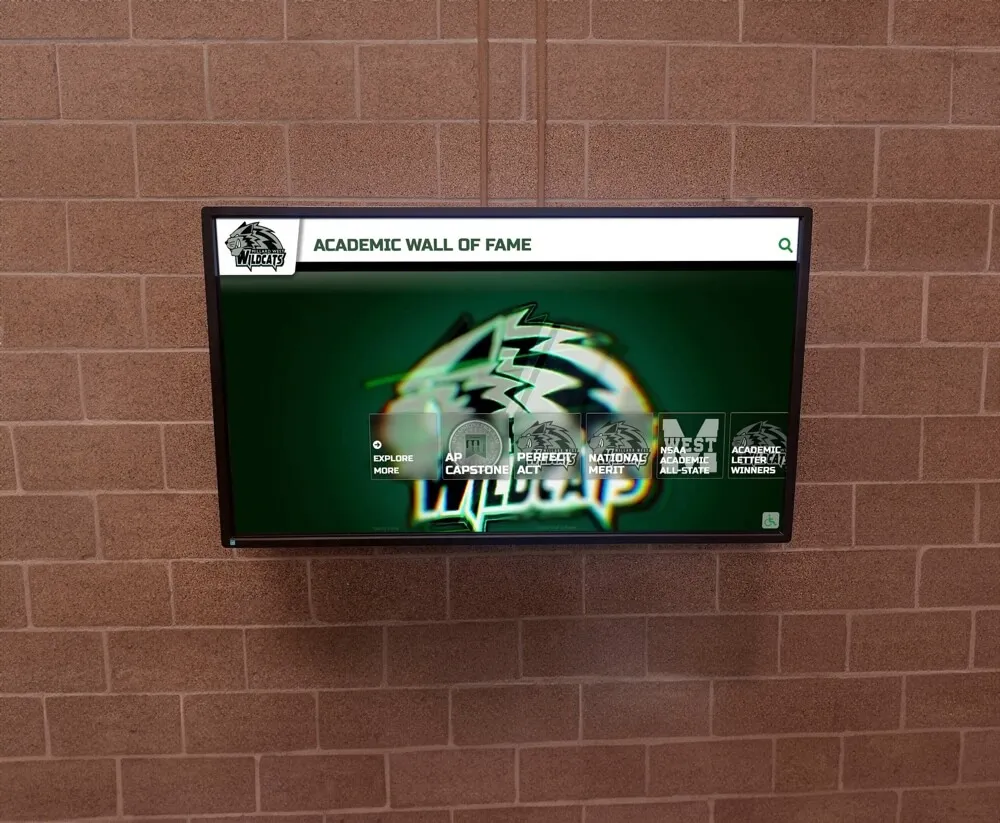
Hallway digital displays and trophy cases serve visitors throughout the day—SKIP LOCKED queuing protects the display query path from import-side lock contention, keeping athlete profiles and award records responsive during even the highest-volume import windows
Accessibility of Recognition Displays During Import Windows
Athletic recognition programs that serve diverse audiences—students, families, alumni, and community visitors—must ensure that display access remains reliable and inclusive during import operations. WCAG 2.1 AA compliant kiosk interfaces, including skip navigation links tested for keyboard navigation, depend on a backend that returns results consistently regardless of what import workers are doing in the background.
Because SKIP LOCKED queuing isolates import contention to the queue table rather than the display-facing awards table, the recognition display remains fully available during even high-volume import windows. Visitors using keyboard navigation, screen readers, or other assistive technology on a kiosk are not affected by the import pipeline’s activity. The separation of concerns between the queue table and the awards table is what makes this isolation possible: displays read from one table while workers write to the other.
Platforms and Managed Recognition Systems
Schools using a purpose-built recognition platform rather than a custom PostgreSQL backend receive concurrent import handling as part of the platform’s infrastructure. Rocket Alumni Solutions manages the import pipeline for connected recognition displays, handling concurrent award record updates through its application layer so that athletic directors and recognition coordinators can push records from any device without configuring database queues directly.
For programs on custom PostgreSQL backends—where a SKIP LOCKED queue is the appropriate implementation—the pattern described in this guide applies directly. The queue table, worker processes, upsert logic, and recovery job are all standard PostgreSQL tooling that a qualified IT administrator or database engineer can deploy and maintain.
School athletic programs operating recognition kiosks in secured, locked-down browser configurations benefit directly from the import-display isolation that SKIP LOCKED provides. Because import-side lock contention is contained to the queue table, the kiosk browser never encounters a stalled page load caused by a blocking import transaction. Visitors browsing athlete profiles and award histories during an active import cycle see the same consistent response times as visitors browsing during off-peak hours.

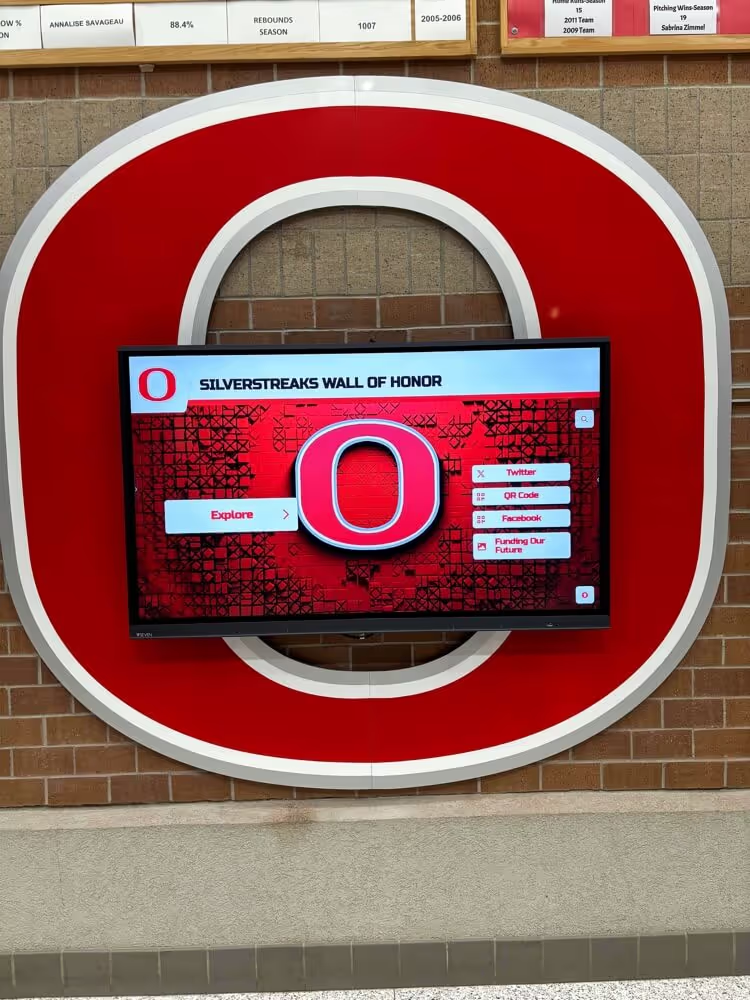
Visitors browsing a hall of fame touchscreen expect immediate responses—SKIP LOCKED queuing protects the display query path from import contention so athlete profiles and award records remain fast and accessible throughout the import cycle
Comparing Concurrent Import Approaches for Recognition Databases
Schools evaluating how to manage concurrent athletic award imports should understand the operational trade-offs between available coordination approaches before choosing a pattern.
| Approach | Concurrency | Duplicate Risk | Failure Recovery | Operational Complexity |
|---|---|---|---|---|
| SKIP LOCKED queue | High — multiple workers in parallel | Low — row-level locks prevent double-processing; upsert handles source duplicates | Defined — stuck rows reset by recovery job on schedule | Moderate — requires queue table, worker loop, recovery job, and archive job |
| Advisory locks | Medium — coordination at operation-type level | Low — advisory locks prevent concurrent runs of same operation type | Requires application-level retry logic | Moderate — requires disciplined advisory lock acquisition and release in every import path |
| Serial import (one worker) | None — single-threaded | Very low — no concurrent access | Simple — retry the single process | Low — no coordination mechanism required |
| Concurrent direct writes (no coordination) | High — unconstrained | High — no mechanism prevents duplicate records from multiple writers | None — partial failures may leave inconsistent data | None — but outcomes are unpredictable under concurrent load |
For end-of-season athletic award imports where multiple sources feed records simultaneously, SKIP LOCKED provides the best combination of throughput, duplicate prevention, and defined failure recovery. Serial processing is appropriate for low-volume programs with a single import source; concurrent direct writes without coordination should be avoided for any program where recognition data quality matters.
For programs exploring how locked-down kiosk environments handle network and download restrictions during import windows, digitalwarming.net’s kiosk lockdown guide covers the browser-level constraints that complement database-level import isolation.
Frequently Asked Questions
What is the difference between SKIP LOCKED and NOWAIT in PostgreSQL?
Both SKIP LOCKED and NOWAIT modify the behavior of SELECT ... FOR UPDATE when the query encounters a row locked by another transaction. NOWAIT raises an error immediately if any row in the result set is already locked—the entire query fails rather than waiting, and the application must decide what to do next. SKIP LOCKED silently omits locked rows from the result, returning only the rows the current transaction can claim immediately. For a work queue where the goal is to process whatever is available rather than fail when a specific row is contested, SKIP LOCKED is the correct choice. NOWAIT is appropriate when a process must handle a specific record and cannot defer it to another worker.
Can SKIP LOCKED cause any rows to be permanently skipped and never processed?
No. A row is skipped only while another transaction holds a lock on it. Once that transaction commits or rolls back, the row becomes available and the next worker pass will claim it. The practical exception is a worker that crashes while holding 'processing' status on a batch—those rows appear locked to other workers because they are stuck at a non-terminal status. The Step 5 recovery job resets them to 'pending' after the configured timeout, making them available again. Without the recovery job, crashed-worker rows would remain invisible to other workers indefinitely.
How many concurrent SKIP LOCKED workers should an athletic awards import queue run?
The right worker count depends on import volume and database server capacity. A practical starting point for a school athletic program is two to four workers during the end-of-season import window. Too few workers means records queue up and take longer to process; too many means workers frequently return empty batches (because all pending rows are already claimed) and add unnecessary load to the database server. Monitor the queue depth and oldest-pending-record metrics from Step 7 and adjust worker count based on observed behavior during the first full import cycle.
Should award import queue workers run inside the school’s existing application server, or as separate processes?
Either architecture works with SKIP LOCKED. Workers can be background threads or coroutines within the application server that handles other recognition workflows, or they can be standalone processes scheduled by a job runner. The critical constraint is that each worker connection to PostgreSQL must be a separate database connection—two workers running on the same connection cannot hold independent row locks, because a single connection can only be in one transaction at a time. Verify that your connection pooling configuration assigns each worker its own dedicated database connection.
What happens if the primary awards table has a unique constraint violation during an upsert?
INSERT ... ON CONFLICT DO UPDATE handles unique constraint violations silently by updating the existing row rather than inserting a new one. If the upsert is configured correctly—with the ON CONFLICT clause specifying the correct unique index columns—the worker never encounters a runtime unique violation. If the ON CONFLICT clause is missing or specifies the wrong columns, PostgreSQL raises a unique violation error, and the worker should catch it, mark the queue row 'failed', and record the error detail so staff can investigate the duplicate source data.
Does SKIP LOCKED work with PostgreSQL partitioned tables?
Yes. SELECT ... FOR UPDATE SKIP LOCKED works with partitioned tables in PostgreSQL 11 and later. If the import queue table is partitioned—for example, by import date or status—workers issue the SKIP LOCKED query against the parent partitioned table, and PostgreSQL routes the lock operations to the appropriate child partitions automatically. Ensure partition-specific partial indexes exist to support efficient SKIP LOCKED claim queries within each partition; a parent-table index does not automatically create matching indexes on child partitions in all PostgreSQL versions.
Building Concurrent Award Imports That Protect Recognition Quality
An athletic awards database postgres skip locked queue is the structured pattern for athletic programs that need multiple import sources to run concurrently without producing duplicate records, blocked updates, or stalled recognition displays. The pattern is PostgreSQL-native, requires no external coordination service, and scales from a single worker during low-volume periods to several workers during the end-of-season import peak—while keeping display queries fast and accessible throughout.
Programs that implement SKIP LOCKED queuing gain predictable import behavior: each award record is processed exactly once, failed records are recoverable through the error log, and the primary awards table remains fully available to the kiosks, record boards, and portals that students, families, and visitors use to celebrate school achievements.
Rocket Alumni Solutions provides schools and athletic programs with a fully managed recognition platform that handles concurrent award record updates, bulk uploads, and duplicate detection through its application layer—without requiring database queue configuration from school IT staff. The platform is trusted by 600+ institutions, supports unlimited award categories and inductees, is fully WCAG 2.1 AA compliant, and operates on any touchscreen from 32 to 100 inches.
If your program is building the import infrastructure that makes a reliable, public-facing recognition display possible, request a custom demo and see how Rocket Alumni Solutions handles concurrent award record updates for programs that recognize athletes, academic achievers, arts participants, and community contributors without data quality gaps or display interruptions.