



Direct answer. An athletic awards database VACUUM FREEZE policy is a set of per-table and server-level PostgreSQL parameters — primarily autovacuum_freeze_max_age, vacuum_freeze_table_age, and vacuum_freeze_min_age — that control how often PostgreSQL’s freeze process runs against recognition database tables, protecting long-lived athlete records, season histories, award entries, and honoree profiles from the transaction-ID (XID) wraparound failure that causes PostgreSQL to refuse all writes when the 32-bit transaction counter approaches its two-billion-transaction limit.
This guide explains what transaction-ID wraparound is, why athletic recognition databases accumulate freeze risk faster than typical applications, how to write and apply a table-level VACUUM FREEZE policy in eight steps, how to monitor remaining XID headroom, what to do when freeze debt approaches the emergency threshold, and how to verify the policy is working before wraparound becomes an operational threat.
An athletic awards database VACUUM FREEZE policy sits at the intersection of two realities that most school IT teams do not encounter until the problem becomes urgent: PostgreSQL’s transaction-ID counter is finite, and athletic recognition databases are unusually good at exhausting it invisibly.
Every transaction that touches a PostgreSQL database — every SELECT wrapped in an explicit BEGIN, every INSERT, every UPDATE, every DELETE, every autovacuum cycle — consumes one transaction ID from a 32-bit counter that wraps around after approximately two billion uses. PostgreSQL freezes old row versions to mark them as pre-dating all active transactions, allowing their XID stamps to be safely discarded. When freeze work falls too far behind the advancing transaction counter, PostgreSQL takes increasingly drastic self-protection measures: first triggering emergency autovacuum passes, then entering a read-only shutdown mode that refuses all writes until a manual VACUUM FREEZE clears the backlog.
For a recognition database that holds twenty years of athletic records, hall of fame inductees, championship rosters, and individual award histories — records that are inserted once and rarely modified — the risk is not that transactions accumulate quickly. The risk is that rows inserted during founding-year imports carry XID stamps from the very beginning of the database’s life and grow older every day without being frozen, while the transaction counter advances through routine autovacuum cycles, monitoring queries, and mid-season import sessions. Without a deliberate freeze policy, the gap between those old row versions and the current transaction counter grows silently until it crosses PostgreSQL’s safety thresholds.

Recognition displays powered by long-lived PostgreSQL databases accumulate transaction-ID freeze debt on historical award records — a VACUUM FREEZE policy ensures that debt is cleared on a predictable schedule rather than accumulating until PostgreSQL enters emergency read-only mode
What Is Transaction-ID Wraparound and Why It Threatens Athletic Award Records
PostgreSQL identifies every row version with the transaction ID of the transaction that created it. This XID is a 32-bit unsigned integer, which gives PostgreSQL a maximum of approximately 2.1 billion distinct transaction IDs before the counter wraps back to zero. Because transaction comparison in PostgreSQL is modular — designed to correctly identify which of any two XIDs is “older” — a wrapped-around counter would make rows created before the wrap appear newer than rows created after it. PostgreSQL prevents this by refusing to let any table’s oldest unfrozen XID fall more than two billion transactions behind the current counter.
The freeze mechanism is PostgreSQL’s solution: rows are periodically updated with a special “frozen” marker that replaces their XID with a value recognized as older than all possible live transactions. Once frozen, a row’s age no longer advances relative to the current XID counter, and its slot in the two-billion-transaction safety margin is permanently reclaimed.
Four configuration parameters govern when freezing occurs:
vacuum_freeze_min_age— rows younger than this (in transactions) are not frozen even during explicitVACUUM FREEZEpasses. Default: 50,000,000. Lowering it to 10,000,000–25,000,000 allows rows to be frozen earlier in their life cycle.vacuum_freeze_table_age— when a table’s oldest unfrozen XID is older than this, VACUUM scans the entire table rather than only the pages changed since the last VACUUM, ensuring no old rows are missed. Default: 150,000,000.autovacuum_freeze_max_age— when a table’s oldest unfrozen XID exceeds this age, autovacuum triggers a forced freeze pass regardless of whether any other autovacuum threshold has been crossed. Default: 200,000,000. This is the parameter most commonly set at the table level to spread freeze work earlier.vacuum_multixact_freeze_min_ageand related multixact parameters — govern freeze behavior for rows involved in row-level lock sharing; these rarely require tuning for athletic recognition databases.
The practical danger threshold: when any table’s relfrozenxid age exceeds 1,600,000,000 (1.6 billion), PostgreSQL begins issuing WARNING: database "dbname" must be vacuumed within N transactions messages. At approximately 1,900,000,000, autovacuum runs emergency passes. At 2,000,000,000 minus a small safety margin, PostgreSQL enters read-only mode and logs ERROR: database is not accepting commands to avoid wraparound data loss in database "dbname". At that point, a DBA must connect as a superuser and run VACUUM FREEZE manually before any writes resume.
For athletic recognition programs that manage facility and database upkeep alongside recognition displays — the athletic facility management guide at digitalyearbook.org covers the maintenance discipline these programs require — a database entering emergency read-only mode during an awards ceremony or hall of fame induction is exactly the kind of preventable failure that a proactive freeze policy eliminates.
Why Athletic Award Databases Accumulate Freeze Debt Faster Than Expected
The transaction-ID wraparound risk is not primarily a function of how many transactions a database processes — it is a function of how old the oldest unfrozen row in any table becomes. Athletic recognition databases have three structural properties that cause freeze debt to accumulate faster than their low write volume would suggest.
Long-lived founding records. When a school launches a digital recognition program and migrates its historical archive — records from the 1970s, 1980s, and 1990s transcribed from printed programs, yearbooks, and physical trophy plaques — those founding records receive XID stamps from the first sessions of the database’s life. They are inserted once and never modified. Unless a freeze policy ensures that autovacuum runs freeze passes over those tables regularly, those founding-year rows grow older relative to the current XID counter every day, accumulating freeze debt even during off-seasons when the database processes almost no application transactions.
Low transaction volume masking dangerous table age. A self-managed athletic recognition database hosted on a school server may process only a few thousand transactions per day outside of import windows. At that rate, advancing 200 million transactions — the default autovacuum_freeze_max_age — takes roughly 55 years of continuous operation at steady rates. But autovacuum’s freeze threshold is measured not against wall-clock time but against the XID counter. If the database also hosts other applications, runs routine health-check queries in explicit transactions, or accumulates autovacuum cycles from unrelated tables, the XID counter advances faster than the recognition-specific transaction rate alone would suggest.
Concentrated import windows followed by long read-only periods. Season-end imports process hundreds or thousands of transactions in a compressed window, advancing the XID counter significantly in a short time. After the import, the database returns to a low-transaction read-mostly state. The XID counter advances slowly during that quiet period, but the gap between the counter and the age of founding-year records — which still carry their original XIDs — continues to widen.
Cross-country and track programs that maintain athlete records spanning multiple seasons, including the cumulative recognition histories described in the cross-country awards recognition guide at halloffame-online.com, accumulate exactly this kind of long-lived, rarely-modified record set — the category most vulnerable to XID freeze debt buildup.
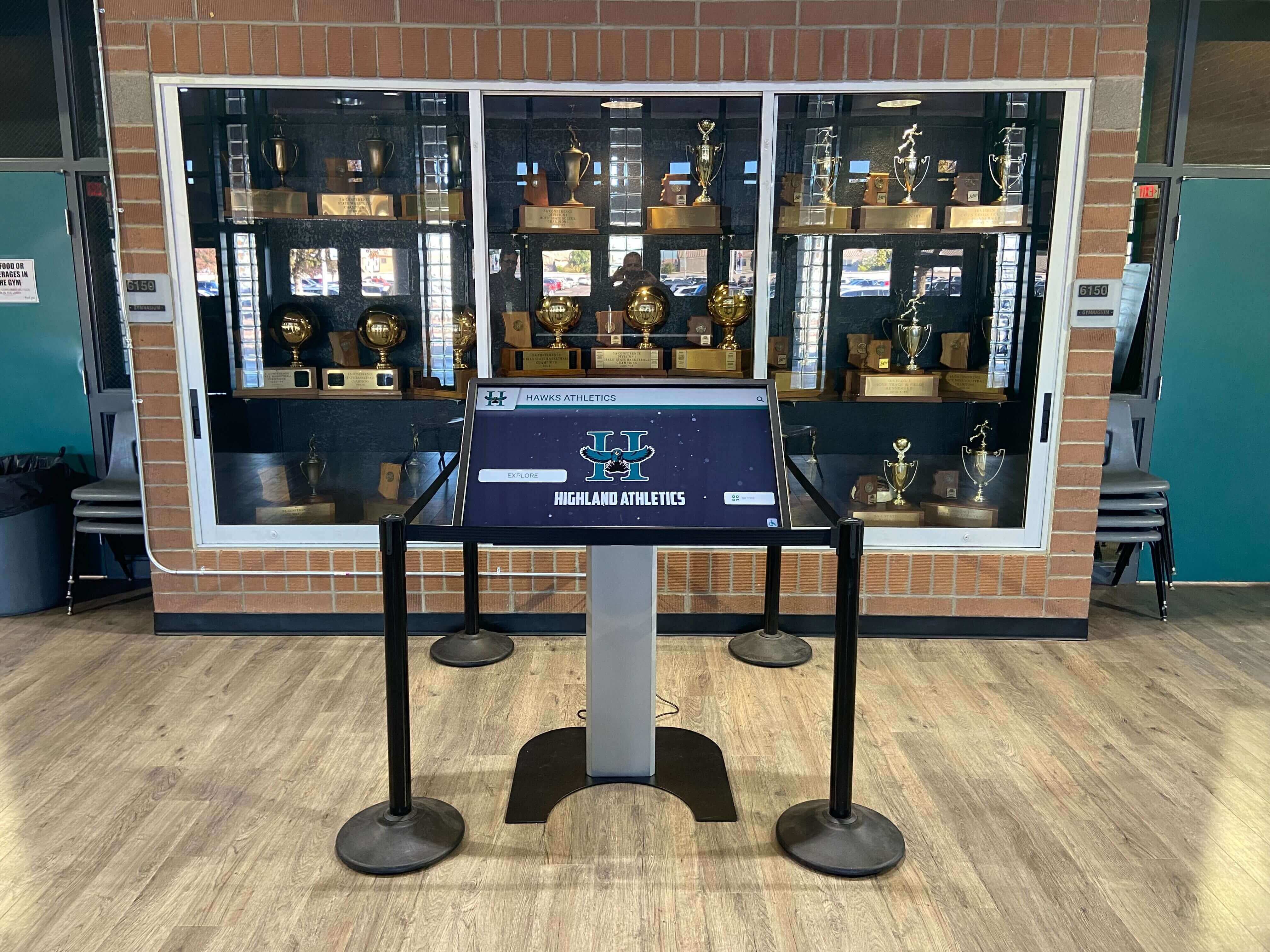
Touchscreen kiosks embedded in school trophy cases surface decades of athletic recognition data — the oldest records in those databases carry XID stamps from founding import sessions and require a proactive VACUUM FREEZE policy to prevent freeze debt from accumulating to the wraparound threshold
Athletic Awards Database VACUUM FREEZE Policy: Step-by-Step
The following eight steps apply to any PostgreSQL-backed athletic recognition database, from a single-school program with a few hundred records to a multi-campus archive spanning multiple decades.
Step 1: Measure current freeze debt for all award tables
Before configuring any policy, establish the current freeze debt baseline. The age() function on relfrozenxid returns the number of transactions between the oldest unfrozen XID in a table and the current transaction counter:
-- Measure freeze age for all award-related tables
SELECT
    relname                                    AS table_name,
    age(relfrozenxid)                          AS xid_age,
    2000000000 - age(relfrozenxid)             AS transactions_until_forced_freeze,
    pg_size_pretty(pg_total_relation_size(oid)) AS table_size
FROM pg_class
WHERE relkind = 'r'
  AND relnamespace = 'public'::regnamespace
ORDER BY age(relfrozenxid) DESC;
Also check the database-level freeze debt, which represents the oldest unfrozen XID across all tables in the database:
SELECT
    datname,
    age(datfrozenxid)                          AS db_xid_age,
    2000000000 - age(datfrozenxid)             AS transactions_until_emergency
FROM pg_database
WHERE datname = current_database();
Record the xid_age for each award table and the db_xid_age. Any table showing an age above 150,000,000 should be treated as a priority target for an immediate VACUUM FREEZE and a tighter ongoing policy.
Step 2: Identify tables with the oldest unfrozen rows
The tables with the highest age(relfrozenxid) are the ones that require the most urgent attention and the tightest per-table freeze policy. In a typical athletic recognition schema, the highest-age tables are usually the ones populated during the founding archive import:
athletes— populated in bulk during initial digitization, then updated incrementallyawards— founding-year award records inserted once and never modifiedseasons— reference table populated at database creation with historical season recordssportsandaward_types— reference tables with rows from initial schema setup
Tables populated through ongoing seasonal imports tend to have lower ages because their rows are newer. The freeze policy should be tightest for the tables whose oldest rows date from the earliest import sessions.
Step 3: Set autovacuum_freeze_max_age per table
Lower the per-table autovacuum_freeze_max_age to ensure autovacuum runs freeze passes before the default 200-million-transaction threshold is reached. A value of 100,000,000 to 150,000,000 triggers freeze passes earlier and distributes the freeze work across more autovacuum cycles:
ALTER TABLE awards SET (autovacuum_freeze_max_age = 100000000);
ALTER TABLE athletes SET (autovacuum_freeze_max_age = 100000000);
ALTER TABLE seasons SET (autovacuum_freeze_max_age = 100000000);
ALTER TABLE sports SET (autovacuum_freeze_max_age = 100000000);
ALTER TABLE award_types SET (autovacuum_freeze_max_age = 100000000);
With autovacuum_freeze_max_age = 100000000, autovacuum triggers a freeze pass on each table once its oldest unfrozen XID reaches 100 million transactions old — half the default threshold. The freeze work is spread across more frequent, smaller passes rather than concentrated in infrequent emergency passes.
Step 4: Lower vacuum_freeze_min_age to allow earlier freezing
The vacuum_freeze_min_age parameter controls the minimum XID age before a row is eligible for freezing during a VACUUM pass. The default of 50,000,000 means rows that are less than 50 million transactions old are skipped during freeze passes — a sensible default for high-write systems where recently inserted rows might still be visible to open transactions, but unnecessarily conservative for an athletic recognition database where rows inserted during a season-end import are never accessed by long-running transactions.
Lower this value at the server level (or per-table where possible) to allow freeze passes to process a larger fraction of each table’s rows:
-- Server-level setting (requires postgresql.conf edit or ALTER SYSTEM)
ALTER SYSTEM SET vacuum_freeze_min_age = 10000000;
SELECT pg_reload_conf();
With vacuum_freeze_min_age = 10000000, rows older than 10 million transactions are eligible for freezing during any VACUUM FREEZE pass, compared to 50 million with the default. On a recognition database where founding-year records are millions of transactions old at creation, this allows the first freeze pass to process essentially the entire historical archive.
Step 5: Lower vacuum_freeze_table_age to trigger whole-table scans earlier
When a table’s oldest unfrozen XID exceeds vacuum_freeze_table_age, PostgreSQL’s VACUUM switches from scanning only modified pages to scanning the entire table, ensuring that all old rows — including those on pages that have not been modified since the last VACUUM — are processed by the freeze pass. The default is 150,000,000 transactions.
Lower this to 80,000,000–100,000,000 for award tables to trigger whole-table freeze scans before the autovacuum_freeze_max_age threshold is reached:
-- Server-level: triggers whole-table scan earlier
ALTER SYSTEM SET vacuum_freeze_table_age = 80000000;
SELECT pg_reload_conf();
For a database that receives few page-level modifications between import windows, this setting ensures that freeze passes are comprehensive rather than missing old rows on unmodified pages.
Step 6: Schedule explicit VACUUM FREEZE after each major import
Even with tuned autovacuum parameters, there is a window between when an import completes and when autovacuum’s freeze threshold is triggered. For programs that load a full season’s data and immediately open the database to hall of fame display traffic, close that window by running an explicit VACUUM FREEZE on the high-risk tables immediately after the import completes:
-- Run after each major seasonal import
VACUUM FREEZE VERBOSE awards;
VACUUM FREEZE VERBOSE athletes;
VACUUM FREEZE VERBOSE seasons;
The VERBOSE flag outputs freeze statistics — including how many pages were scanned, how many rows were frozen, and the new relfrozenxid after the pass — which should be captured in the import log for the quarterly review.
For large archives, VACUUM FREEZE can be I/O intensive. Schedule it during a low-traffic window, or use vacuum_cost_delay to throttle the I/O footprint if the database must remain responsive to interactive display queries during the freeze pass.
Step 7: Configure a monitoring alert for XID age thresholds
A VACUUM FREEZE policy is only effective if someone is notified when freeze debt approaches a dangerous level. Set up a monitoring query — via pg_cron, a cron job, or an external monitoring tool — that alerts when any table’s relfrozenxid age crosses 500,000,000 (25% of the two-billion-transaction limit):
-- Returns rows only when a table's XID age is approaching a concerning threshold
-- Schedule with pg_cron: SELECT cron.schedule('daily-freeze-check', '0 7 * * *', $$...$$);
SELECT
    relname                       AS table_name,
    age(relfrozenxid)             AS xid_age,
    CASE
        WHEN age(relfrozenxid) > 1500000000 THEN 'CRITICAL — vacuum freeze immediately'
        WHEN age(relfrozenxid) > 1000000000 THEN 'WARNING — schedule vacuum freeze within one week'
        WHEN age(relfrozenxid) > 500000000  THEN 'ADVISORY — review freeze policy settings'
        ELSE 'OK'
    END                           AS freeze_status
FROM pg_class
WHERE relkind = 'r'
  AND relnamespace = 'public'::regnamespace
  AND age(relfrozenxid) > 500000000
ORDER BY age(relfrozenxid) DESC;
Any row returned by this query should trigger a review of the autovacuum freeze policy and, if the status is WARNING or CRITICAL, an immediate VACUUM FREEZE pass on the flagged tables.
Recognition programs that maintain keyboard-accessible digital displays — where consistent uptime is required for visitors with assistive technology, as described in the digital hall of fame keyboard navigation checklist at halloffametouchscreen.com — cannot afford unplanned database downtime caused by preventable XID exhaustion. A daily monitoring alert is the lowest-effort safeguard against that outcome.
Step 8: Document the policy and schedule quarterly reviews
Record the freeze policy configuration in the database maintenance runbook alongside:
- The current
age(relfrozenxid)for each award table as of the policy implementation date - The
autovacuum_freeze_max_ageandvacuum_freeze_table_agevalues applied - The rationale for the chosen thresholds
- The schedule for explicit post-import
VACUUM FREEZEruns - The monitoring alert thresholds and the on-call contact for freeze-related alerts
Review the policy each quarter. If the database has grown significantly — through archive expansion, new school integrations, or a new category of recognition records — recalculate the freeze risk from the updated row volumes and XID ages.

Athletic recognition walls depend on databases that are available and writable at any moment — a VACUUM FREEZE policy with quarterly review and daily monitoring keeps XID age from accumulating to the threshold where PostgreSQL would refuse all writes
VACUUM FREEZE Configuration Reference for Athletic Award Tables
Use this table as a starting-point reference when configuring the freeze policy. Adjust values based on the age of your founding archive records and the transaction volume your database processes between import windows.
| Parameter | Default Value | Recommended for Award Tables | Where to Apply | Effect |
|---|---|---|---|---|
autovacuum_freeze_max_age | 200,000,000 | 100,000,000 | Per-table ALTER TABLE SET | Forces freeze pass when table XID age reaches this value |
vacuum_freeze_table_age | 150,000,000 | 80,000,000–100,000,000 | postgresql.conf or ALTER SYSTEM | Triggers whole-table scan (not just dirty pages) at this age |
vacuum_freeze_min_age | 50,000,000 | 10,000,000–25,000,000 | postgresql.conf or ALTER SYSTEM | Minimum row age before freeze eligibility during VACUUM FREEZE |
| Monitoring alert threshold (advisory) | — | 500,000,000 | Monitoring script | Early warning to schedule a review |
| Monitoring alert threshold (warning) | — | 1,000,000,000 | Monitoring script | Trigger scheduled VACUUM FREEZE within one week |
| Monitoring alert threshold (critical) | — | 1,500,000,000 | Monitoring script | Trigger immediate VACUUM FREEZE |
| PostgreSQL emergency threshold | ~1,600,000,000 | N/A | System-enforced | Warning messages begin appearing in server logs |
| PostgreSQL read-only threshold | ~2,000,000,000 | N/A | System-enforced | All writes refused until VACUUM FREEZE completes |
The most impactful single change for a recognition database carrying a multi-decade historical archive is lowering autovacuum_freeze_max_age from the default 200,000,000 to 100,000,000 at the table level. This doubles the frequency of autovacuum-triggered freeze passes on the oldest tables and proportionally reduces the maximum freeze debt those tables can accumulate between automated maintenance cycles.
Monitoring XID Age and Verifying Freeze Progress
Applying a VACUUM FREEZE policy produces no benefit if the configuration changes are not reflected in the actual freeze progress of the award tables. Use these queries to verify that freeze passes are running at the intended frequency and that XID ages are decreasing after each maintenance cycle.
Check freeze progress after a policy change:
-- Run immediately after applying the policy, then again after the first autovacuum cycle
SELECT
    relname,
    age(relfrozenxid)                               AS current_xid_age,
    last_autovacuum,
    n_dead_tup
FROM pg_stat_user_tables
JOIN pg_class ON pg_class.relname = pg_stat_user_tables.relname
WHERE pg_stat_user_tables.schemaname = 'public'
  AND pg_stat_user_tables.relname IN ('awards', 'athletes', 'seasons', 'sports', 'award_types')
ORDER BY age(relfrozenxid) DESC;
After the first autovacuum freeze pass triggered by the new autovacuum_freeze_max_age, the current_xid_age for the affected tables should decrease — confirming that rows are being frozen and their XID stamps are being replaced with the frozen marker.
Verify per-table storage parameters are saved:
-- Confirm that ALTER TABLE SET parameters are recorded
SELECT relname, reloptions
FROM pg_class
WHERE relname IN ('awards', 'athletes', 'seasons', 'sports', 'award_types')
  AND reloptions IS NOT NULL;
The reloptions column should list autovacuum_freeze_max_age=100000000 for each configured table. A null result means the ALTER TABLE SET did not apply — check for permission issues or a connection to the wrong schema.
Run an explicit VACUUM FREEZE and capture output:
-- Run as a database superuser or table owner
VACUUM (FREEZE, VERBOSE, ANALYZE) awards;
The verbose output shows: number of pages scanned, number of tuples frozen, the new relfrozenxid value after the pass, and whether the entire table was scanned (versus only dirty pages). Capture this output in the import log for each maintenance window.
Recognition programs that publish filter-based athletic displays — where visitors browse by sport, year, or award category, as covered in the digital hall of fame filter chips guide at touchscreenrecognition.com — depend on database availability at exactly the moments when year-end recognition events drive the highest visitor traffic. A VACUUM FREEZE policy that prevents emergency read-only mode is a prerequisite for that availability guarantee.
Emergency Procedure: When XID Age Approaches the Critical Threshold
If monitoring reveals that a table’s relfrozenxid age has crossed 1,500,000,000 — or if PostgreSQL itself begins logging wraparound warnings — treat the situation as a priority incident and execute the following steps immediately.
Step 1: Verify the scope of the problem
-- Identify all tables with critical XID age
SELECT relname, age(relfrozenxid) AS xid_age
FROM pg_class
WHERE relkind = 'r'
  AND relnamespace = 'public'::regnamespace
ORDER BY age(relfrozenxid) DESC
LIMIT 20;
Step 2: Run VACUUM FREEZE on the highest-age tables immediately
Connect as a superuser and run:
VACUUM FREEZE awards;
VACUUM FREEZE athletes;
VACUUM FREEZE seasons;
For very large tables with high XID ages, these commands may run for several minutes to an hour depending on table size. Do not interrupt them — an interrupted VACUUM FREEZE does not roll back but also does not complete the freeze of all eligible rows, leaving some pages partially frozen. Let each complete before starting the next.
Step 3: Confirm the XID age has decreased
SELECT relname, age(relfrozenxid) FROM pg_class
WHERE relkind = 'r' AND relname IN ('awards', 'athletes', 'seasons');
The age(relfrozenxid) should now reflect the XID at the time the VACUUM FREEZE ran — typically within the last few thousand transactions — confirming that the freeze debt has been cleared.
Step 4: Tighten the freeze policy to prevent recurrence
After resolving the immediate risk, lower autovacuum_freeze_max_age further — to 50,000,000 if necessary — and add an explicit post-import VACUUM FREEZE to the import runbook. The emergency procedure is a symptom of a freeze policy gap; tightening the policy ensures the gap does not reopen.
Physical recognition programs that manage sports graphic assets and championships histories alongside digital databases — the kind of program described in the sports graphic design templates guide at rocketgraphics.ai — understand that maintenance disciplines span both physical and digital layers. The VACUUM FREEZE policy is the digital equivalent of a preventive maintenance schedule for physical display hardware: it costs time on a routine basis and avoids a far larger cost when a failure forces an unplanned emergency.
VACUUM FREEZE Policy and Other Athletic Database Maintenance Disciplines
A VACUUM FREEZE policy does not operate in isolation. It interacts with the broader set of PostgreSQL maintenance disciplines that keep a recognition database performing reliably across seasonal import cycles and long-term archive growth.
Interaction with autovacuum policy. A well-configured autovacuum policy (covering autovacuum_vacuum_scale_factor and autovacuum_analyze_scale_factor) keeps table bloat and planner statistics current — but autovacuum’s primary passes do not perform freezing unless the autovacuum_freeze_max_age threshold has been crossed. A recognition database that has a well-tuned bloat policy but no dedicated freeze policy may have clean, compact tables with dangerously old unfrozen rows. Both policies are necessary.
Interaction with index maintenance. Index bloat accumulates when VACUUM does not reclaim dead index entries quickly enough. A freeze-focused VACUUM pass covers the heap (the main table storage) but also updates index pages to reflect frozen row versions. Scheduling a combined VACUUM FREEZE ANALYZE — which handles bloat, statistics, and freeze in a single pass — is more efficient than running these operations separately.
Interaction with backup and restore procedures. A pg_dump backup captures the logical content of the database but does not capture the current XID state. After restoring a backup to a new server, the restored database starts with a fresh XID counter — all rows appear young relative to the new counter — but relfrozenxid values from before the backup are preserved. Verify freeze ages immediately after any restore to confirm the newly initialized transaction counter does not create a misleading low-age reading that conceals rows that still carry old XID stamps.
Interactive displays used by schools to present comprehensive recognition records — including the engagement-oriented touchscreen systems described in the interactive church information display guide at touchscreenwebsite.com — share the same availability requirements as athletic hall of fame kiosks: records must be writable and queryable without interruption. A VACUUM FREEZE policy is one of the foundational maintenance disciplines that makes that guarantee possible.
Academic recognition archives that run alongside athletic records — including honor societies like those described in the National Junior Honor Society requirements guide at touchwall.tv — add another category of long-lived, rarely-modified records that accumulate freeze debt. Schools that maintain both athletic and academic recognition in the same PostgreSQL database should apply the same per-table freeze policy to every table containing historical records, not just the core athletic award tables.
Graduation recognition programs that preserve long-running student honor histories — including the kinds of milestone records associated with the graduation cap decoration guide at touchhalloffame.us — accumulate annual record additions that, like athletic awards, are inserted once and remain in the database for decades. These tables are equally vulnerable to XID freeze debt and should be included in the VACUUM FREEZE policy scope.
Student athletes interacting with lobby recognition screens depend on a database that is never taken offline by preventable transaction-ID wraparound — a VACUUM FREEZE policy with daily monitoring and quarterly review keeps that risk at zero
How Purpose-Built Recognition Platforms Eliminate Wraparound Risk
Schools that manage athletic award records through a purpose-built, cloud-hosted digital recognition platform shift XID wraparound risk — and all associated database maintenance responsibility — to the platform provider. Platform-managed PostgreSQL instances include automated VACUUM FREEZE scheduling, proactive XID age monitoring, and DBA-on-call response for any freeze emergency as part of the managed service layer. Athletic directors and school IT teams do not need to configure autovacuum_freeze_max_age, run manual VACUUM FREEZE sessions, or interpret PostgreSQL wraparound warning messages.
The operational advantages that eliminate wraparound risk in managed platforms include:
Automated freeze scheduling. Platform-managed databases run VACUUM FREEZE passes on a defined schedule keyed to the platform’s transaction volume patterns — timed to the post-import maintenance window rather than relying on autovacuum’s threshold-based triggering alone.
Proactive XID age monitoring. Database health dashboards track relfrozenxid age for all recognition tables continuously. An alert fires when any table’s XID age crosses the advisory threshold (500,000,000), giving the platform’s DBA team time to schedule a preventive VACUUM FREEZE before the warning threshold (1,000,000,000) is reached.
No direct database access required. Athletic directors, coordinators, and IT staff interact with recognition records through a managed web CMS. The database layer — including all freeze maintenance — is handled by the platform’s infrastructure team. Wraparound risk does not surface as an operational concern for school staff.
Managed migration tooling. When a school migrates a historical archive into the platform, the migration pipeline includes a post-migration VACUUM FREEZE pass that resets the XID age baseline for all imported records before the first application query runs. The database enters production with a known-good freeze state rather than carrying unresolved freeze debt from the source system.
Trusted by 600+ institutions, Rocket Alumni Solutions’ cloud-based digital recognition platform handles all database maintenance — including VACUUM FREEZE scheduling, XID age monitoring, and emergency response — so athletic departments can focus on recognizing student athletes rather than managing PostgreSQL internals. The platform’s CMS supports unlimited inductees, categories, and multimedia content, with WCAG 2.1 AA compliant displays on any screen from 32" to 100"+.
FAQ: Athletic Awards Database VACUUM FREEZE Policy
What is an athletic awards database VACUUM FREEZE policy?
An athletic awards database VACUUM FREEZE policy is a set of PostgreSQL parameters — primarily autovacuum_freeze_max_age, vacuum_freeze_table_age, and vacuum_freeze_min_age — that control how often freeze passes run against recognition tables. Without a policy, PostgreSQL’s defaults allow freeze debt to accumulate on historical award records until emergency autovacuum or database-level read-only mode intervenes.
What is transaction-ID wraparound in PostgreSQL?
PostgreSQL assigns a 32-bit transaction ID (XID) to every row version. After approximately 2.1 billion transactions, that counter wraps around. PostgreSQL freezes old rows to prevent them from appearing newer than current rows after a wraparound. When any table’s oldest unfrozen XID falls more than two billion transactions behind the current counter, PostgreSQL enters read-only mode and refuses all writes until VACUUM FREEZE completes.
Why are athletic award databases at risk of transaction-ID wraparound?
Athletic recognition databases hold long-lived, rarely-modified records — founding-year award entries, historical athlete profiles, and decades-old season archives. These rows carry XID stamps from the database’s earliest sessions and grow older every day, even during off-seasons when few application transactions run. Without a freeze policy, that age gap accumulates silently until it approaches the wraparound threshold.
How do I check whether my athletic award database has freeze debt?
Run SELECT relname, age(relfrozenxid) AS xid_age FROM pg_class WHERE relkind = 'r' ORDER BY age(relfrozenxid) DESC. Ages above 500,000,000 warrant a policy review; above 1,000,000,000 warrant a scheduled VACUUM FREEZE; above 1,500,000,000 should be treated as an incident requiring immediate VACUUM FREEZE.
What is the safest autovacuum_freeze_max_age for an athletic recognition database?
For most recognition databases with a multi-decade historical archive, autovacuum_freeze_max_age = 100000000 (half the default) is a practical starting point. It doubles the frequency of autovacuum-triggered freeze passes and proportionally limits the maximum freeze debt any table can accumulate. For very old archives with low transaction volume, 50,000,000 provides additional safety margin.
A Freeze Policy That Protects Decades of Athletic Recognition History
An athletic awards database VACUUM FREEZE policy is not a one-time configuration task — it is a standing maintenance discipline that grows more important as a recognition archive ages and the XID gap between founding-year records and the current transaction counter widens. The eight-step process in this guide gives any school IT team or database administrator the tools to measure current freeze debt, apply table-level configuration parameters, schedule explicit post-import VACUUM FREEZE passes, monitor XID age daily, and respond to approaching emergency thresholds before they become production incidents.
The cost of a well-configured freeze policy is a few hours of initial setup and a quarterly review cadence. The cost of skipping it — a database that enters emergency read-only mode during an awards ceremony, a hall of fame induction, or a season-end display refresh — is far higher: unplanned downtime, a time-sensitive manual DBA intervention, and the reputational impact of a recognition program that goes dark at the moment it is most needed.
Schools that have built recognition archives spanning multiple decades of athletic achievement have made a long-term investment in institutional memory. An athletic awards database VACUUM FREEZE policy ensures that investment is protected by the maintenance discipline it requires — and that the athletes, families, and alumni whose records live in that archive can always access the recognition they earned.
Move Your Award Records to a Platform That Handles Database Maintenance Automatically
Rocket Alumni Solutions' cloud-based digital recognition platform manages VACUUM FREEZE scheduling, XID age monitoring, and all PostgreSQL maintenance so your IT team never has to run an emergency VACUUM FREEZE during an awards event. Trusted by 600+ institutions, WCAG 2.1 AA compliant, with unlimited inductees on any screen from 32" to 100"+.
Request a Platform Demo