



Intent: define. An athletic awards temporal table policy is a formal governance framework that specifies how a school athletic program captures, versions, corrects, and archives award records over time—ensuring that every change to a published recognition display is traceable, every prior state is recoverable, and every public correction can be explained with an audit trail rather than a silent overwrite.
The core principle: when an athletic award record changes—because a statistic was recorded incorrectly, a name was misspelled, or a previously unknown achievement is added to the archive—the policy governs whether that change is treated as a correction to current data, an addition of new historical data, or a replacement that must preserve the prior version. Without a written framework, corrections are applied inconsistently, historical states are lost, and programs cannot explain why a record currently shows something different from what it showed at last year’s ceremony or on last season’s banquet program.
This guide defines the temporal record model, explains its four core record states, provides a six-step correction workflow, and covers display integration so that athletic directors, IT administrators, facilities teams, and recognition-program owners can implement consistent temporal record governance across physical displays, digital platforms, and archived materials.
Athletic recognition records are more than data. A school’s list of all-time rushing leaders, its hall of fame roster, its championship banner history—these are institutional commitments. When a record is corrected after public display, the question is not just “what does the record show now?” but “what did it show before, why did it change, and who authorized that change?” A program without a temporal record policy cannot answer those questions reliably.

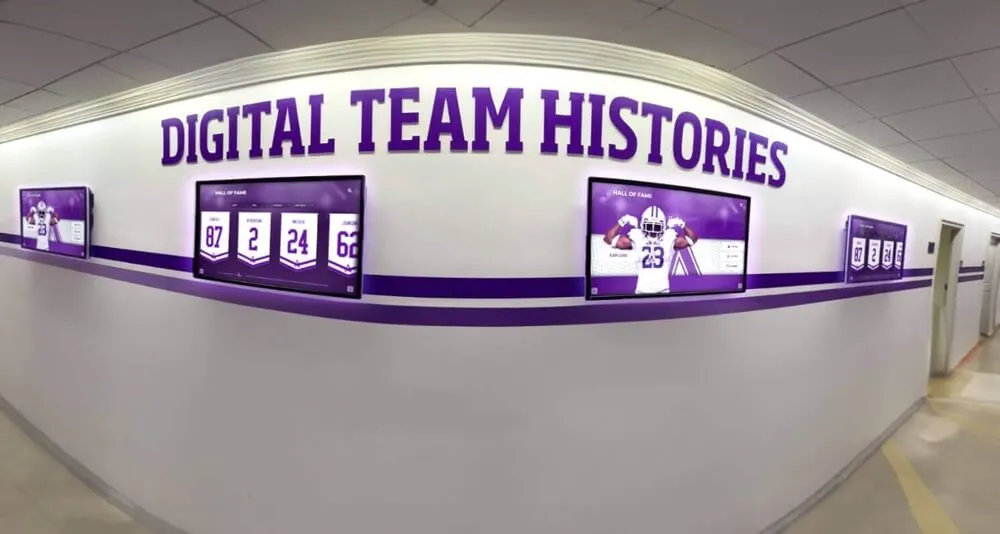
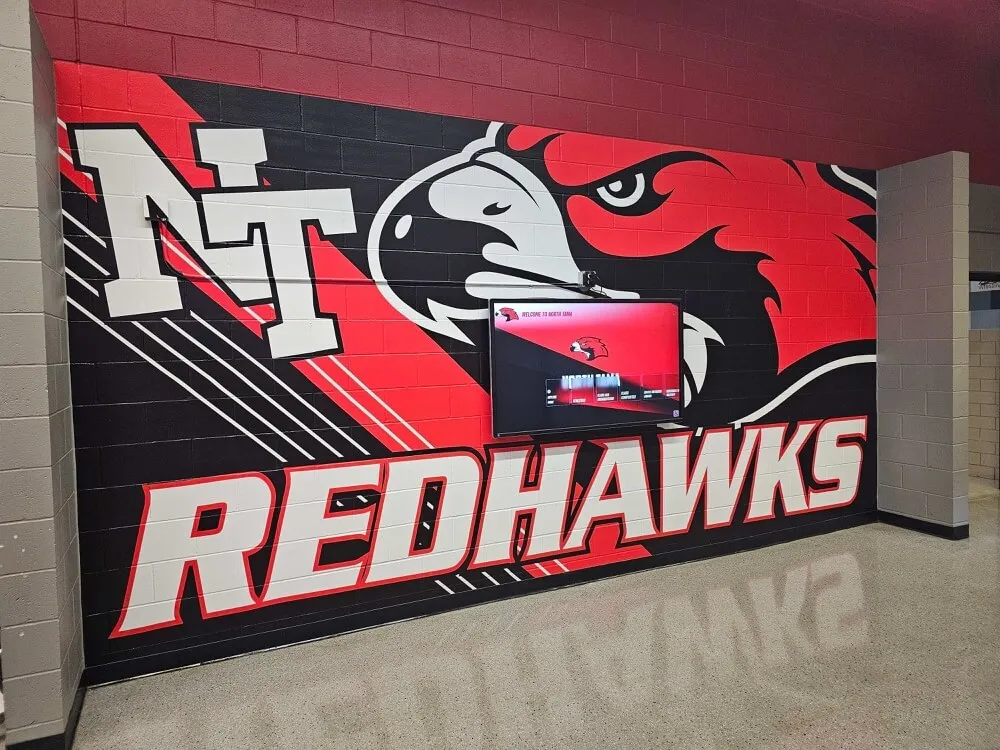
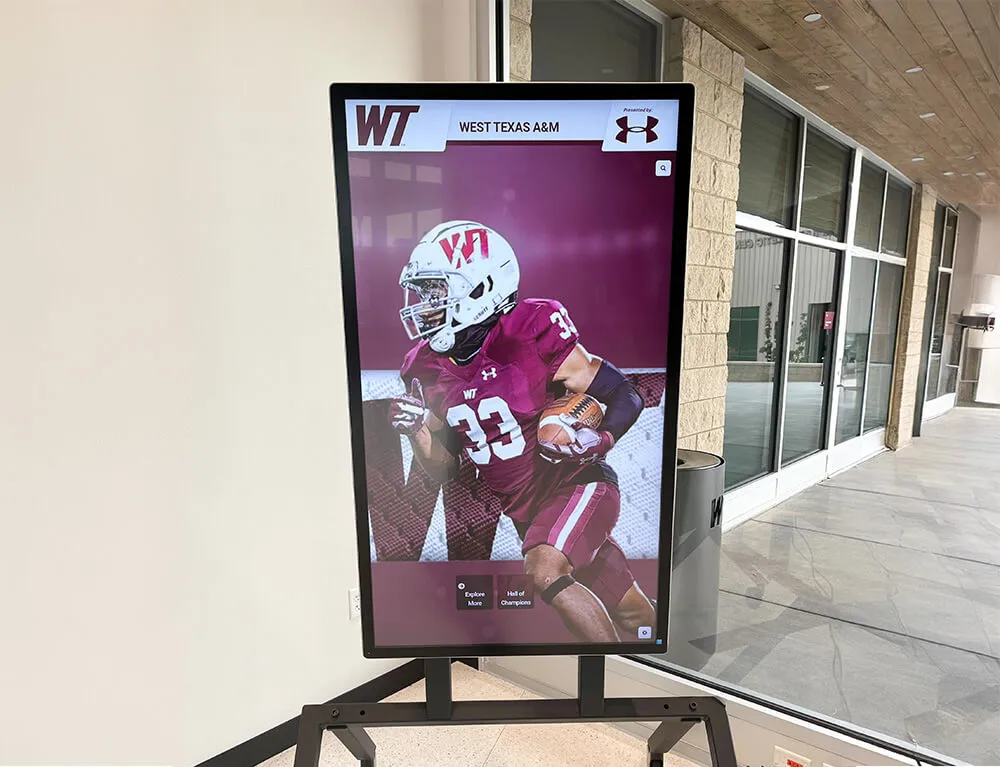
Athletic hall of fame walls display institutional commitments that span decades—a temporal table policy ensures that every correction to these records is documented, traceable, and explainable
What Is an Athletic Awards Temporal Table Policy?
An athletic awards temporal table policy defines how records in a recognition system are managed over time—specifically, how the system distinguishes between what a record currently shows, what it showed in the past, and when each version was valid.
The concept originates in database design. The ISO/IEC 9075 SQL:2011 standard introduced temporal tables as a formal mechanism for tracking data history, defining two time dimensions: system time (when a record was stored in the database) and application time (the business period during which a value is considered valid). For athletic award records, these translate directly:
- System time corresponds to when a record was entered or modified in the recognition system
- Application time corresponds to the athletic season, year, or event period to which an award applies
A temporal policy for athletic recognition does not require a database platform that natively supports SQL temporal tables. Schools running recognition programs in spreadsheets, CMS platforms, or specialized digital recognition software can implement the same principles by maintaining explicit version fields, change-date columns, and correction logs. The policy defines the rules; the system enforces them.
Why Temporal Record Management Matters for Recognition Programs
Athletic recognition records are subject to correction in ways that most other institutional records are not. Statistics get revised when scoring errors are discovered. Names require updates after legal name changes. Achievement classifications change when governing body rulings are reversed. Archival research sometimes surfaces achievements from decades past that were never formally recognized at the time.
Each of these scenarios produces a record change. Without a temporal policy, that change is either applied silently—overwriting the prior version with no trace—or left unresolved because there is no defined process for introducing a correction.
Both outcomes create problems. Silent overwrites lose the institutional memory of what was once displayed, making it impossible to explain discrepancies when alumni, journalists, or governance reviewers compare current records against historical materials. Unresolved discrepancies accumulate into a backlog of uncorrected records that undermine the program’s credibility over time.
For programs maintaining display walls that connect physical recognition with digital records—as explored in the comprehensive guide to alumni recognition programs at touchhalloffame.us—the stakes are particularly high. An alumnus who received an award in 2008 may compare their physical plaque against a current digital roster and find a discrepancy the program cannot explain because no correction history exists.
The Family Educational Rights and Privacy Act (FERPA) establishes that schools must maintain accurate student records and provide a defined process for correcting inaccurate information. While FERPA’s primary application is academic records, the general principle—that records should be accurate, correctable, and explainable—applies to athletic recognition archives as a governance standard for any program committed to institutional integrity.

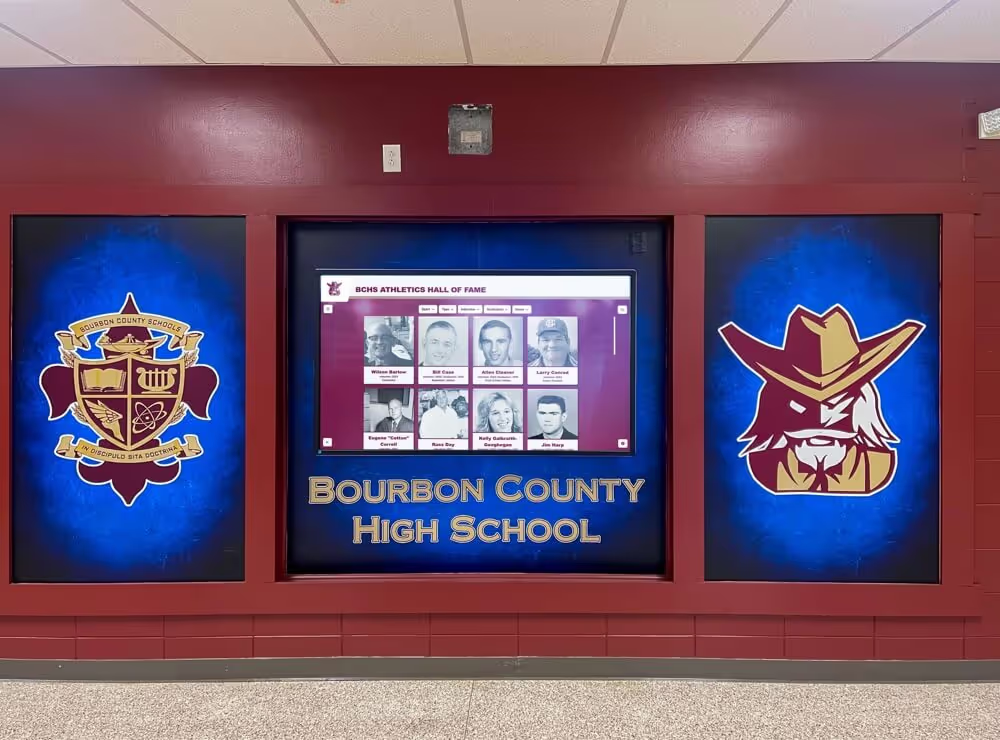
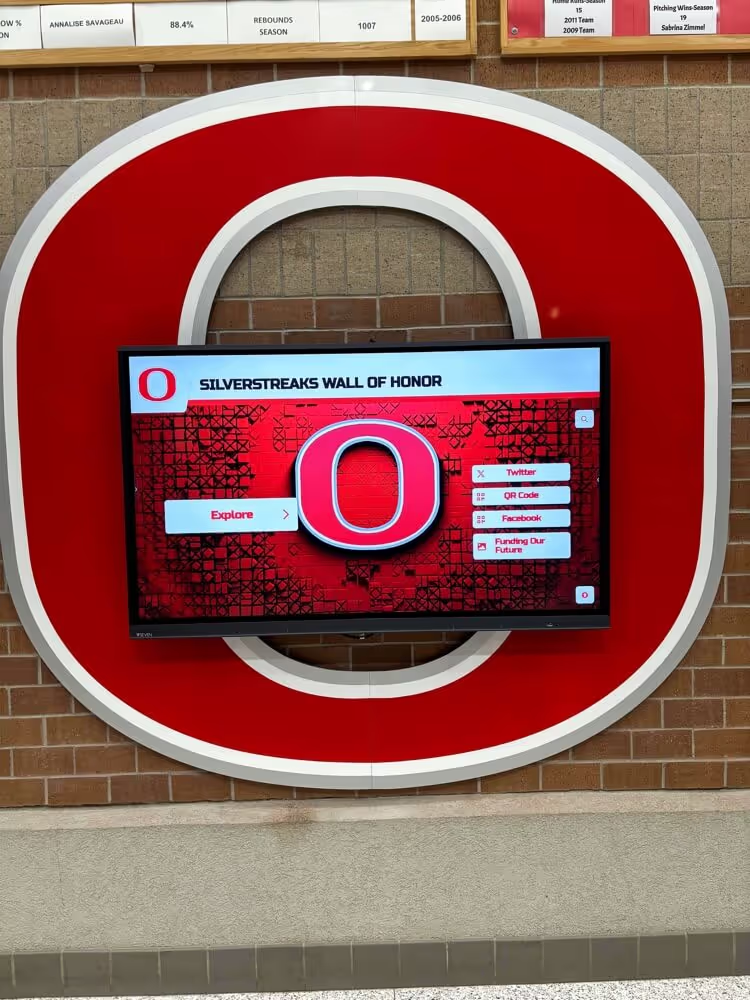
Digital recognition displays that aggregate records across decades of athletic history depend on a temporal record policy to distinguish current data from corrected data and archived history
The Four Record States a Temporal Policy Must Define
An effective athletic awards temporal table policy distinguishes four distinct states for any record in the recognition system. Every record occupies exactly one of these states at any given time.
| Record State | Definition | Who Sees It | How Long It Persists |
|---|---|---|---|
| Current | The most recent verified version of the record | All public displays, active rosters, ceremony programs | Until a correction supersedes it |
| Historical | A prior version of the record that was once current | Audit logs, correction reports, version history | Indefinitely (permanent retention recommended) |
| Corrected | A current record that has replaced a prior version | Public displays; correction notice optionally published | Until further correction |
| Archived | A record retired from active display but preserved for reference | Internal archives, alumni inquiry responses | Indefinitely |
The distinction between current and corrected is particularly important for display governance. A corrected record is a current record—it reflects the most accurate known information about an award. But a corrected record carries additional metadata: when the prior version was replaced, what the prior version showed, and who authorized the correction. A temporal policy ensures that metadata is captured and retained even when the public-facing display shows only the corrected version.
Core Components of an Athletic Awards Temporal Table Policy
A complete temporal table policy for an athletic recognition program addresses five governance areas.
1. Record Classification
The policy must define which record types are subject to temporal management. For most programs, this includes:
- Hall of fame inductee records (name, sport, induction year, career highlights)
- All-time record board entries (athlete name, season, statistical result)
- Championship and team achievement records (season, sport, conference, title level)
- Annual award recipient records (athlete name, award category, season)
- Season roster records (team composition, coaching staff, won-loss record)
Records that are administrative in nature—budget documents, scheduling records, facility inspection logs—are typically governed by the school’s general records retention schedule and fall outside the athletic recognition temporal policy.
2. Change Classification
Not all changes to a recognition record are equivalent. The policy must distinguish:
- Error corrections: The record contained incorrect information from the time it was first entered (a misspelled name, a wrong statistic, an incorrect year). The prior version was never accurate.
- Updates: The record was accurate when entered but has since become outdated (a name change, a reclassification by a governing body, a correction issued by an official scorebook). The prior version was accurate at the time.
- Additions: New information about a historical period has surfaced that was not available when the record was originally created. No prior version exists—the record is being created retroactively.
These distinctions determine how the record’s history is described. An error correction notes that the prior version contained an inaccuracy. An update notes that the prior version was accurate at entry but has since been superseded. An addition notes the source of newly discovered information and why it was not included in the original record.
3. Authorization Authority
The policy must specify who may initiate each type of change and who must approve it before the record is updated in the live recognition system.
A standard authority matrix for athletic award records:
| Change Type | Initiation Authority | Approval Authority |
|---|---|---|
| Error correction (clerical) | Recognition coordinator | Athletic director |
| Error correction (contested) | Athletic director | Principal or designee |
| Update (governing body ruling) | Recognition coordinator | Athletic director |
| Update (name change) | Requestor (honoree) + recognition coordinator | Athletic director |
| Addition (historical) | Recognition coordinator or alumni request | Athletic director + records committee |
Changes initiated by outside parties—an alumnus requesting a correction, a family member reporting a discrepancy, a journalist citing a records dispute—are received as requests and processed through the internal workflow rather than applied directly.
4. Correction Disclosure Policy
When a recognized athlete’s record is publicly corrected—particularly for high-visibility records like career statistical leaders or hall of fame listings—the program should define how and whether the correction is disclosed.
Options include:
- Silent correction: The record is updated without a public notice. Appropriate for minor clerical errors where the prior version was never widely circulated.
- Version note: The record displays a brief note indicating that the entry was corrected on a specified date and describes what changed. Appropriate for corrections to records publicly displayed for a material period.
- Correction announcement: A formal notice is published through the program’s communication channels explaining the nature of the correction. Appropriate for high-profile records where the prior version was widely cited or distributed.
The disclosure threshold should be defined by the nature of the error, the visibility of the record, and the length of time the prior version was public—not by the preference of whichever staff member discovers the error.
5. Retention Schedule
Temporal record management generates additional data: version histories, change logs, authorization records, and correction notices. The policy should specify:
- How long version histories are retained (permanent retention is recommended for hall of fame and all-time record categories)
- Where version histories are stored (attached to the live record in the CMS, in a separate archive system, or in physical documentation files)
- Who has access to version history data (internal staff only, or also visible to authenticated alumni)

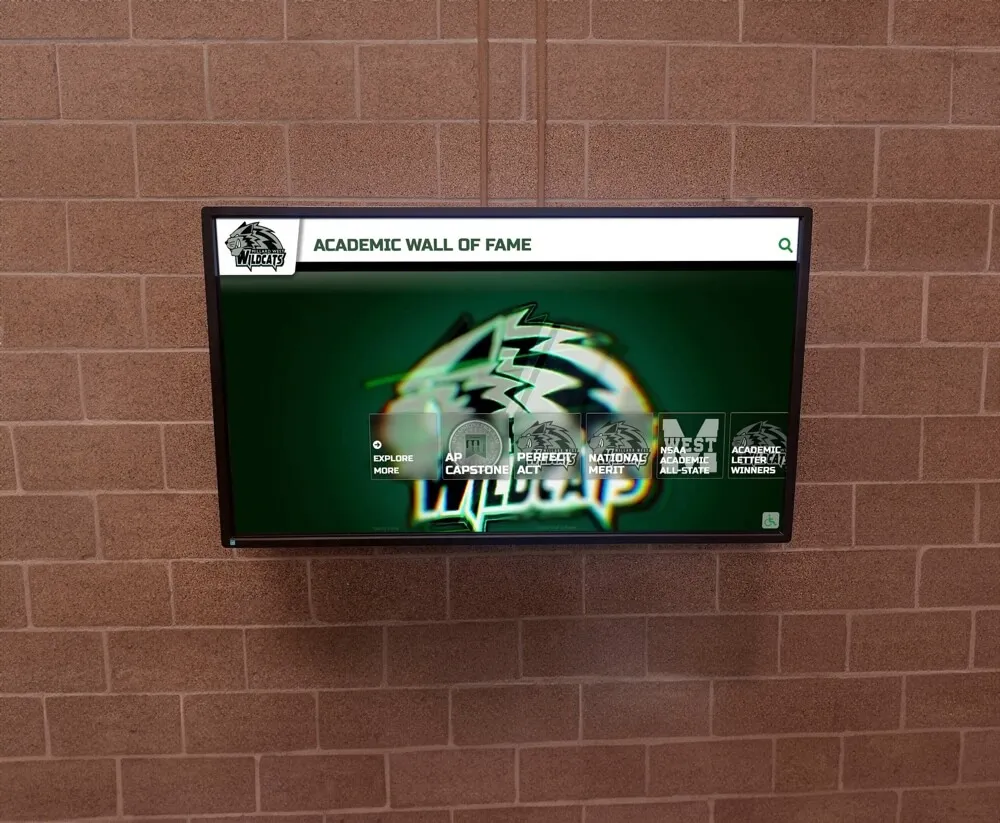
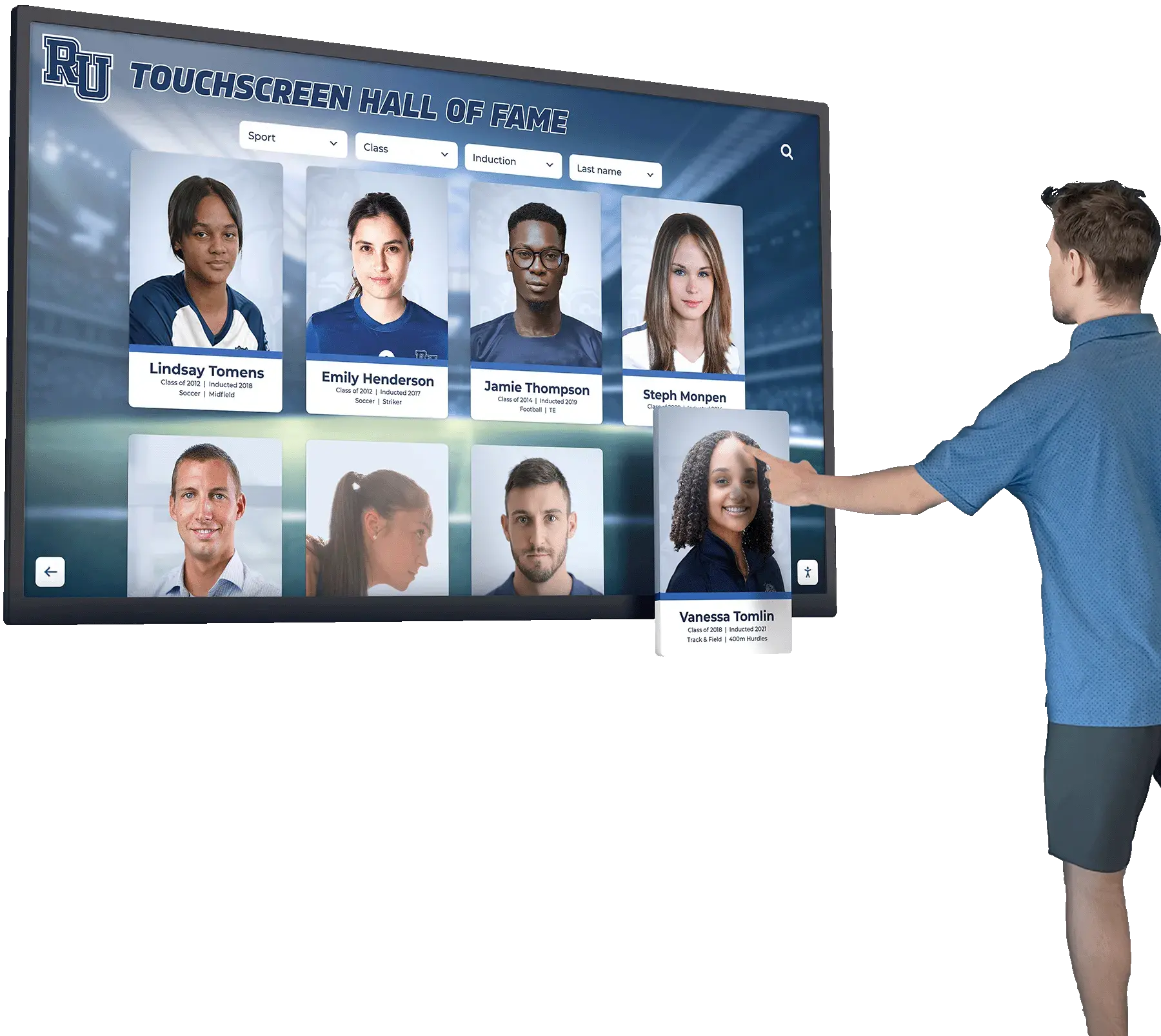
Individual athlete profiles on digital recognition displays represent single records with potentially complex version histories—a temporal policy ensures that corrections to these profiles are documented and traceable
Six-Step Workflow: Processing a Record Correction
The following workflow applies to all change types—error corrections, updates, and additions—that require modifying a previously published recognition record.
Step 1: Receive and Log the Correction Request
All correction requests, regardless of source, are logged in the program’s correction request register at the moment they are received. The register entry captures: the date received, the source of the request (internal staff, alumni, family member, governing body), the record affected, and the claimed nature of the error.
Do not make any changes to the live record at this step. The request is logged, not acted upon.
Step 2: Retrieve the Current Record and Version History
Before evaluating the correction request, retrieve the current version of the affected record and, if available, all prior versions stored in the system’s version history. This establishes the baseline: what the record currently shows, when it was last modified, who made that modification, and whether prior corrections have already been applied.
Programs using digital recognition platforms with built-in edit histories have this information available natively. Programs maintaining records in spreadsheets or documents should maintain a separate version log—a dated copy of the record as it appeared before each prior modification.
Step 3: Classify the Change Type and Verify the Claim
Apply the policy’s change classification framework to categorize the request as an error correction, an update, or an addition. Then verify the claim against authoritative sources before any change is made:
- For error corrections: identify the source document containing accurate information (official game record, governing body publication, enrollment record)
- For updates: identify the authoritative source of the change (governing body ruling, legal name change documentation, official records correction)
- For additions: identify the source of the historical information and evaluate its reliability (archived program, historical newspaper, official statistics compilation)
If the claim cannot be verified against an authoritative source, place the request in pending status with a note explaining what documentation is needed.
Step 4: Obtain Authorization
Present the verified correction to the appropriate approving authority as defined in the authorization matrix. Provide: the current record, the proposed correction, the source verification, and the proposed change classification. The approver reviews and either approves, modifies, or denies the correction.
Authorization is documented in the correction request register: the approver’s name, the date of approval, and the final approved correction.
Step 5: Apply the Correction and Archive the Prior Version
With authorization confirmed, apply the correction to the live record. Before overwriting, capture the prior version in its entirety—all fields, as they appeared at the moment of correction—and store it in the record’s version history with a timestamp and the approver’s name.
Update the live record to the corrected version and mark it with a “corrected” flag, the correction date, and a brief description of what changed. The version history now contains the prior version alongside the correction record.
Step 6: Propagate the Correction Across All Display Formats
Recognition records often appear in multiple locations: a digital platform, printed programs from prior ceremonies, a physical display panel, an archived PDF, a website listing. Propagate the correction to every format the program controls directly.
For digital platforms, updating the CMS record typically propagates changes to all connected display outputs automatically. For physical formats, the policy should define which materials are candidates for correction (display panels the school controls) and which are not (certificates and trophies in the honoree’s possession). Document which formats were updated and which could not be updated, and retain this as part of the correction record.
For programs seeking a model for how recognition governance connects to broader organizational administration, recognition governance frameworks for student organizations at touchwall.tv illustrate how structured recognition authority is a governance need across all program types.
Display Integration: Publishing Accurate Records Without Erasing History
The display layer is where temporal policy decisions become visible to the public. Three design principles govern how corrected records should appear on recognition displays.
Principle 1: The current version is always the displayed version. A corrected record is the current record. Public displays show the corrected version. There is no scenario where a display surfaces a known-inaccurate prior version because “that’s what it showed at the ceremony.”
Principle 2: Version history is preserved internally, not hidden from inquiry. The prior version is not erased—it exists in the record’s version history, available to staff and to authorized stakeholders who request it. The display does not surface the prior version proactively, but it can be retrieved.
Principle 3: Material corrections are flagged, not silently applied. When a high-visibility record changes materially—a different athlete name on a career record, a revised statistical mark—the display should carry a version note indicating that the record was corrected, the date of correction, and a brief explanation. This protects the institution from appearing to have silently changed a record that community members remember differently.

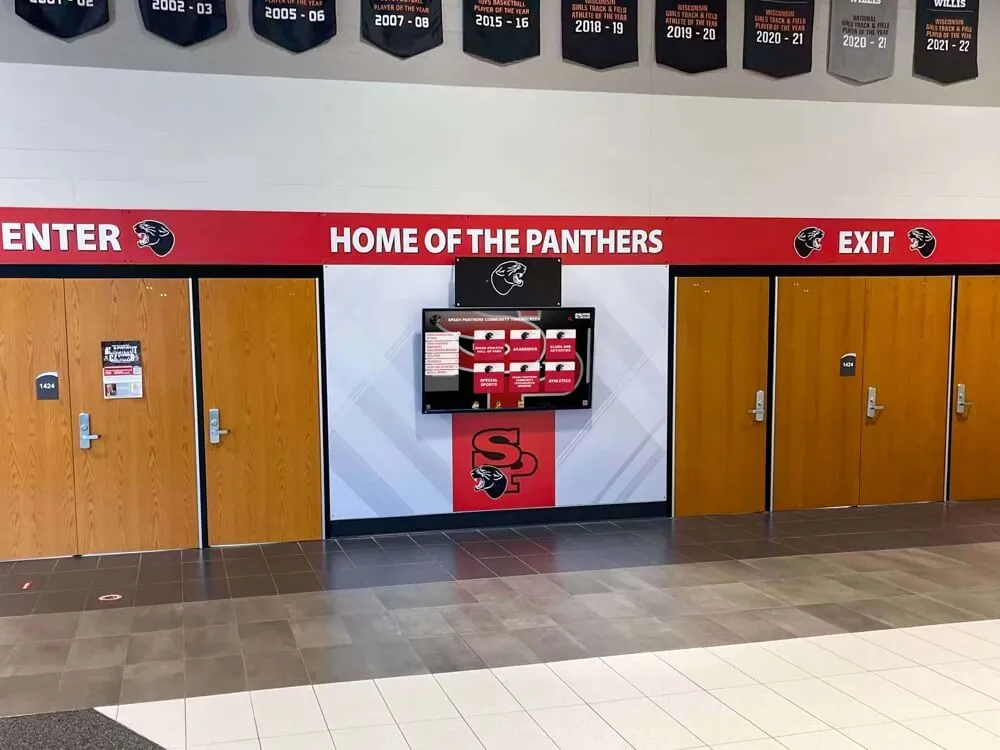
Recognition walls that combine physical shield panels with digital screens offer both the permanence of physical recognition and the editability of digital records—temporal policy governs how corrections on the digital side are handled when physical elements cannot be changed
Digital recognition platforms that maintain per-honoree CMS records with built-in edit histories are well-suited to temporal record management. When a correction is applied to a CMS record, the platform’s edit history captures the prior version automatically. Display administrators can review the version history without leaving the platform, and the public-facing display surfaces only the current version.
For programs evaluating how to structure recognition data before migrating to a digital display, championship celebration record-keeping practices at digitalyearbook.org describe how schools preserve historical championship data across multiple seasons—a foundation that temporal record governance builds directly upon.
Schools using Rocket Alumni Solutions’ recognition platform benefit from a CMS architecture where every record change generates an edit log entry, display outputs update automatically when CMS records are updated, and administrative access is controlled through tiered permissions that align with the authorization matrix a temporal policy defines. Request a custom demo to see how the platform’s edit history and permission controls support temporal record management for recognition programs of any size.
Common Athletic Award Record Scenarios: A Temporal Policy Reference Table
| Scenario | Change Type | Display Action | History Preserved |
|---|---|---|---|
| Athlete name misspelled on first entry | Error correction | Correct in all display formats; no version note needed for clerical errors with short display period | Yes — prior version captured before correction |
| Athlete name change (legal, post-recognition) | Update | Correct in all controllable formats; version note optional | Yes — prior name retained as alias in record history |
| Statistical record found to be an error by official scorebook | Error correction (high-visibility) | Correct and add version note; consider correction announcement | Yes — prior record and source document retained |
| Governing body retroactively revokes a championship title | Update | Remove or flag affected records per governing body ruling; document the ruling | Yes — original record preserved with ruling reference |
| Historical record discovered in archived newspaper | Addition | Create new record with source citation and acquisition date | Yes — source document retained with record |
| Duplicate record discovered (same athlete entered twice) | Error correction | Merge records; retain merge history with explanation | Yes — both original entries preserved in merge history |
| Award recipient deceased; family requests display correction | Update | Apply per posthumous recognition policy; document family request | Yes — original record and correction authorization retained |
For programs designing hallway recognition displays that will carry records for years or decades—like the installations profiled in the guide to high school letterman jacket recognition at best-touchscreen.com—building temporal record governance into the display system from the start is considerably less costly than retrofitting it after years of untracked changes.

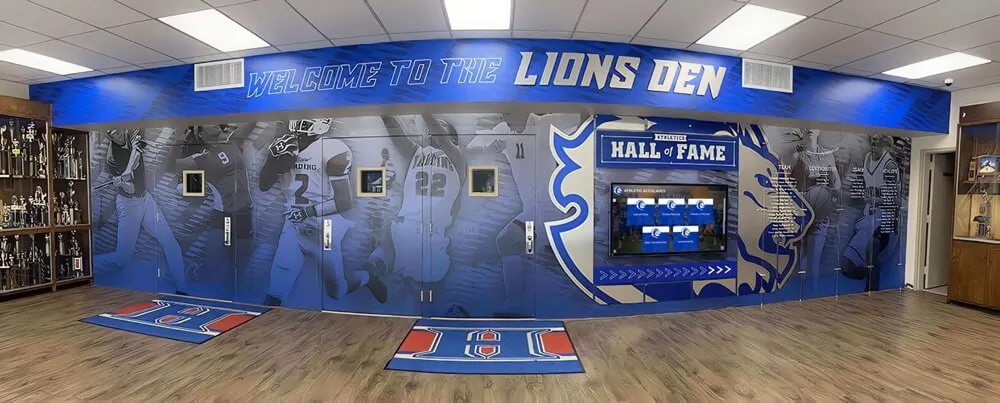
Hallway athletic honor walls that display records accumulated over decades require a temporal record policy to manage the inevitable corrections and updates that long-running recognition programs generate
When a school’s athletic honor wall commemorates significant milestones spanning multiple generations of athletes—much like the enduring design principles behind memorial program tribute recognition at digital-trophy-case.com—the records behind those displays carry meaning that makes accuracy and traceability especially important.
FAQ: Athletic Awards Temporal Table Policy
What is a temporal table in the context of athletic award records?
A temporal table is a record structure that stores both the current state of a data entry and the history of all prior states, along with timestamps showing when each version was valid. In athletic recognition, this means keeping the current version of an award record alongside archived versions of what that record showed before each correction was applied. The ISO/IEC SQL:2011 standard defines temporal tables formally; athletic programs implement the same concept through any system that supports version logging and change documentation.
Does implementing a temporal table policy require specialized database software?
No. The principles of temporal record management—capturing prior versions before making corrections, tagging records with modification dates and authorizing staff names, retaining version histories indefinitely for permanent records—can be implemented in any system that allows data entry and record-keeping. Spreadsheets with version tabs, document management systems with change tracking, and CMS platforms with edit logs all support temporal governance when the policy requires their consistent use.
Who should have access to historical record versions?
Access to version history should be restricted to internal administrative staff by default: the athletic director, recognition coordinator, and IT or CMS administrator. Honorees and their families may request access to the version history of their own records. The general public does not have routine access to version histories, though programs may choose to publish correction notices for high-visibility record changes.
How long should prior versions of athletic award records be retained?
For permanent recognition categories—hall of fame, all-time records, championship histories—prior versions should be retained indefinitely alongside the current record. For seasonal awards (annual certificates, letter awards, team rosters), prior versions should be retained for the same period as the primary record under the program’s records retention schedule—typically seven to ten years for supporting materials.
What should a program do when a correction affects a record already on a physical display that cannot be changed?
Apply the correction to all digital and controllable formats, and document the physical format in the correction record as “not updated due to production format constraints.” The correction record notes the discrepancy between the physical and digital versions. For significant discrepancies, the program may display a supplemental notice near the physical format explaining the correction and directing viewers to the updated digital record.
Building a Recognition Program Where History Is Never Lost
The programs that manage athletic award records most reliably over time treat version history as a first-class data asset—not a byproduct of corrections, but a deliberate product of sound governance. Every award entered into the recognition system is the beginning of a temporal record. Every correction extends that record’s history rather than erasing it.
A written athletic awards temporal table policy ensures that the institutional memory embedded in recognition records survives staff transitions, system migrations, and the passage of time. When a new athletic director inherits a program’s archive ten years from now, they should be able to trace every record to its source, every correction to its authorization, and every prior version to its preservation location—not reconstruct that history from scattered emails and memory.
For programs ready to build a recognition system designed for long-term temporal record integrity—where every edit generates an audit entry, every display update is traceable, and corrections propagate automatically to all connected outputs—request a custom demo of Rocket Alumni Solutions to see how the platform supports temporal record governance for athletic recognition programs of any size and record depth.