



Intent: research. A championship banner condition assessment checklist is a structured inspection tool that athletic directors, facilities managers, and archive staff use to evaluate the physical and historical state of each hanging or stored banner—and to decide whether the appropriate next step is repair, replacement, retirement, or digitization.
The short answer: walk every banner through a seven-category inspection covering fabric integrity, color fidelity, hardware condition, lettering adhesion, historical significance, display suitability, and record completeness. Score each category, calculate a composite rating, and apply the decision matrix at the end of this guide to route each banner to the correct action path. The sections below provide the complete checklist, scoring rubric, decision matrix, and a digitization workflow schools can follow once physical assessment is complete.
Championship banners represent decades of student-athlete effort, coaching achievement, and institutional identity. A banner hung in 1987 to mark a state title carries the same symbolic weight as the season it commemorates—but the fabric, hardware, and lettering that carry that weight age at different rates depending on gymnasium climate, sunlight exposure, and handling history. Without a systematic condition assessment, athletic departments make banner decisions reactively: replacing something that could be restored, or continuing to display something that is degrading in ways visitors and former athletes can see clearly.
A structured championship banner condition assessment checklist addresses that gap. It ensures every banner receives the same inspection criteria, that decisions are documented and defensible, and that significant banners are captured digitally before their physical condition deteriorates further.

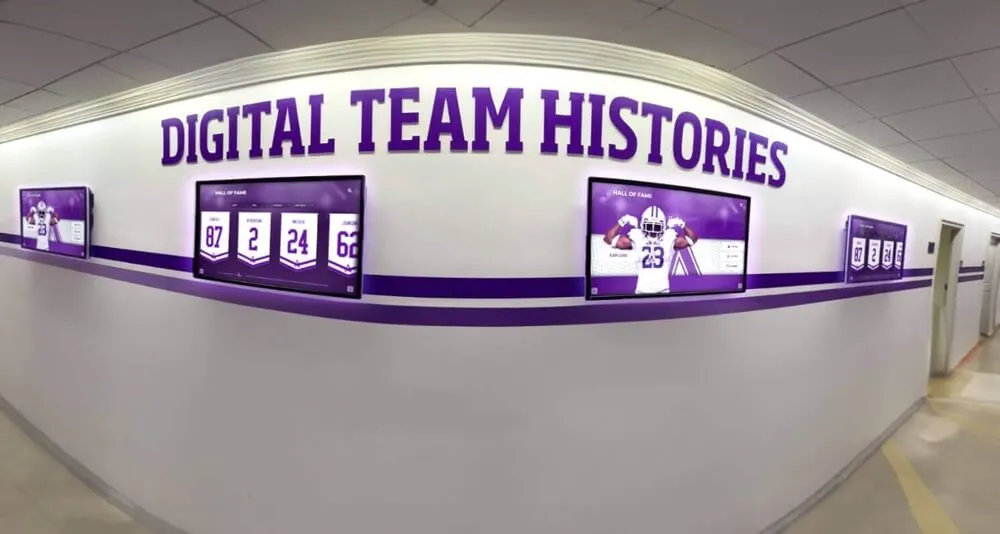
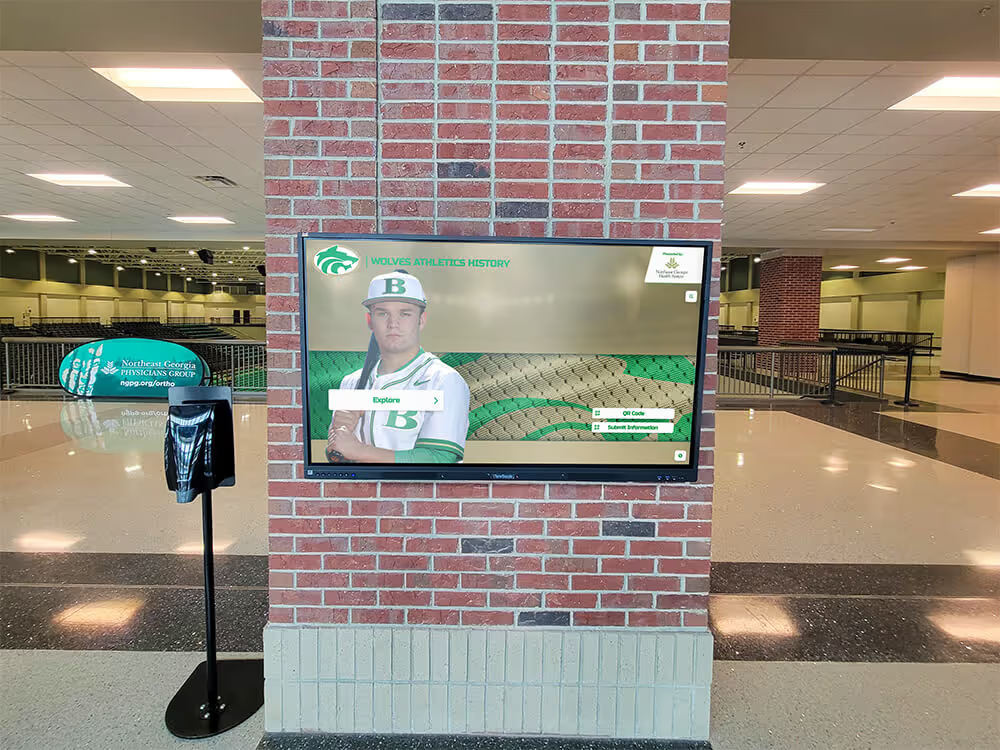
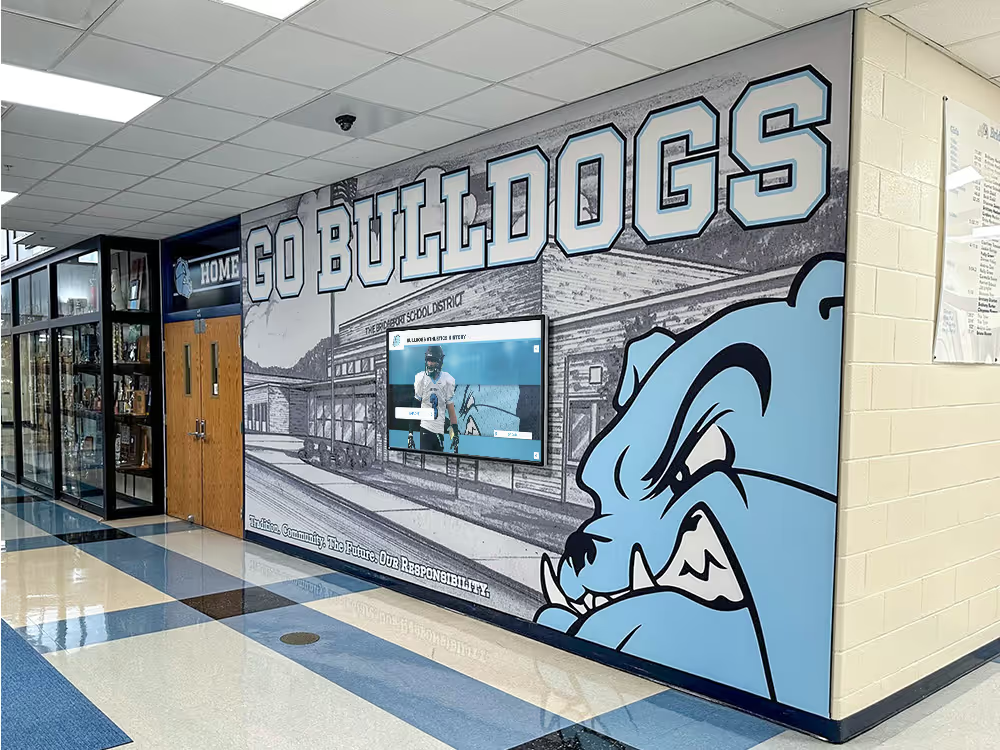
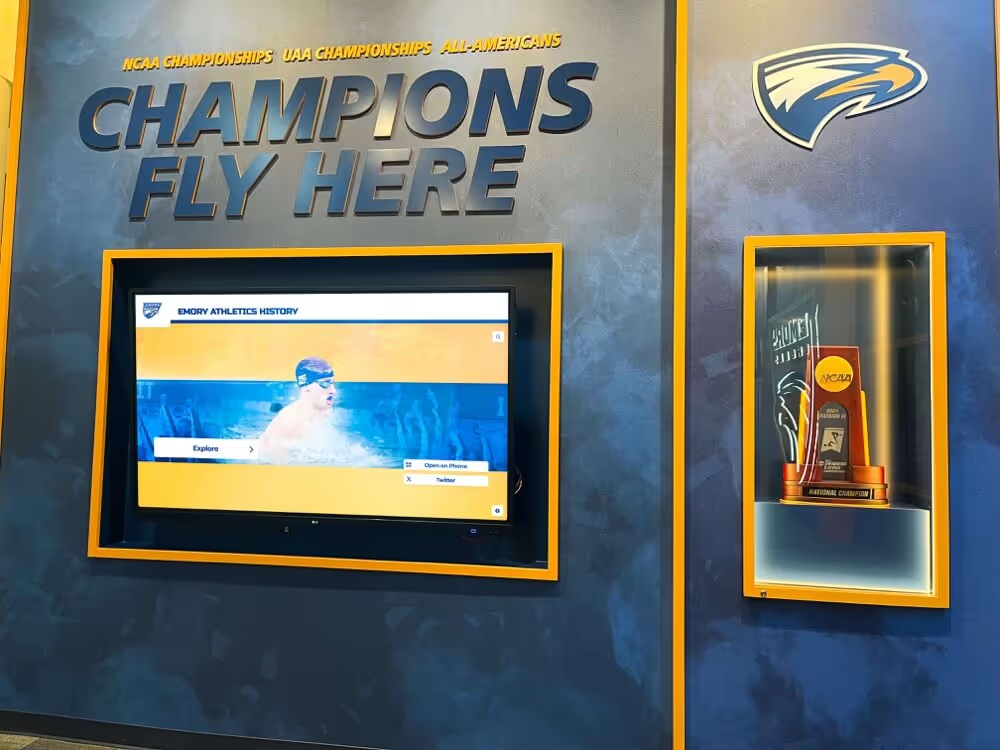
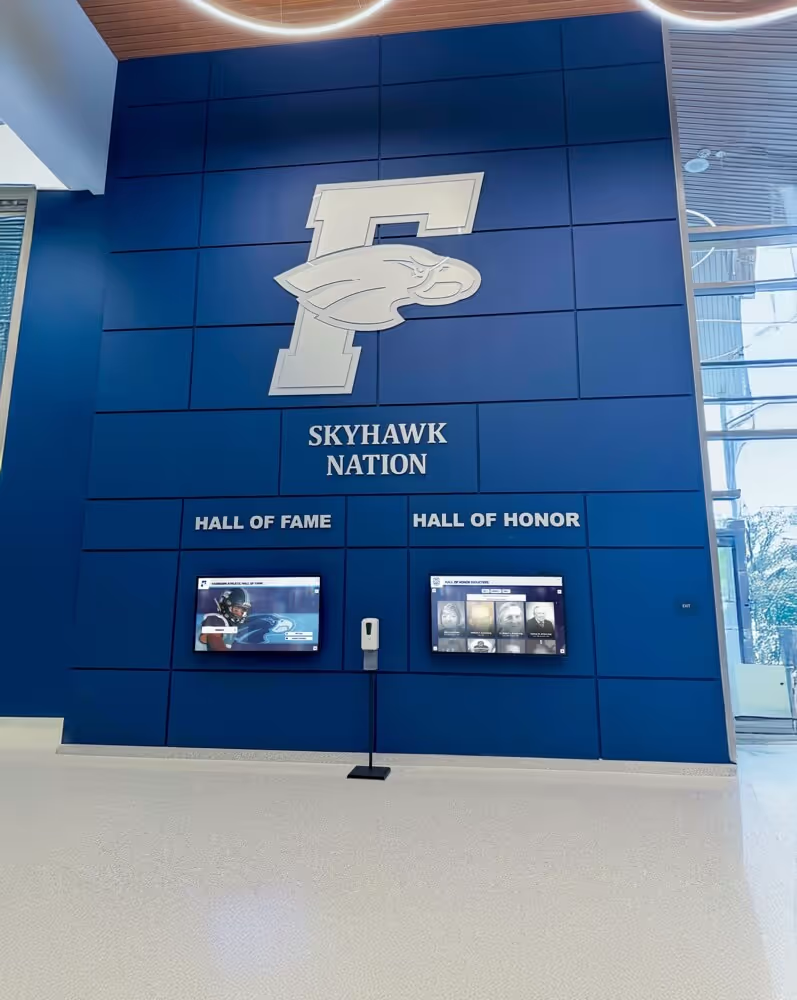
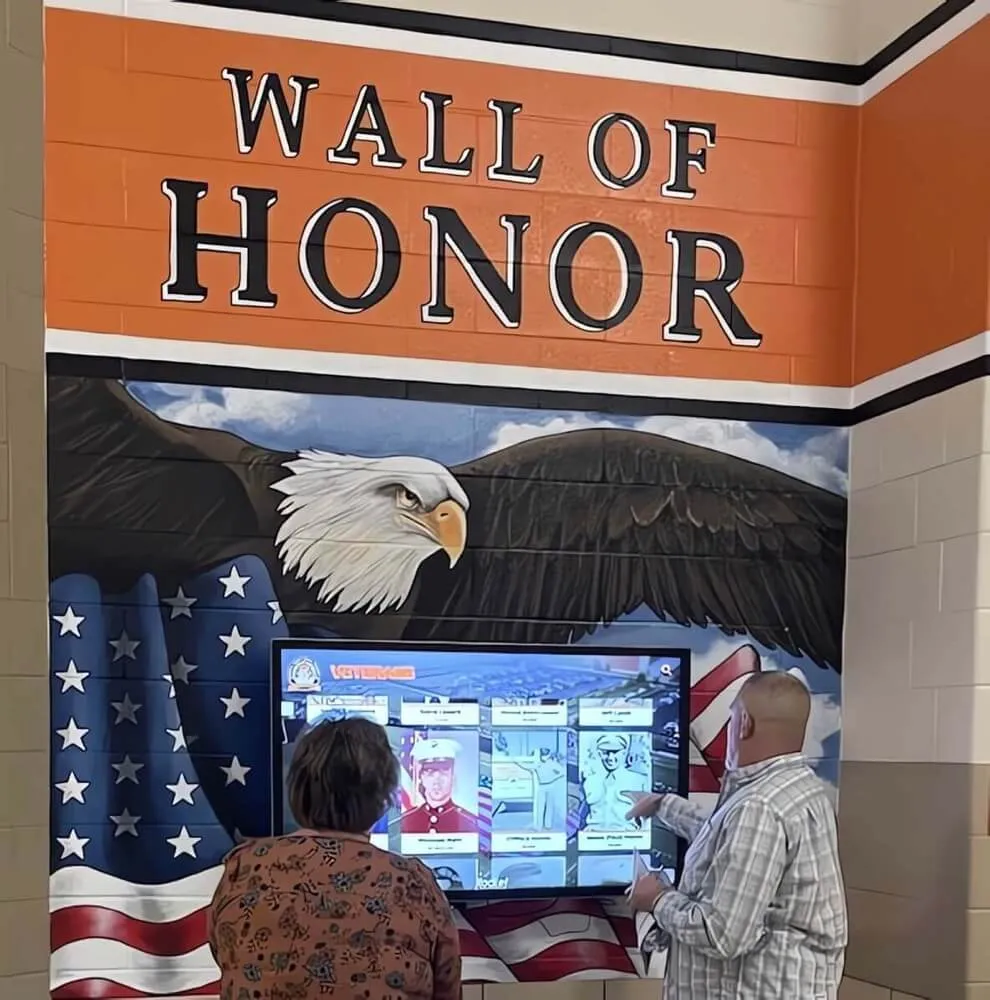
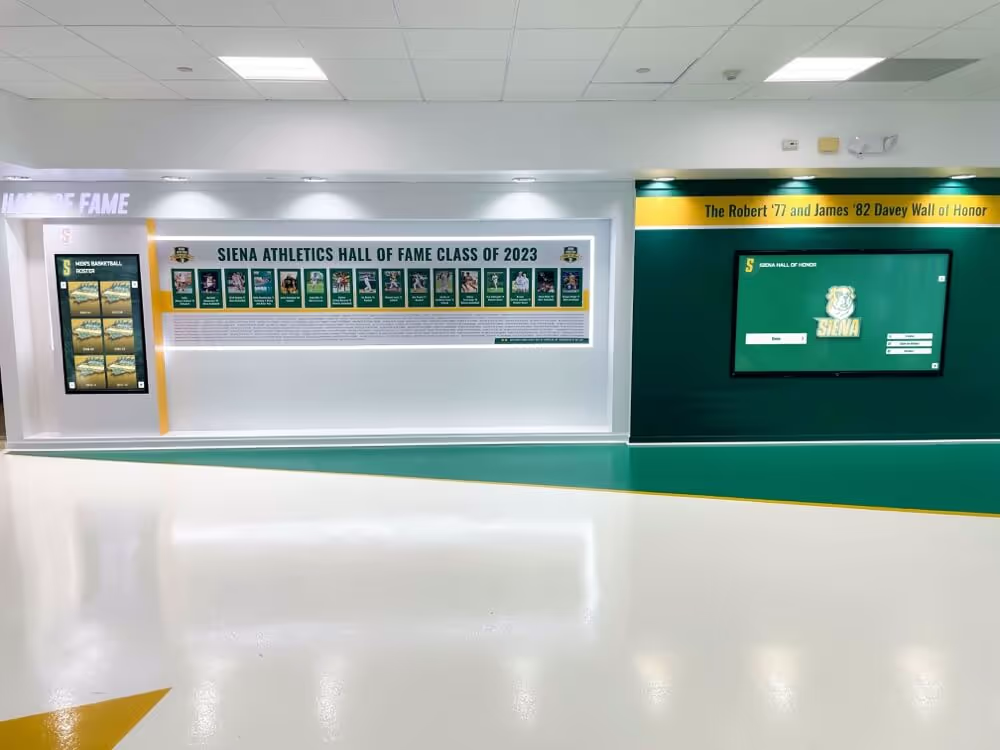
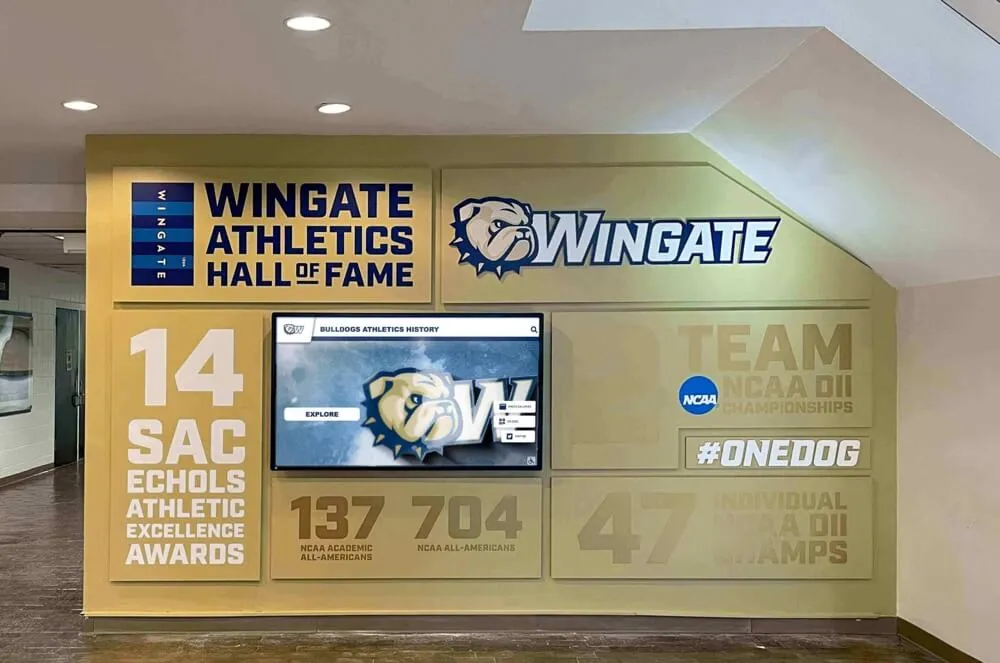
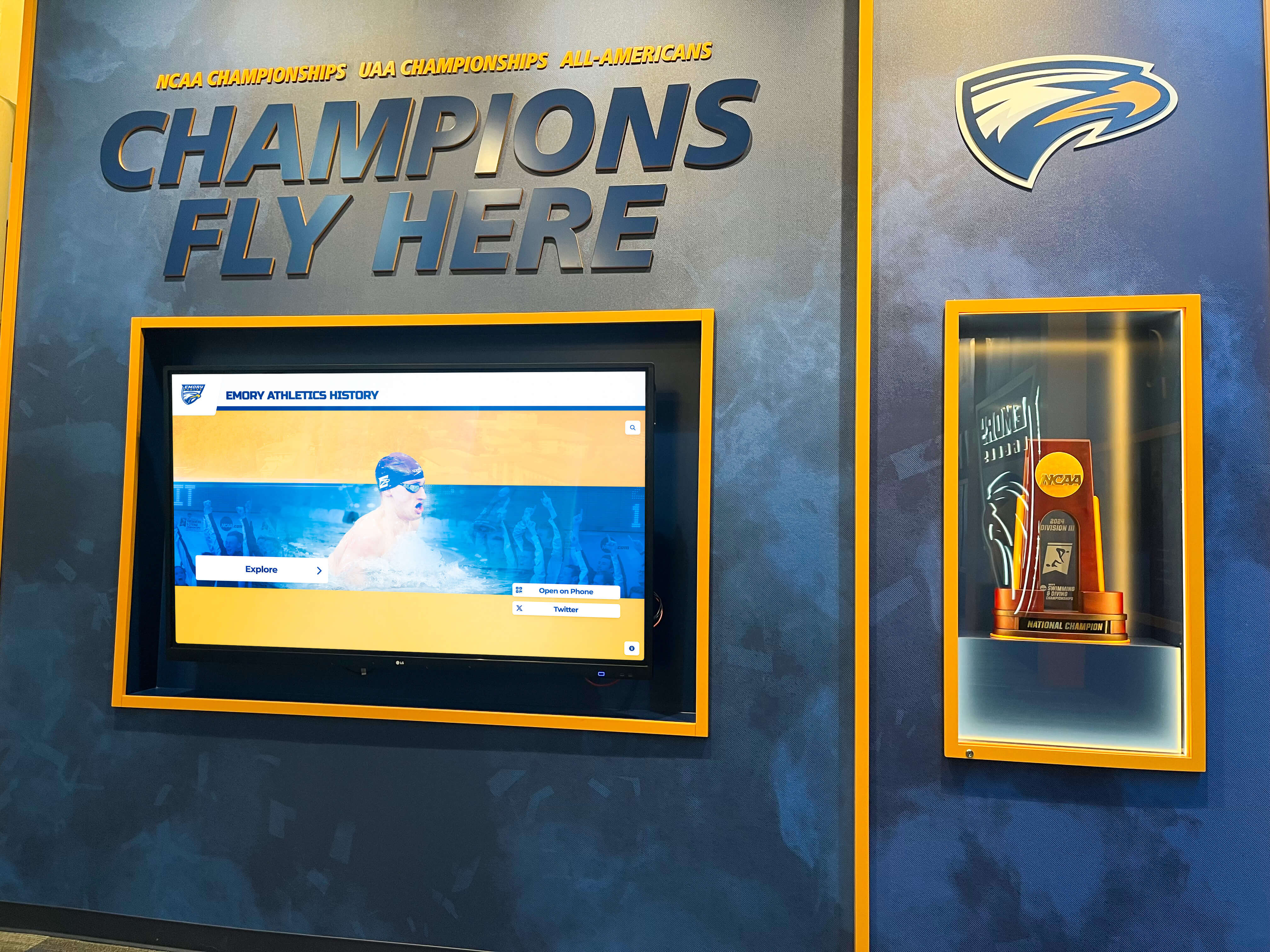
Championship displays take many forms—physical banners, trophy walls, and digital archives each serve a distinct role in preserving athletic history
Why Banner Condition Assessment Belongs on the Athletic Director’s Agenda
Athletic departments typically assess banners only when a replacement request surfaces or a renovation project forces the issue. That reactive pattern has predictable consequences: some banners are replaced at higher cost than a timely repair would have required, others continue to hang in deteriorating condition because no budget request was ever formally documented, and the historical record behind certain banners is lost when the physical object fails before anyone captures the information it carries.
A proactive annual or biennial assessment solves all three problems. It creates a documented inventory, surfaces repair and replacement needs before they become emergency requests, and generates the record of historical significance that a digitization project needs to proceed. For schools planning alumni wall updates or a broader recognition renovation, a completed banner inventory also serves as the baseline catalog from which digital content is built.
The assessment is not a facilities-only exercise. Athletic directors, coaches with institutional memory, archive staff, and IT or AV stakeholders each contribute information the others cannot supply on their own. The checklist below is designed to support a collaborative walk-through that captures physical condition and historical context in a single pass.
Step-by-Step: The Championship Banner Condition Assessment Process
Step 1 — Create a Banner Inventory Before Inspection Begins
Do not begin physical inspection without first building a complete inventory. Walk every gymnasium, corridor, field house, storage area, and auxiliary space where banners may be located. Record each banner’s location, approximate dimensions, sport, season year, and award level (conference, regional, state, national). Include banners in storage; degraded condition in storage does not remove the historical obligation to assess and document.
The inventory becomes the spine of the assessment: each entry receives a unique identifier (e.g., BANNER-2004-SWIM-STATE), a location code, and a condition worksheet. If your school’s records are incomplete, cross-reference the inventory against available sources—yearbooks, local newspaper archives, sports information department records, and coach memory—before assessment day. Gaps in the historical record are a finding in their own right and drive the digitization priority score.
Step 2 — Assemble the Assessment Team
Assign roles before inspection begins:
- Physical inspector (facilities or maintenance staff): evaluates fabric, hardware, and structural condition
- Content verifier (athletic director or records staff): confirms accuracy of lettering, dates, and award designations
- Historical consultant (senior coach, athletic historian, or alumni liaison): provides context on significance and identifies banners with stories not captured in the lettering
- Digitization lead (IT, AV, or archivist): documents what information exists and what needs to be captured before the physical object degrades further
Small programs may combine roles. What matters is that physical condition and historical significance are both assessed—not only the first without the second.
Step 3 — Conduct the Seven-Category Physical Inspection
For each banner, complete the inspection scoring rubric below. Score each category 1–4 using the descriptors provided, then total the score. The maximum possible score is 28 (excellent condition across all categories). A composite score guides the decision matrix in Step 6.
| Category | Score 4 — Excellent | Score 3 — Acceptable | Score 2 — Degraded | Score 1 — Critical |
|---|---|---|---|---|
| Fabric integrity | No tears, fraying, or stress points; material is structurally sound | Minor fraying at edges; no structural compromise | Visible tears or holes; structural stability reduced | Significant tears, water damage, or mold; structural failure risk |
| Color fidelity | Colors match original specification; no fading, bleed, or discoloration | Light fading present; colors still legible and representative | Moderate fading; colors no longer accurately represent original design | Severe fading or discoloration; original colors unrecognizable |
| Lettering and graphic adhesion | All lettering, numbers, and graphic elements fully adhered; no lifting or loss | Minor lifting at edges of one or more elements; no text loss | Partial loss of lettering or graphic elements; content may be misread | Significant text or graphic loss; content no longer accurately readable |
| Hardware condition | Grommets, rods, cables, and mounting hardware intact and functional | Minor surface corrosion on hardware; structurally functional | Hardware shows significant corrosion or damage; remounting required | Hardware failure; banner cannot be safely mounted |
| Display posture | Banner hangs flat and level; no curvature, warping, or bunching | Minor warping at edges; does not affect legibility | Visible warping or bunching that reduces display quality and legibility | Severe warping, rolling, or structural distortion; unsuitable for display |
| Cleanliness and hygiene | Clean; no dust accumulation, staining, or biological growth | Light dust; minor surface staining; no biological growth | Moderate staining or dust accumulation; no active biological growth | Active mold, mildew, pest evidence, or severe staining |
| Structural mounting safety | Current mounting meets safety standards for the space and banner weight | Minor adjustment needed to meet current standards | Mounting requires remediation before continued display is appropriate | Banner should be removed immediately for safety reasons |
Record the score for each category and the composite total on the banner’s condition worksheet. Photograph each side of the banner and each hardware mounting point as part of the record.
Step 4 — Complete the Historical Significance Assessment
Physical condition alone does not determine what action a banner warrants. A badly degraded banner that records a historically significant achievement may justify a higher restoration investment, or at minimum a more urgent digitization effort, than a well-preserved banner from a routine season. Assess significance using the four dimensions below.
| Significance Dimension | High (Score 3) | Moderate (Score 2) | Low (Score 1) |
|---|---|---|---|
| Award tier | National championship; state title; conference championship | Regional championship; league title; district title | Sectional; invitational; participation recognition |
| Historical rarity | Only championship of this type in school history; first of its kind | One of a small number (2–4) of comparable achievements | One of many comparable achievements in school history |
| Documented community connection | Specific athletes, coaches, or seasons with ongoing community recognition or alumni engagement | Historical interest exists but no active engagement | No specific community connection documented |
| Record completeness | Full roster, coach, and contextual records exist and are accessible | Partial records exist; some gaps | Records are sparse or unavailable; physical banner is primary surviving record |
Total the significance score (maximum 12). A banner with a low physical condition score but a high significance score is a priority digitization candidate, not simply a disposal candidate.
Step 5 — Document Accuracy Verification
Confirm that the information displayed on each banner is accurate. Check the sport name, season year, award designation, and any other lettering against the most reliable available source (state association records, official athletic department archives, or school board minutes if championship recognition was formally acknowledged). Note any discrepancies. A banner with an incorrect year or misattributed award creates a documentation problem that digitization will propagate unless corrected before capture.
Step 6 — Apply the Decision Matrix
Use the composite physical condition score (Step 3) and significance score (Step 4) together to determine the appropriate action path for each banner.
| Physical Condition Score | Significance Score | Recommended Action |
|---|---|---|
| 22–28 (Excellent) | Any | Continue display; schedule next assessment in 2–3 years; digitize if not yet captured |
| 16–21 (Acceptable) | 8–12 (High) | Repair within current budget cycle; prioritize digitization immediately |
| 16–21 (Acceptable) | 4–7 (Moderate–Low) | Repair if cost-effective; replace if repair estimate exceeds replacement cost; digitize |
| 10–15 (Degraded) | 8–12 (High) | Digitize immediately; restore if feasible; replace for continued display; retire physical banner with ceremony |
| 10–15 (Degraded) | 4–7 (Moderate) | Replace for continued display; digitize before retirement; retire physical banner |
| 10–15 (Degraded) | 1–3 (Low) | Replace if display space is needed; retire physical banner; digitize if records are incomplete |
| 7–9 (Critical) | 8–12 (High) | Remove from display immediately for safety; digitize immediately; commission replacement; plan retirement ceremony |
| 7–9 (Critical) | 1–7 (Any) | Remove from display immediately; retire; replace if display space warrants; digitize if records are incomplete |
Document the recommended action for each banner on its condition worksheet before moving to the next one. The completed worksheets become the basis for budget requests, vendor outreach, and digitization project scoping.
Step 7 — Build the Action Plan and Assign Owners
Sort all banners into four action lists: Repair, Replace, Retire, and Digitize. Note that digitize is not an exclusive category—most banners should be digitized regardless of their physical action path, because a digital record persists independent of what happens to the physical object.
For each action list, assign an owner, a target completion date, and an estimated cost. For repair and replacement, gather vendor quotes. For digitization, identify the responsible staff or contractor and the system into which the digital record will be loaded. For retirement, plan any recognition event that accompanies the physical banner’s removal from display—a formal retirement ceremony is appropriate for banners of high historical significance. Resources on dedication ceremony planning for schools and organizations can help structure that event appropriately.
Repair vs. Replace vs. Digitize: Expanded Guidance
When Repair Is the Right Path
Repair is appropriate when the physical condition score is 16 or above and the degradation is limited to one or two categories—typically fabric edge fraying, minor lettering lifting, or surface grommet corrosion. Most banner repair vendors can address these issues without full reconstruction. Get itemized quotes that specify what will be restored, what the expected lifespan of the repair is, and whether the repaired banner will meet the structural weight and mounting requirements of its display location.
If a repair quote approaches or exceeds the cost of a replacement banner, replacement is almost always the better investment unless the physical object itself has archival value (e.g., it is a genuinely historic artifact the school wishes to preserve for museum or display case purposes, separate from gymnasium display).
When Replacement Is the Right Path
Commission a replacement when the physical condition score falls below 16, when repair costs are uncompetitive, or when the display itself is degraded in ways that reflect on the program’s presentation standards. When commissioning replacements, use the accuracy verification completed in Step 5 to confirm the new banner’s content before production. Replacement is also the right path when a banner’s dimensions, hardware type, or material are no longer compatible with current mounting systems.
Budget planning for replacement projects may benefit from a structured approach—a booster club budget template can help athletic boosters and department administrators allocate recognition spending across banner replacement, repair, and digitization in the same planning cycle.
When Retirement Is the Right Path
Retirement is appropriate when a banner is in critical physical condition, when the achievement it represents has been superseded by a subsequent championship that warrants the display space, or when the recognition program has been redesigned in ways that make the banner’s format inconsistent with current standards. Retirement is not disposal by another name—it is a deliberate, documented transition in which the physical object is removed from active display, its historical record is preserved (digitally or in physical archives), and stakeholders are notified.
For banners with high significance scores, retirement without a ceremony is a missed opportunity. Former athletes, coaches, and community members who associate themselves with the achievement deserve acknowledgment when the physical object that carried it is removed from the gymnasium they remember. A retirement event also generates content—photographs, recollections, video—that enriches the digital archive.
When Digitization Is the Right Path (and Why It Should Always Be Part of the Plan)
Digitization is not a replacement for a physical banner—it is a parallel record that survives whatever happens to the physical object. A digitized banner record captures the achievement, the visual design, the roster, the context, and the date in a format that can be searched, shared, embedded in a digital campus storytelling experience, and presented on interactive displays without physical constraints.
Every banner assessed under this checklist should be digitized as part of the assessment cycle, regardless of its physical action path. The argument for immediate digitization is strongest for banners with high significance scores and degraded physical condition—these are the records most at risk of being lost without a digital backup.
Digitization Workflow for Championship Banners
Once the physical assessment is complete, digitize each banner using the following workflow:
1. Photograph the full face and reverse — Use a high-resolution camera (minimum 300 DPI output). Photograph flat against a neutral background if the banner can be safely removed; if not, photograph in place with controlled lighting to minimize glare and shadow.
2. Capture the detail — Photograph each major graphic element, all lettering, and any physical wear points that the full-face shot does not clearly capture.
3. Document the metadata — Record: banner unique identifier, sport, season year, award designation, award tier (conference/regional/state/national), school name as it appeared at the time, roster data if available, coach name if available, notable context (game scores, opponents, exceptional circumstances), physical dimensions, current location, physical condition score at time of digitization, and the name of the person who completed the assessment.
4. Archive the master files — Store full-resolution images in a school-managed archive location (local server or cloud storage with institutional control). Do not store only in a vendor platform; retain the master files independently.
5. Create display-optimized derivatives — Produce web-resolution and touchscreen-optimized versions from the master for use in digital display systems. Athletic directors evaluating platforms for displaying digitized championship content should review guidance on choosing a digital hall of fame provider before selecting a system.
6. Load into the recognition platform — Enter the digitized record into whatever system manages the school’s athletic recognition content—an interactive display, a website-based hall of fame, or a digital recognition wall. Ensure the record links to any related roster entries, coach profiles, or historical context already in the system.
7. Update the inventory — Mark the banner’s assessment worksheet as digitized, including the date and the archive location of the master files.

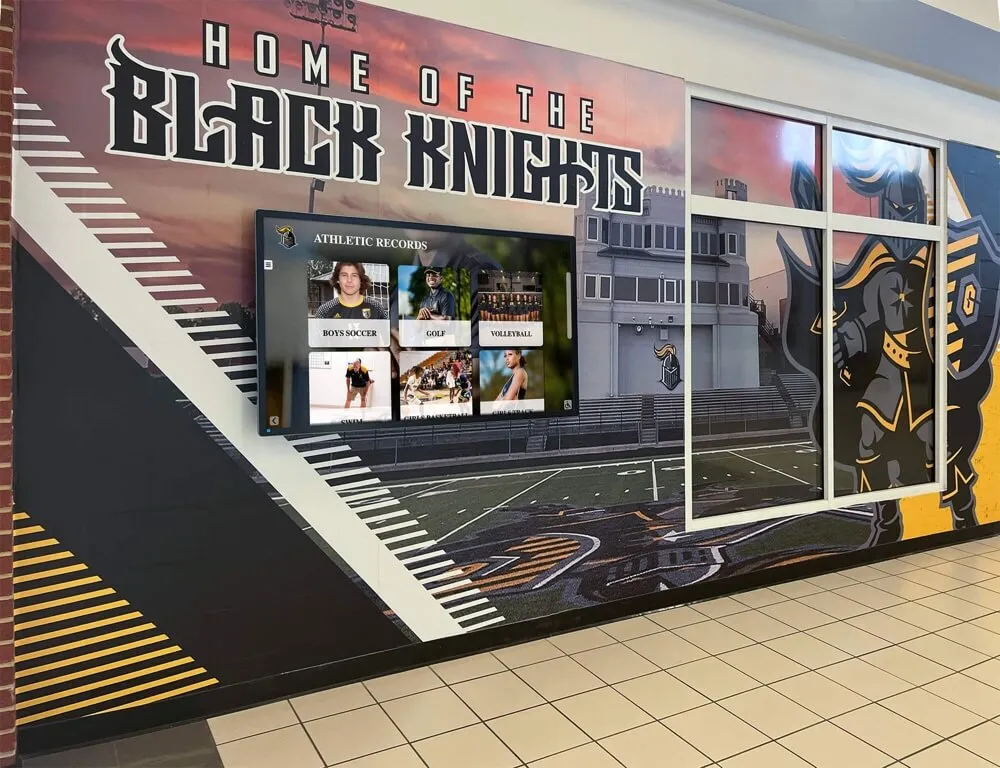
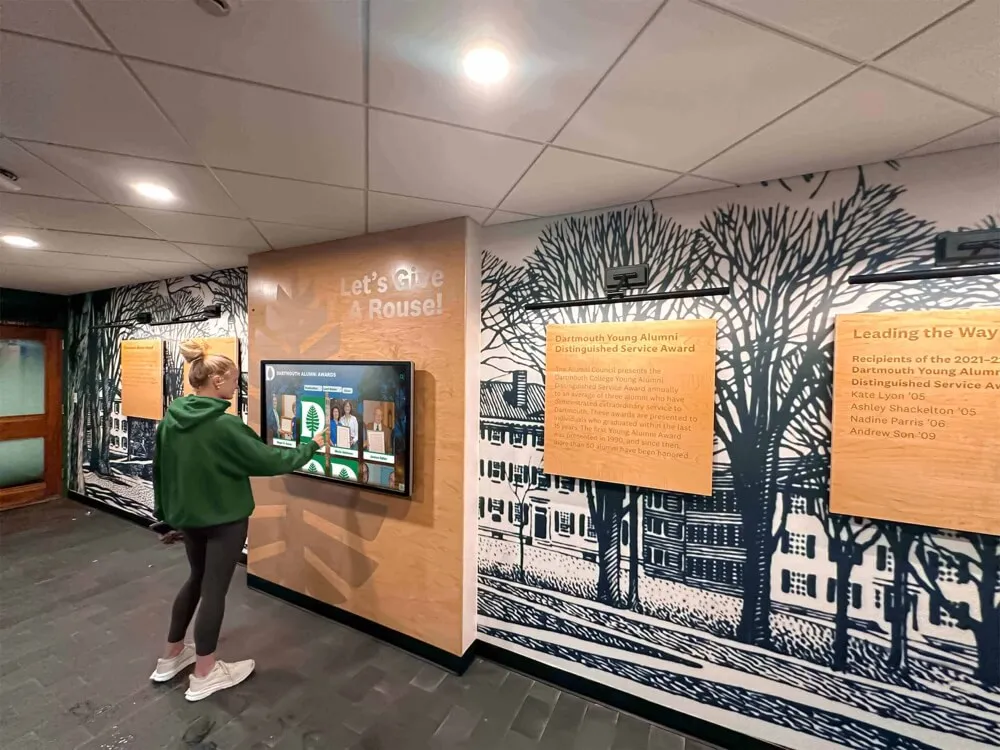
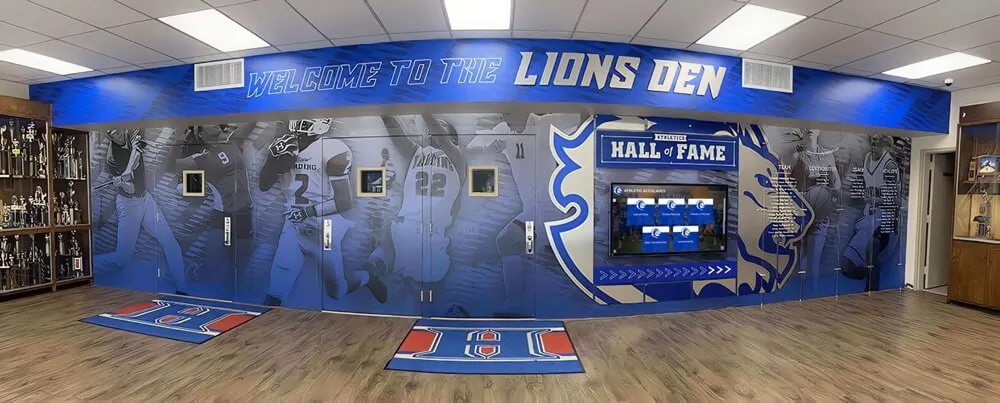
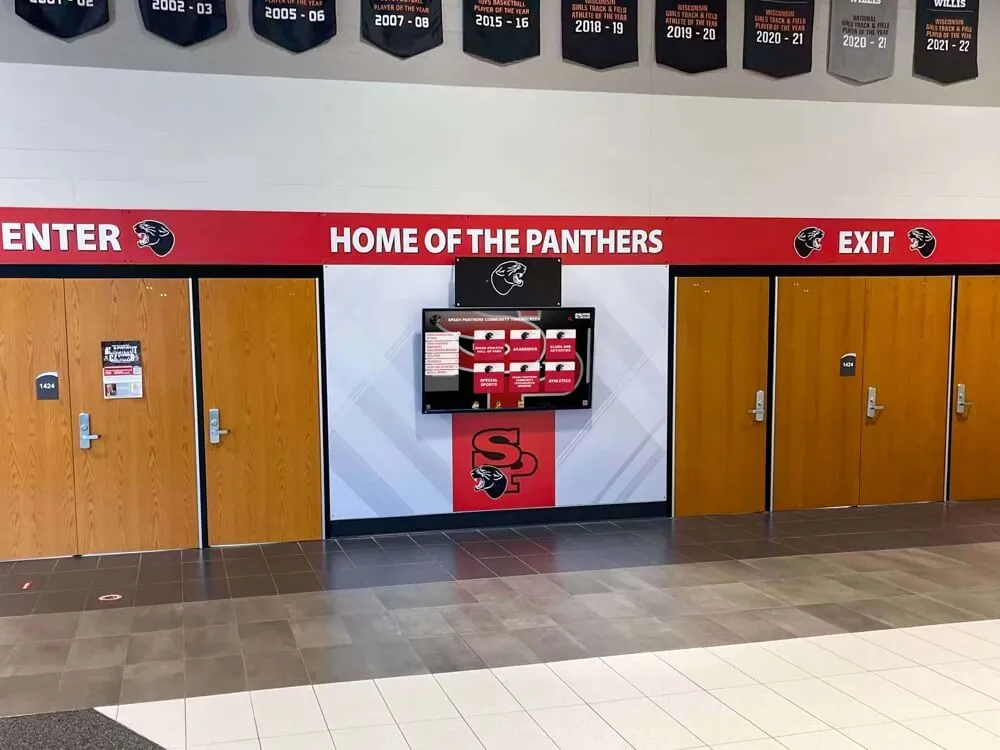
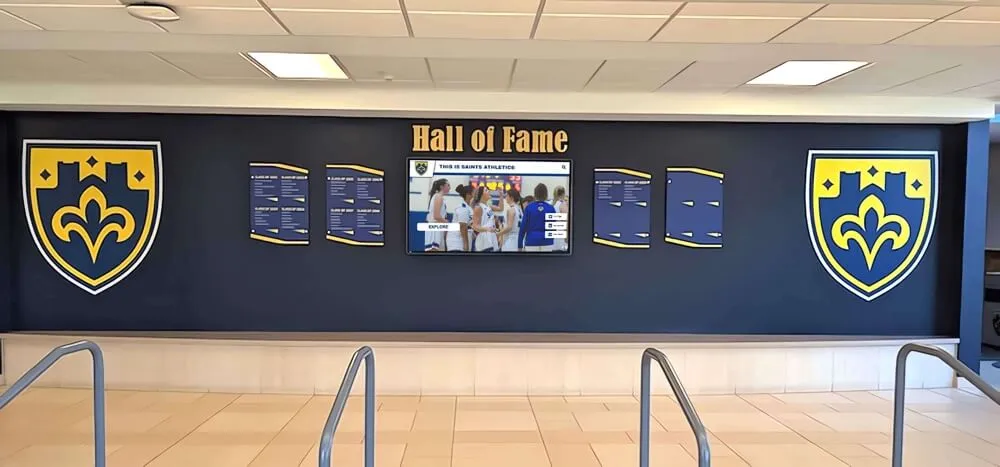
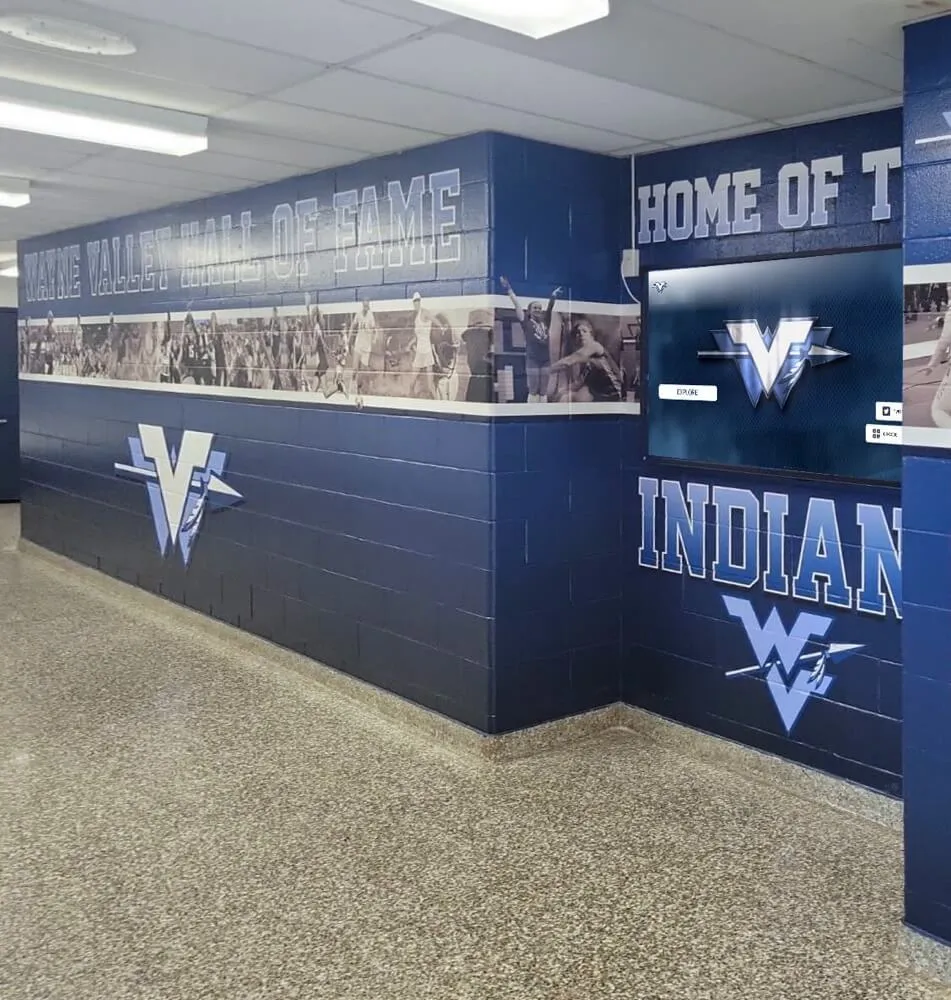
Championship banners are one component of a broader recognition environment that includes trophy cases, murals, and digital displays—assessment and digitization connect them into a coherent archive
Championship Banner Assessment: Annual Maintenance Checklist
After the initial comprehensive assessment is complete, use this abbreviated annual checklist to monitor each banner’s condition between full assessments. Any item that changes from the prior year’s record triggers a full re-inspection.
| Annual Check Item | Method | Flag for Re-Inspection If… |
|---|---|---|
| Fabric edge condition | Visual inspection from floor | New fraying, holes, or tears visible since last inspection |
| Color uniformity | Visual comparison to prior-year photograph | Visible fading or discoloration change |
| Lettering completeness | Visual inspection with binoculars if necessary | Any lettering or graphic element appears to have lifted or separated |
| Hardware integrity | Visual inspection; do not touch unless qualified | Any corrosion, bowing, or gap visible at mounting points |
| Display posture | Visual inspection | Visible warping, rolling, or sagging not present in prior year |
| Cleanliness | Visual inspection | Any staining, dust accumulation significantly heavier than prior year, or any biological growth |
| Mounting safety | Facilities sign-off | Any change to wall, ceiling, or mounting point condition |
Annual checks take fewer than five minutes per banner and prevent the kind of gradual deterioration that becomes a significant repair or safety problem precisely because no one flagged the early signs.
Frequently Asked Questions
How often should a full championship banner condition assessment be conducted?
A comprehensive assessment using the full checklist—physical inspection, significance scoring, accuracy verification, and decision matrix—should be conducted every two to three years for banners in climate-controlled indoor spaces. Banners displayed in facilities with poor climate control, high humidity, or direct sunlight exposure warrant annual full assessments. The abbreviated annual maintenance checklist covers the period between full assessments.
Who should have authority to decide whether a banner is retired or replaced?
Retirement and replacement decisions should require sign-off from the athletic director at minimum, with notification to the school principal or superintendent for banners of high historical significance. Programs with active booster organizations or athletic advisory boards may choose to include those stakeholders in the process. Whatever the decision-making structure, document it before decisions are made, not after. The assessment checklist and decision matrix described above create the factual record that makes those decisions defensible.
What happens to physically retired championship banners?
Options depend on the physical condition and the school’s archive capacity. Banners in stable condition that have been retired from gymnasium display may be donated to the school library or historical archive for display in a case. Banners that are structurally unsound but historically significant can be preserved as flat archival objects in acid-free storage. Banners that have no structural integrity and limited historical significance may be decommissioned after the digital record is confirmed complete. Never destroy a physically retired banner until its digital record has been created and confirmed in the archive.
Can digitized championship banners replace physical ones for display purposes?
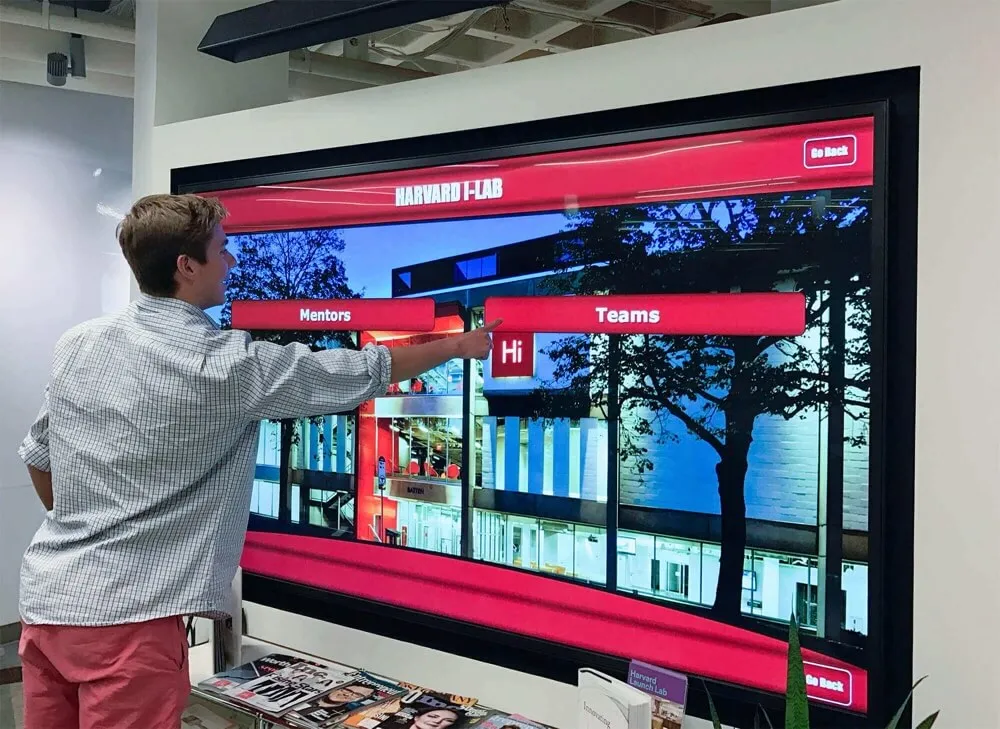
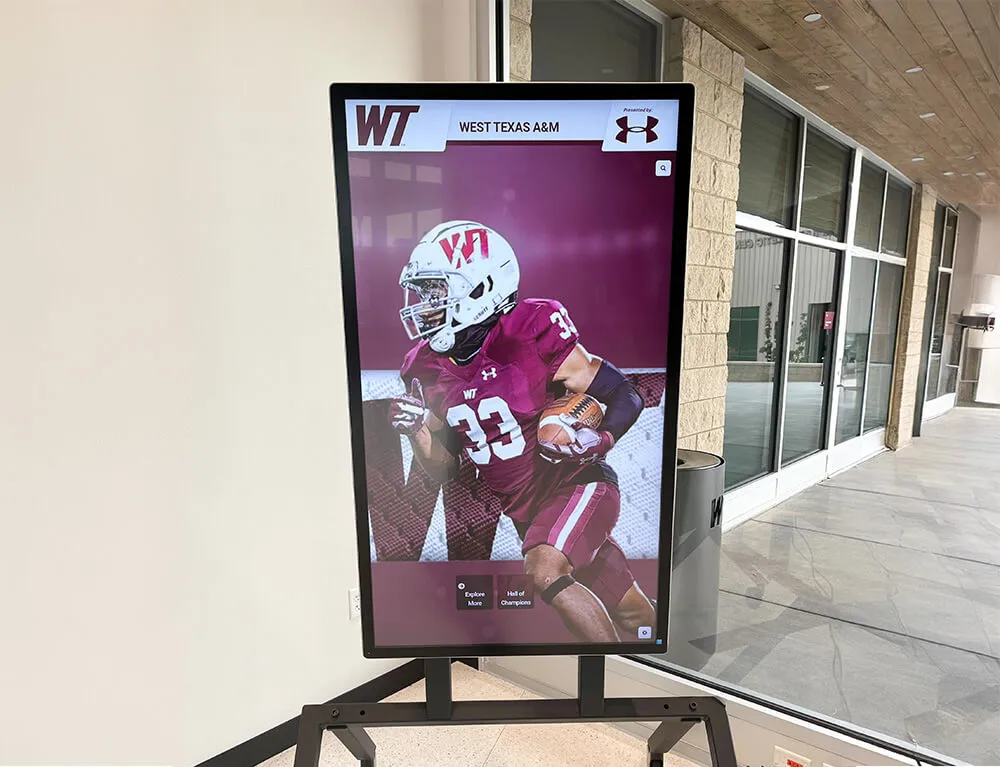
Digitized records and physical banners serve different purposes. A physical banner hung in a gymnasium communicates achievement in the space where that achievement was celebrated; it is experienced in the same place athletes competed. A digital record communicates that same achievement in search results, campus tours, recruitment conversations, alumni outreach, and digital recognition walls where a physical banner cannot hang. Schools that display championship content on interactive digital walls—alongside digital yearbook content, donor walls, and community recognition—report that digital wall mount display systems allow championship archives to reach audiences that never visit the gymnasium. Both physical and digital displays have a role; the assessment process determines which physical banners still merit physical display and which are better served by digital preservation.
What is the estimated cost range for banner repair vs. replacement vs. digitization?
Cost ranges vary significantly by banner size, material, region, and vendor. Repair costs for fabric edge work and lettering re-adhesion typically run from a few hundred dollars up to the cost of replacement for more extensive work. Replacement banners for standard gymnasium sizes typically range from several hundred to over a thousand dollars depending on materials and customization. Photography and metadata documentation for digitization can often be completed by school staff at minimal cost; professional archival scanning or photography for large or complex banners may involve vendor costs. For planning purposes, athletic departments should gather itemized quotes from vendors in each category rather than relying on general estimates. A college football conference championship overview illustrates how championship context and tier influence the scope of archival and display expectations at higher levels—a useful benchmark for understanding what comprehensive recognition infrastructure looks like.
How should championship banners from sports programs that have been discontinued be handled?
Discontinued program banners often carry the highest historical significance scores because there is no ongoing program to generate future championships—the existing banners represent the complete record. Treat discontinued program banners as priority digitization candidates. The physical assessment and significance scoring process remains the same; the action path will almost always favor digitization, careful repair or preservation of the physical object, and retirement from active gymnasium display only if the physical condition requires it. Schools with broader community recognition contexts—alumni walls and multi-program recognition environments—often integrate discontinued program banners into broader archive displays rather than retiring them to storage.
What should be included in the digital record for a championship banner?
At minimum: the sport, season year, award designation, award tier, and school name as it appeared at the time. Where records support it, include the head coach’s name, a roster with first and last names, the opponent and score of the championship event if applicable, any notable context (undefeated season, multiple-year dynasty, comeback from adversity), and one or more photographs of the banner itself. The richer the record, the more useful it is for alumni outreach, recruitment storytelling, and future recognition programming. A thin digital record—year and sport only—is better than nothing, but it is not a substitute for the institutional knowledge that coaches, athletic directors, and community members can contribute when the digitization project is conducted as a collaborative effort rather than a data entry task.
Connecting Banner Assessment to Broader Recognition Strategy
A championship banner condition assessment is not just a maintenance task. It is an occasion to ask a larger question: where does the school’s championship history live, and who can access it?
For most schools, championship history lives primarily in gymnasium spaces that alumni, prospective students, donors, and community members rarely visit. A banner hung thirty feet above a gym floor communicates within that room; it does not communicate on a school website, in a college recruitment conversation, at a graduation celebration, or in the kind of graduation displays and recognition environments that reinforce institutional identity across time.
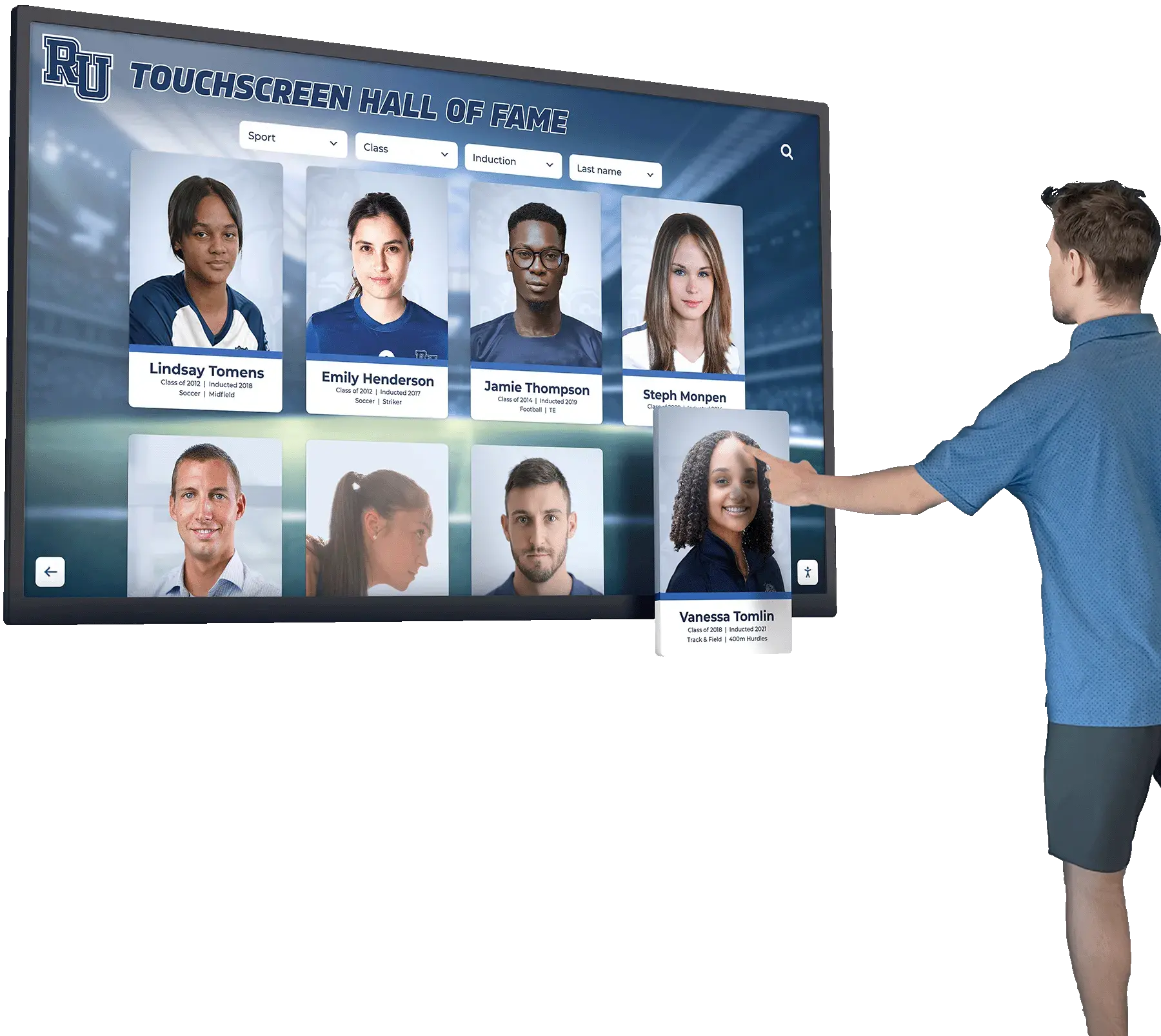
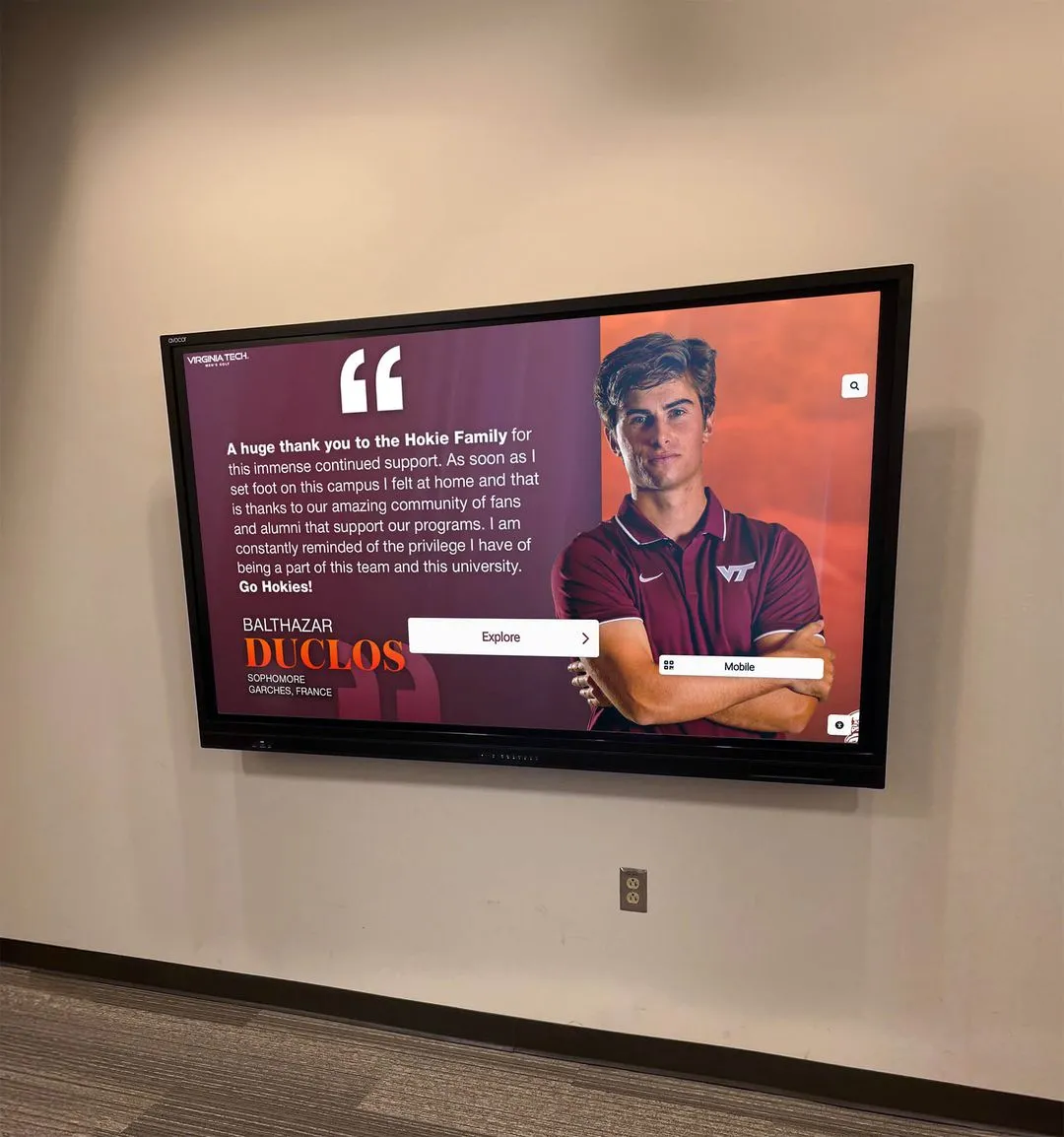
Digital recognition platforms solve that access problem. When championship records are digitized and loaded into an interactive display system, they become part of a recognition environment that is searchable, shareable, and updatable—reaching stakeholders wherever they are, not only in the building where the achievement happened. Trusted by more than 600 institutions, Rocket Alumni Solutions’ platform is fully WCAG 2.1 AA accessible, supports unlimited entries and categories, integrates photos and video, and can be updated remotely by athletic department staff without technical support. Setup typically takes two to four weeks from contract to launch.
A systematic championship banner condition assessment is the responsible starting point for every school that takes its athletic history seriously. The checklist, scoring rubric, decision matrix, and digitization workflow in this guide give your team the tools to inspect every banner, document every decision, and ensure that every championship your school has earned continues to be recognized—in the gymnasium, in the archive, and on the digital platforms where the next generation of students and supporters will encounter it.
Ready to see how a digital recognition platform can extend your championship history beyond the gymnasium walls? Request a custom demo from Rocket Alumni Solutions to see how your school’s banner archive translates into an interactive, accessible digital display.