



A well-maintained volleyball record board is one of the most motivating fixtures an athletic department can install. It tells every player who walks into the gym exactly what the program’s best looks like — and how close she is to joining it. But building a record board that remains accurate, credible, and useful over time requires more planning than simply listing a few numbers on a wall. Schools that invest five minutes in a record board and ten years in neglect end up with a display that undermines program culture rather than reinforcing it.
This guide covers every dimension of volleyball record board planning: which statistical categories to track, how to verify records before they go public, who owns the update process each season, and how digital systems change what is possible for schools serious about long-term recognition.
Walk into most high school gymnasiums and you’ll find one of two situations: a meticulous record board organized by category, maintained with current records, and referenced in team meetings — or a faded sheet behind glass that no one is sure is still accurate. The difference is not talent. It is planning.
According to the National Federation of State High School Associations (NFHS), girls volleyball is the second most popular high school sport in the United States by participation, with more than 470,000 students competing annually. That level of participation means deep statistical history at most schools — and a genuine opportunity to use that history as a motivational and recognition tool, provided the data is organized and accessible.

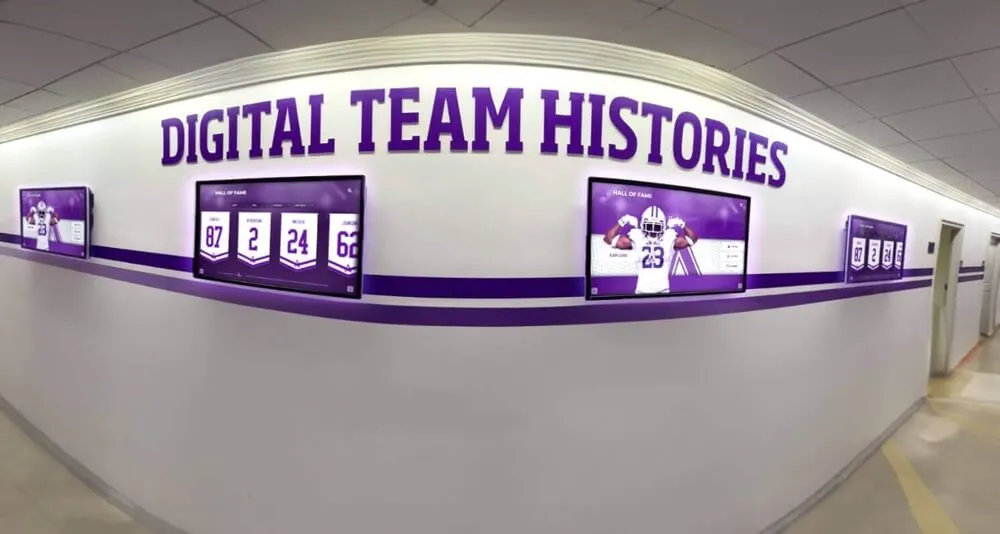
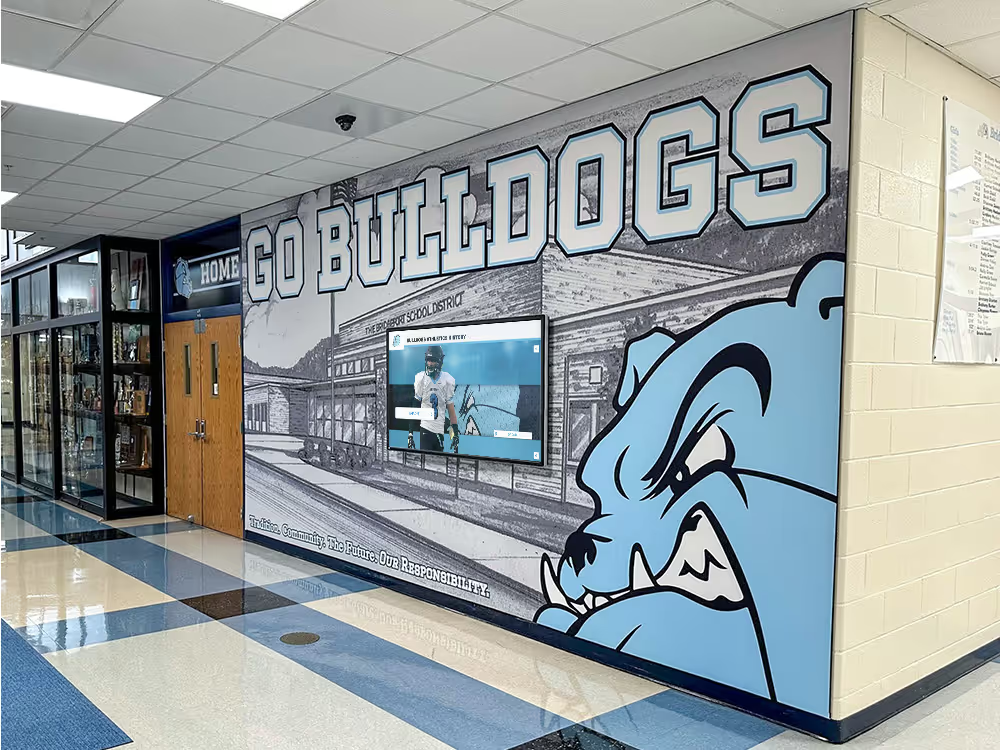
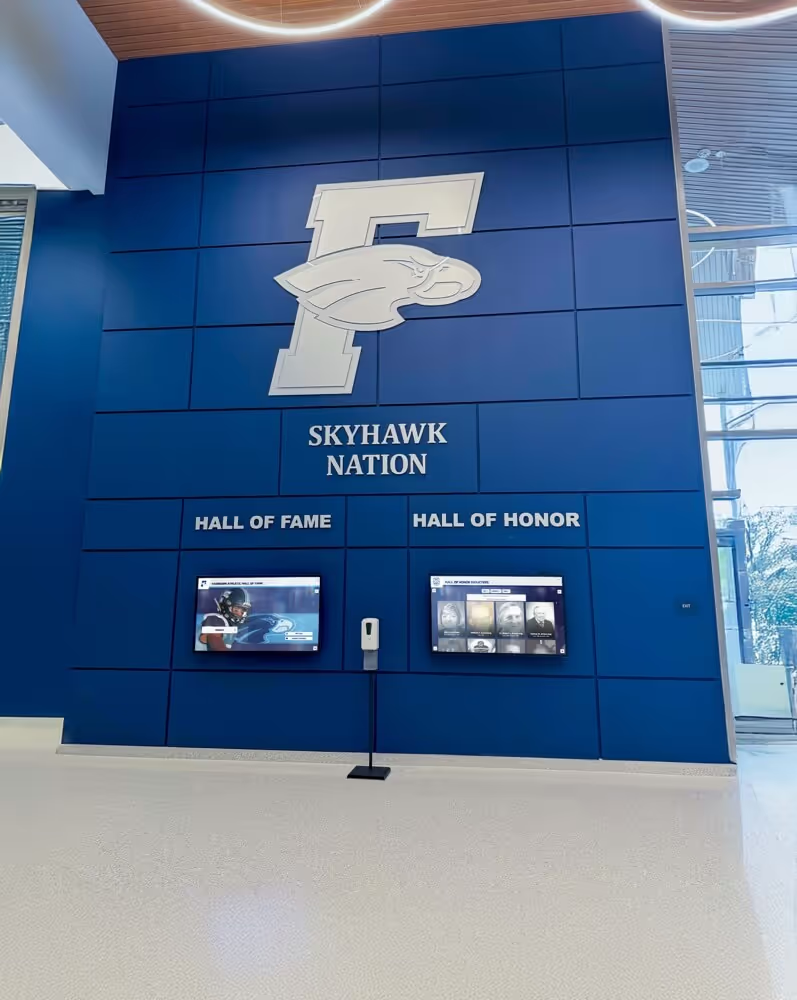
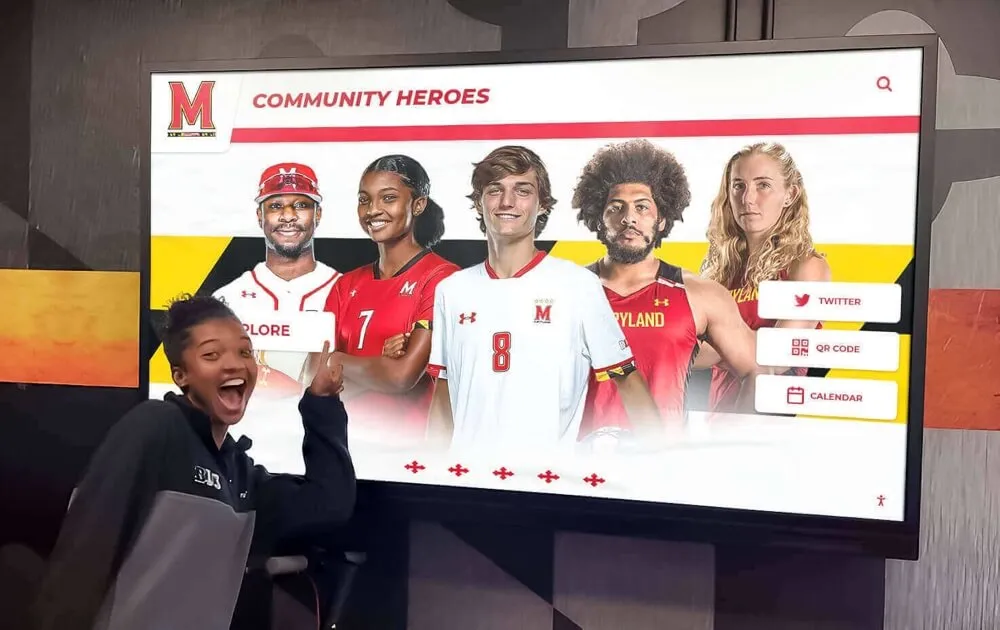
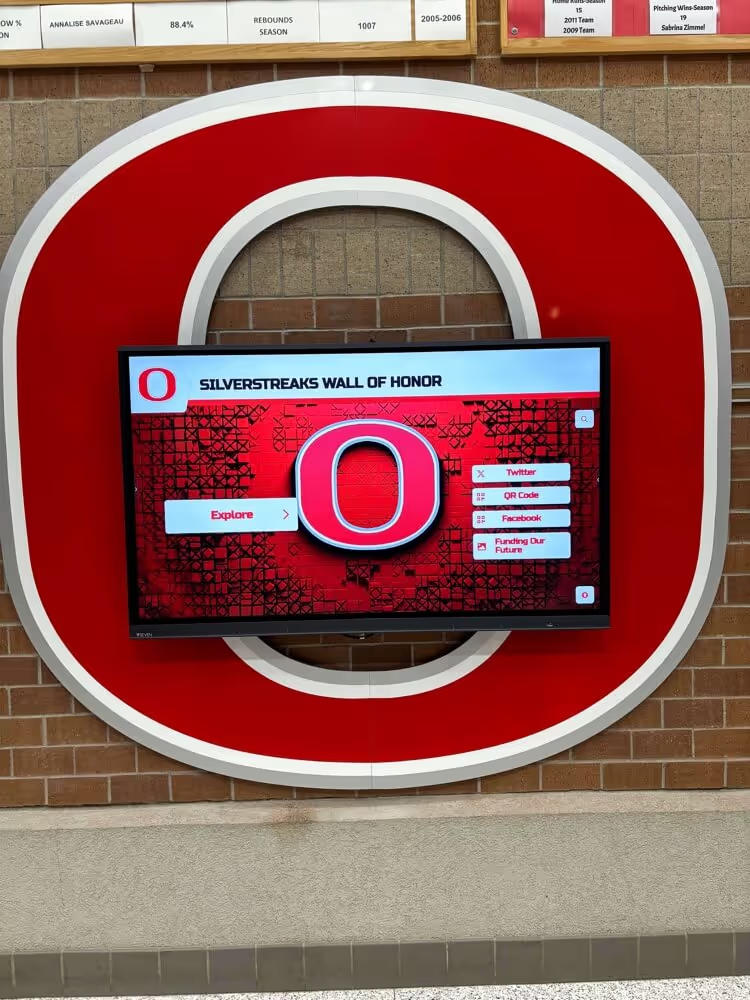
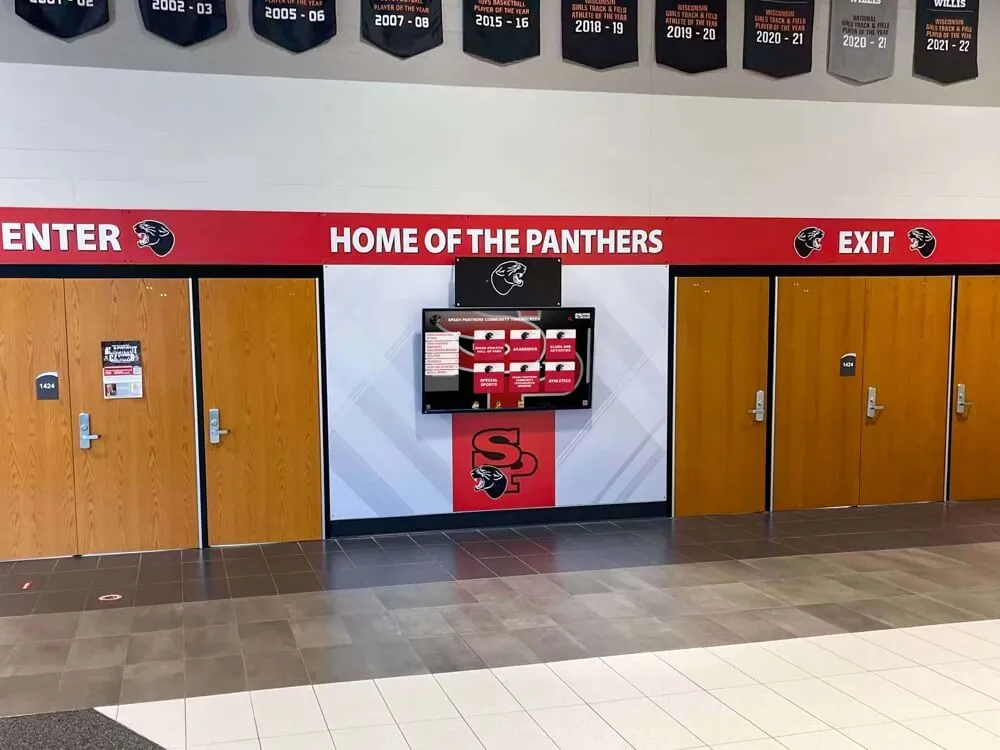
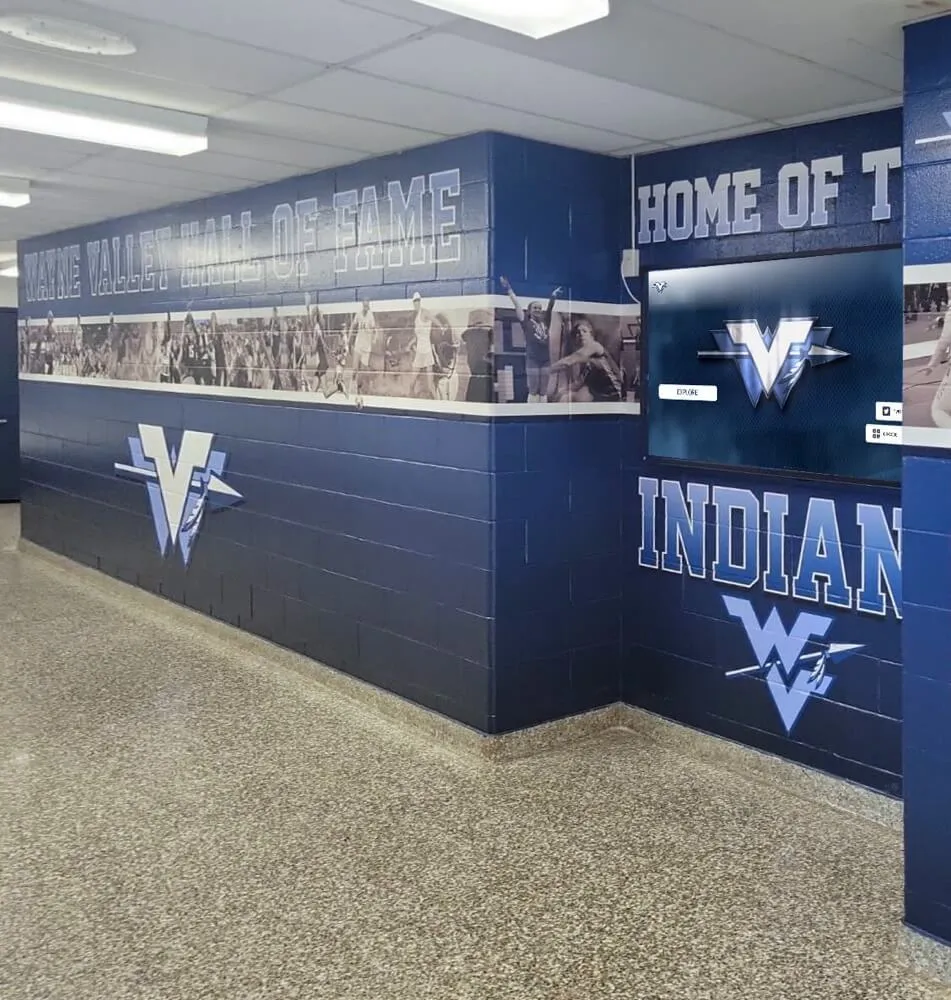
Athletic record displays integrated into hallway murals and digital screens give volleyball programs a visible, high-impact recognition environment that motivates current athletes
What Makes a Volleyball Record Board Work
A volleyball record board serves three constituencies whose needs are not always the same: current players who use it as motivational targets, coaches who use it to communicate program standards, and alumni who return to check whether their achievements have been surpassed or preserved.
For all three, credibility is non-negotiable. A record board with outdated records, missing names, or unverified statistics communicates institutional indifference rather than program pride. Before deciding what categories to track, schools need to establish the operational infrastructure that will keep those categories current.
The fundamental requirements for a functional volleyball record board:
- A designated owner responsible for updates after every season
- A verification standard that defines what documentation is required before a record is posted
- An update schedule that specifies when annual maintenance happens
- A consistent format that applies the same presentation standards to every record, every year
Without these elements, a record board is a decoration. With them, it becomes a program asset.
For schools building out broader athletic recognition infrastructure, the athletic record boards overview provides useful context on how record-keeping principles translate across sports and facility types.
Volleyball Statistics Worth Tracking
Volleyball has a richer statistical vocabulary than many high school record boards reflect. Most programs track kills and aces, then stop. A complete volleyball record board captures the sport’s full statistical range — including defensive and service categories that rarely appear on traditional boards.
Individual Single-Season Records
Single-season records recognize the best cumulative performance across a full season in each statistical category. For volleyball, the most meaningful single-season individual records include:
| Category | Description |
|---|---|
| Kills | Total kills in a single season |
| Kills per set | Average kills per set played (minimum set threshold applies) |
| Aces | Total service aces in a season |
| Aces per set | Average aces per set played |
| Assists | Total assists in a season (setter primary) |
| Assists per set | Average assists per set played |
| Digs | Total digs in a season |
| Digs per set | Average digs per set played |
| Solo blocks | Total solo blocks in a season |
| Block assists | Total block assist touches in a season |
| Total blocks | Solo blocks + half of block assists, per standard statistical convention |
| Hitting percentage | (Kills − errors) ÷ total attempts (minimum attempts threshold applies) |
| Service aces percentage | Aces ÷ service attempts (minimum attempts threshold applies) |
Per-set averages matter because a player who competes in 120 sets has an inherent statistical advantage over a player who competes in 60 — raw totals without context reward participation as much as performance.
Individual Career Records
Career records recognize cumulative achievement across a player’s full varsity tenure. Career records carry different weight than single-season marks because they require sustained performance over multiple years, not a single exceptional campaign.
Career records worth tracking:
- Career kills, aces, assists, digs, and total blocks (matching single-season categories)
- Career games played and sets played (as denominators for per-set calculations)
- Career hitting percentage (minimum career attempts threshold)
Career records are particularly meaningful for a volleyball record board because they represent the athletes most invested in the program over time — and because multi-year contributors are often the first athletes alumni specifically remember when they return to campus.
Team Single-Season Records
Team records document the best collective performance by a program in a single year. These records communicate program trajectory: a team that broke the school record for wins in 2019 and again in 2023 has a program on an upward arc.
Meaningful team single-season records:
- Season wins: Total match victories in a season
- Win percentage: Wins ÷ total matches played
- Conference record: Wins within conference play
- Consecutive wins: Longest win streak in a single season
- Team kills per set: Average kills per set across the full roster
- Team hitting percentage: Team-wide hitting efficiency for the season
- Team aces per set: Average service aces per set, team-wide
- Total sets won: Sets won across the full season (useful for comparing seasons with different match counts)
Match and Set Single-Game Records
Some of the most compelling records on any board are the single-match or single-set bests — performances that capture a peak moment rather than season-long consistency.
Consider tracking:
- Kills in a single match
- Kills in a single set
- Aces in a single match
- Assists in a single match
- Digs in a single match
- Blocks in a single match
Single-game records have a motivational intensity that season totals lack. A player chasing a season kills record needs to outperform an entire season. A player eyeing the single-match kills record has a target she might reach any given night.
Award and Recognition Records
A complete volleyball record board extends beyond statistics to honor records. These categories recognize the accumulation of external achievement rather than raw statistical performance:
- All-conference selections by season: Year-by-year listing of players earning all-conference recognition
- All-state selections: By year and tier (first team, second team, honorable mention)
- Conference championships: Year-by-year listing with win-loss records
- District/regional championships
- State tournament appearances
- State final four, runner-up, or championship finishes
- Player of the year awards: School, conference, regional, or state level
Award records connect the statistical record board to the broader recognition narrative of the program — making visible that the numbers produced results in the form of recognition, championships, and advancement.
For schools looking at how this framework applies to other sports, the basketball record board planning guide demonstrates how comparable categories translate across different team sports and display formats.
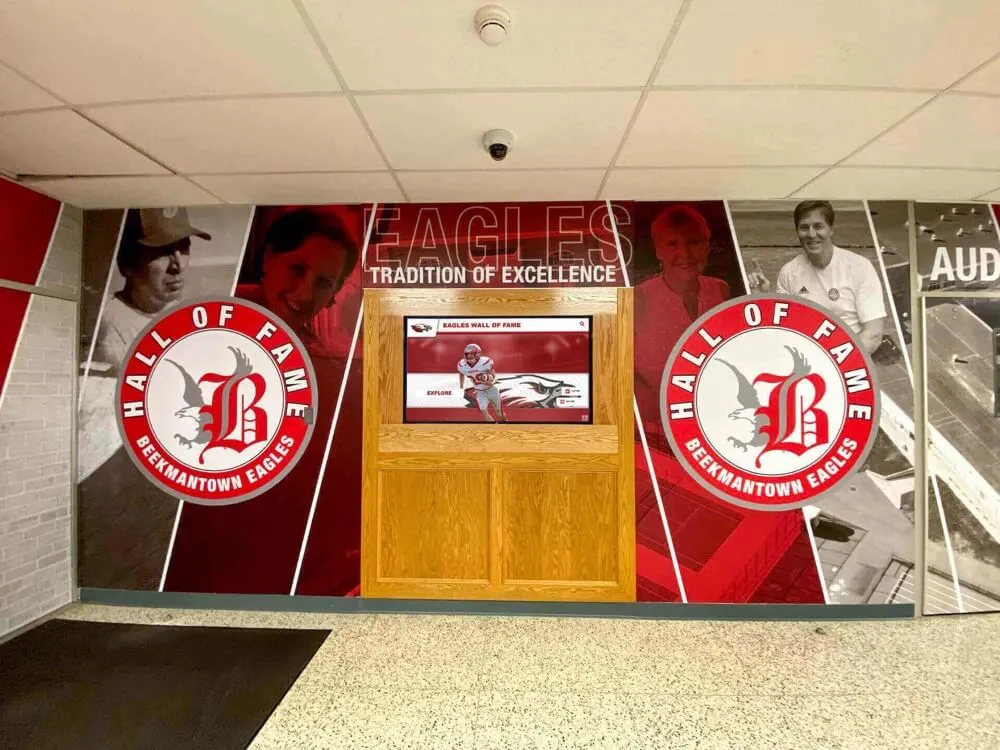
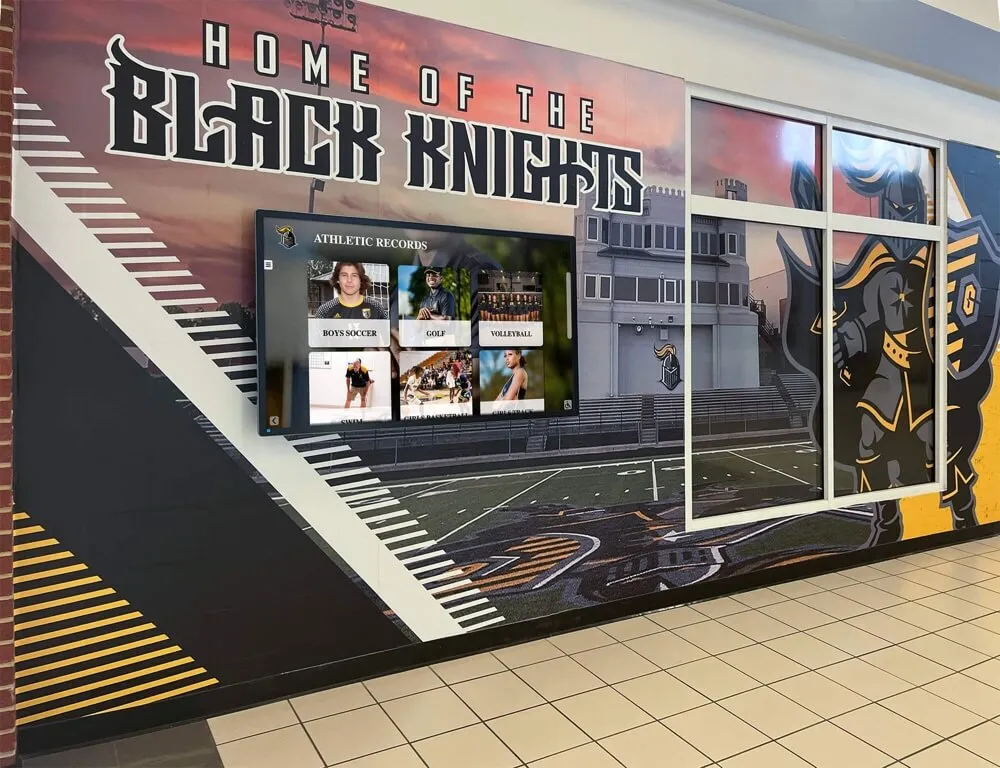
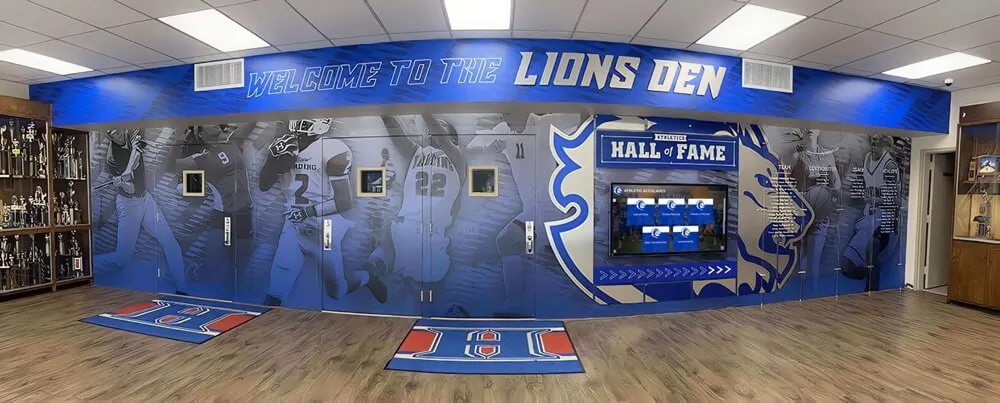
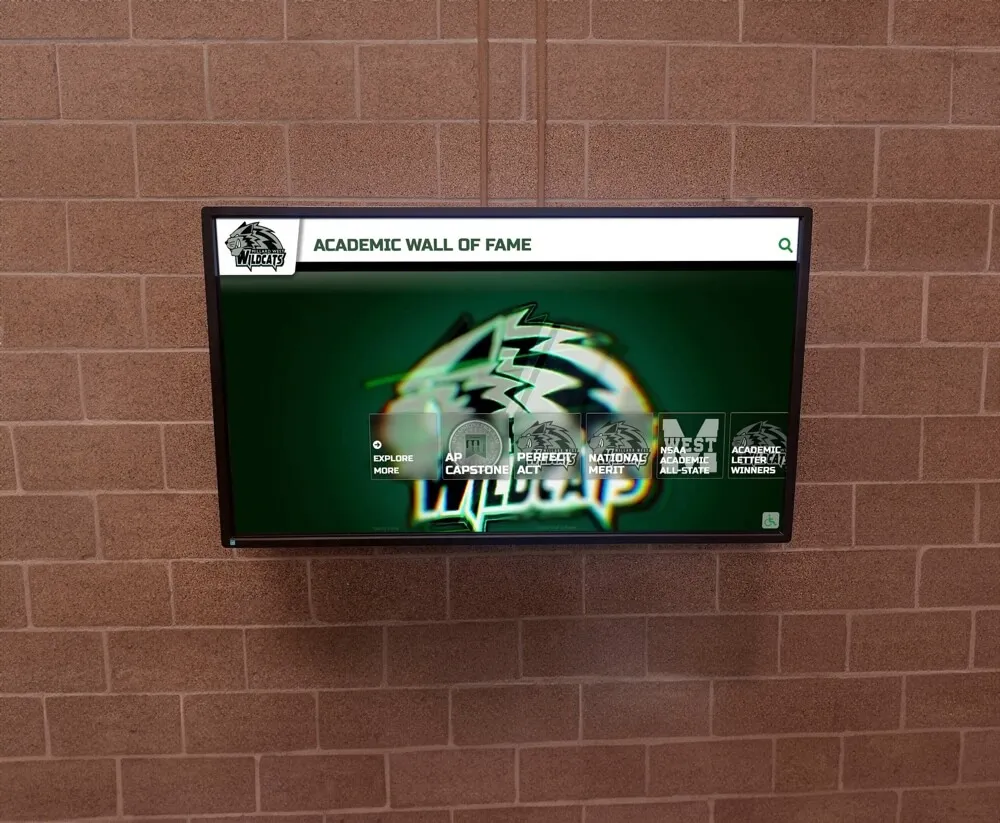
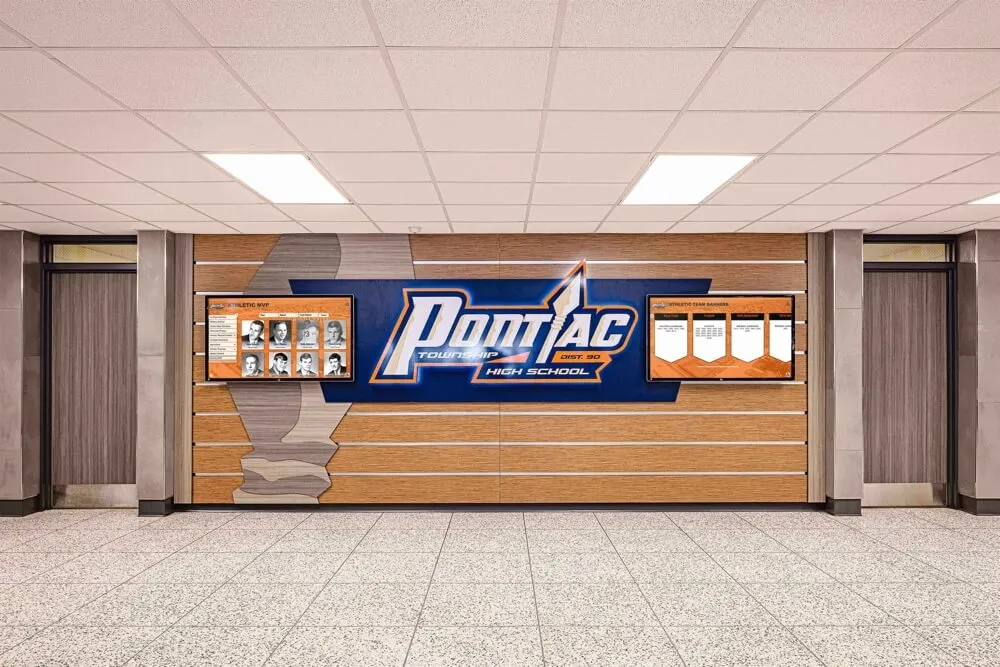
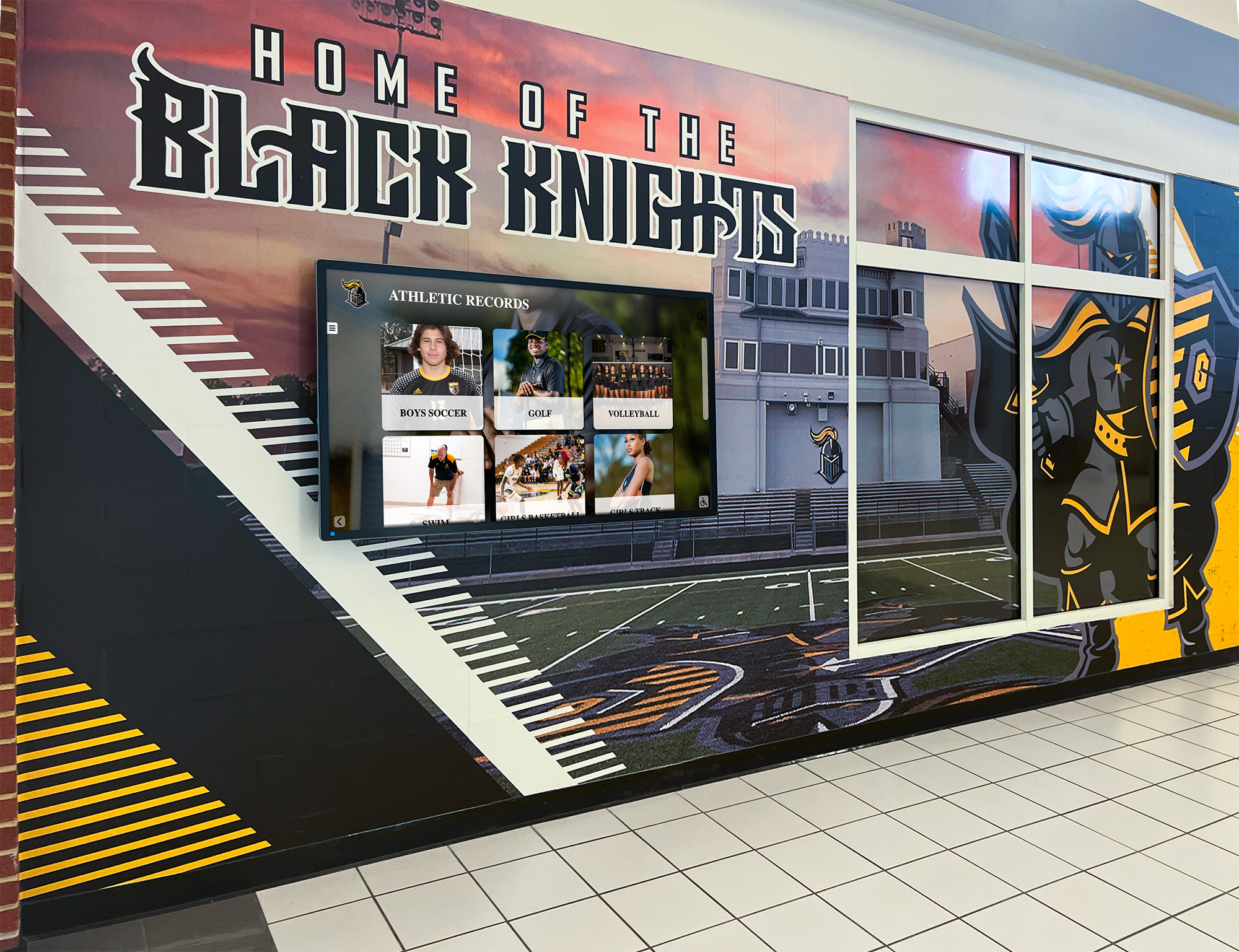
Athletic hallway displays that combine program murals with digital screens allow schools to show real-time records alongside permanent visual identity elements
The Annual Update Checklist
The most common failure mode for volleyball record boards is not bad design — it is gaps in the update process. A single missed season can create enough inaccuracy that the entire board loses credibility. The following checklist prevents that outcome by establishing a repeatable workflow that completes before each new season begins.
End-of-Season Verification (Complete Within 30 Days of Final Match)
- Collect official statistics from the scoring system used for all home and away matches
- Reconcile any discrepancies between the team’s internal stats and official match scorebooks
- Export full season statistics for every player who appeared in varsity competition
- Calculate per-set averages for every eligible statistical category
- Calculate hitting percentage and service ace percentage for players meeting minimum thresholds
- Identify which individual and team records, if any, were broken or tied this season
- Document record-breaking performances with match date, opponent, venue, and official score sheet reference
- Confirm the previous record holder’s documentation is on file before declaring a new record official
- Review award and recognition records: update conference, district, regional, and state results
- Update all-conference and all-state selections as soon as official lists are published
Record Board Update (Complete Before Next Preseason)
- Update all individual single-season records where new bests were set
- Update career records for players who set new career marks in their final season
- Update team single-season records where new bests were set
- Add new entries to award and recognition records (championships, all-state selections)
- Verify every displayed record includes the player’s name, season year, and the statistical value
- Review the record board for accuracy of all records, not just those changed this season
- Photograph the updated record board and store in the athletic department’s digital archive
- Communicate additions to the school’s athletic communications staff for recognition in game programs and social media
Multi-Year Audit (Complete Every Three to Five Years)
- Pull original scorebooks or statistical archives for a full cross-reference against posted records
- Verify that career records reflect complete varsity career totals, not just years within one coach’s tenure
- Confirm that records credited to players who graduated before digital statistical systems were in place have accurate documentation on file
- Review minimum threshold standards for rate statistics (per-set averages, hitting percentage) and confirm they have been applied consistently
- Assess whether any additional statistical categories warrant addition to the record board
Verification Standards That Protect Record Credibility
A volleyball record board is only as credible as its verification process. Schools that post records based on memory, player self-reporting, or partial-season statistics create disputes that are difficult to resolve and damaging to program culture.
A workable verification standard for high school volleyball records:
Primary documentation: Official match scoresheets or the statistical output of the official scoring system used during the season. For programs using statistical software (for example, DigStat, Hudl, or similar platforms), the platform’s official season summary report constitutes primary documentation.
Secondary documentation: Newspaper game reports, official state association records, and official tournament programs can corroborate primary documentation but should not substitute for it.
Minimum thresholds for rate statistics:
- Hitting percentage: minimum 2 attempts per set played for single-season records; minimum 1.5 attempts per set for career records
- Per-set averages: minimum 50 sets played for single-season records; minimum 100 sets played for career records
These thresholds prevent a player who appears in limited action from claiming a rate-based record on a small statistical sample that would regress to the mean over more sets.
Tie-breaking policy: When two players achieve identical values in any record category, both names should be posted with both seasons listed. Do not arbitrarily award a record to the first holder when a tie exists.
Retroactive correction policy: When a record is found to be incorrect due to statistical error, the corrected record should replace it with a notation of when the correction was made. Transparency about corrections maintains credibility better than silently adjusting numbers.
For a broader perspective on how record boards fit into athletic recognition design, the athletic record boards design and display guide covers layout principles applicable to static and digital record displays.
Physical vs. Digital Volleyball Record Boards
High school volleyball programs have two primary display formats to choose from — and increasingly, schools are using both in complementary ways.
Physical Record Boards
Traditional physical volleyball record boards — typically mounted in the gymnasium lobby, the athletic corridor, or the gym itself — provide the immediacy that visitors experience without any technology interface. A player walking into the gym for the first time sees the record board without having to find a screen or tap a display.
Physical boards work best when:
- The program has a stable category structure that changes infrequently
- The facility has dedicated, high-visibility wall space for athletic recognition
- Updates can be made within a budget for engraving or reprinting record entries
- The visual design matches the aesthetic of surrounding recognition elements (trophy cases, championship banners, hall of fame sections)
The primary limitation of physical boards is capacity. A program with 40 years of volleyball history and records across 15+ statistical categories needs substantial wall space. When that space runs out, programs face difficult choices about archiving older records, reducing category coverage, or leaving the display unsustainable.
Physical record board ideas that maximize visual impact include using sport-specific color schemes, custom mascot graphics, and consistent font systems that project program identity rather than generic athletic formatting. For specific design approaches, school record board display ideas provides design frameworks applicable to volleyball-specific installations.
Digital Record Boards
Digital volleyball record boards eliminate the capacity constraints of physical installations and allow programs to track more categories with more depth than any physical format can support. Digital systems can maintain:
- Full career and season statistics for every player in program history
- Video highlights linked to record performances
- Photographs and biographical information for record holders
- Searchable archives accessible by season, category, or athlete name
- Real-time updates without fabrication delays or engraving costs
For programs considering a full digital replacement or a digital-physical hybrid, the touchscreen athletic record board comparison guide evaluates the major system types side by side with relevant school selection criteria.
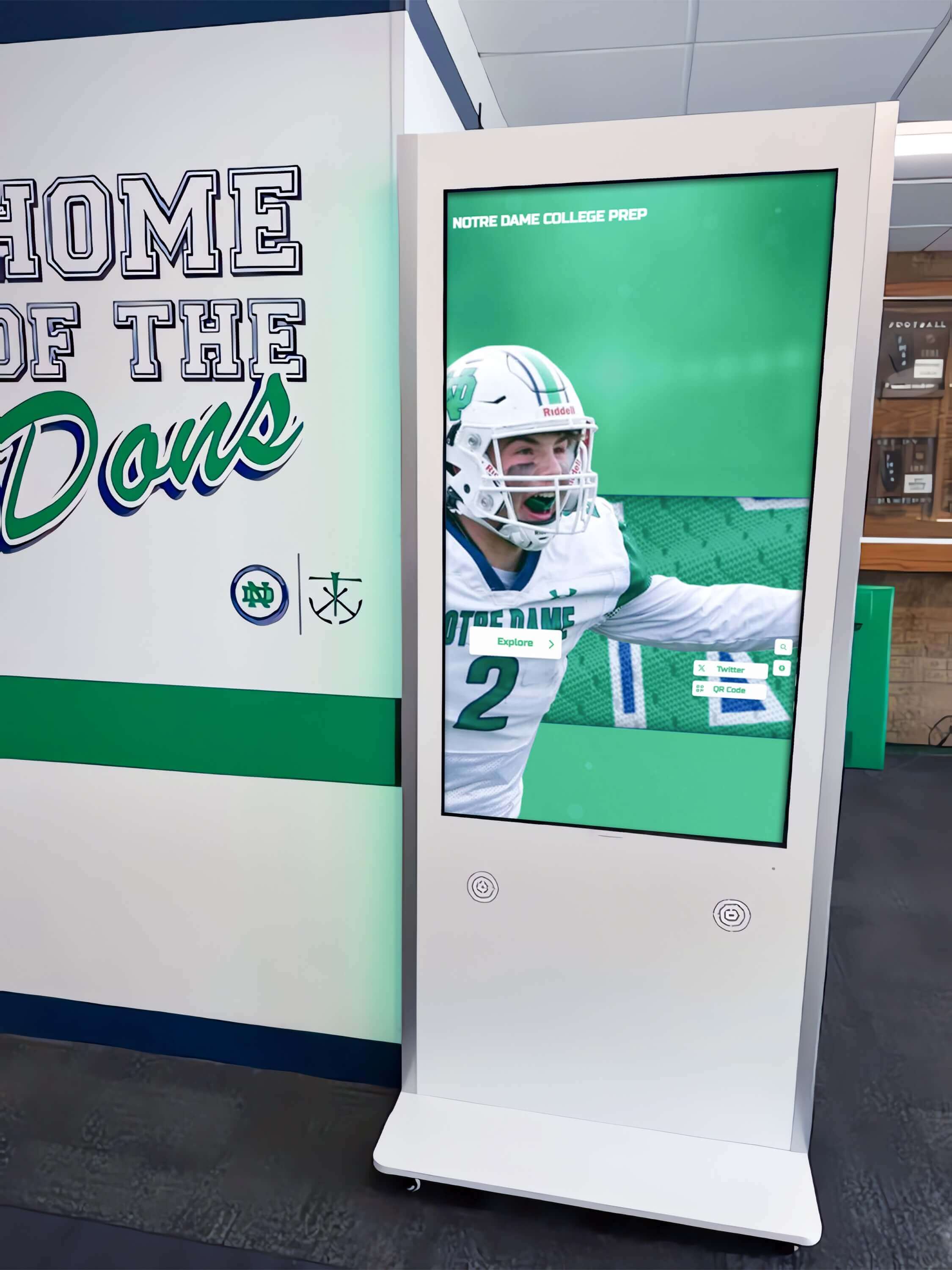
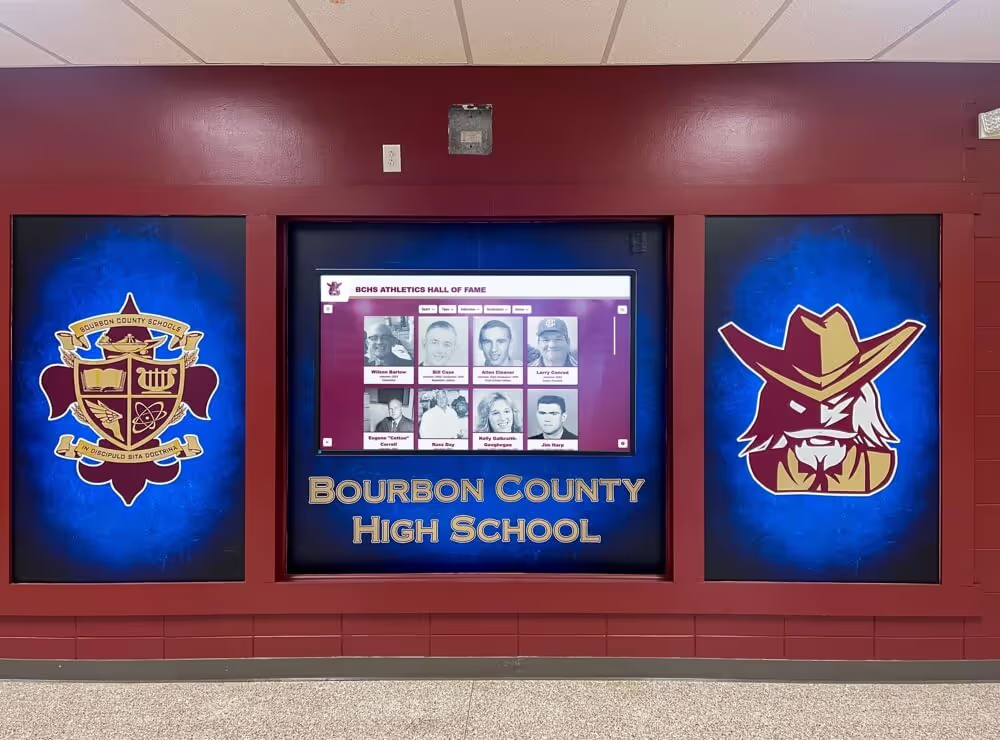
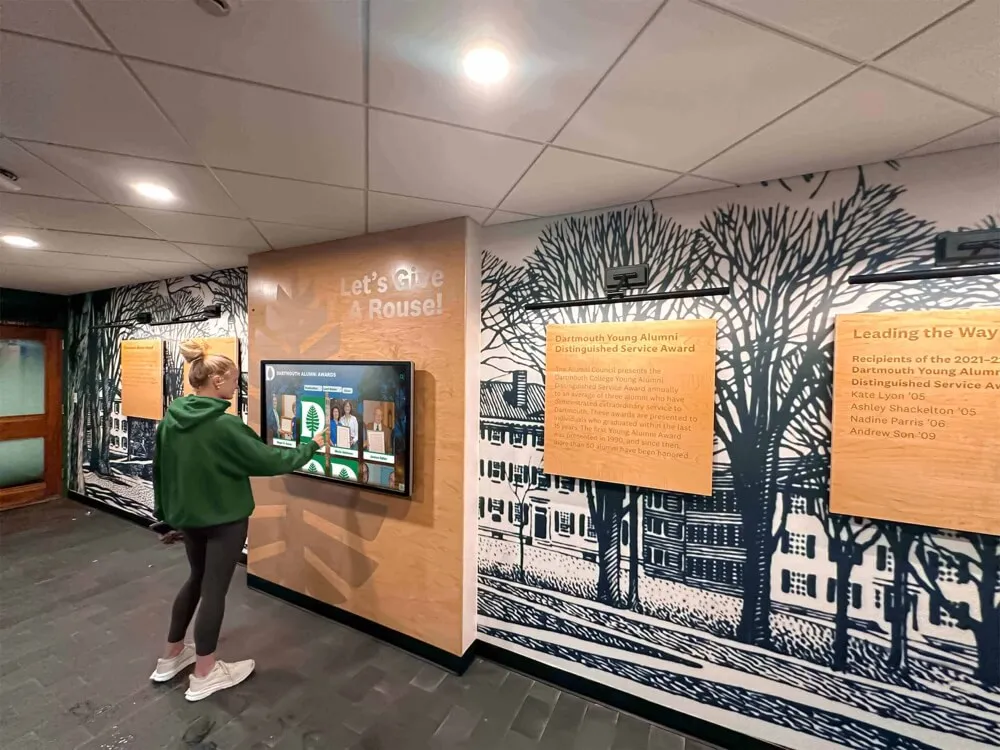
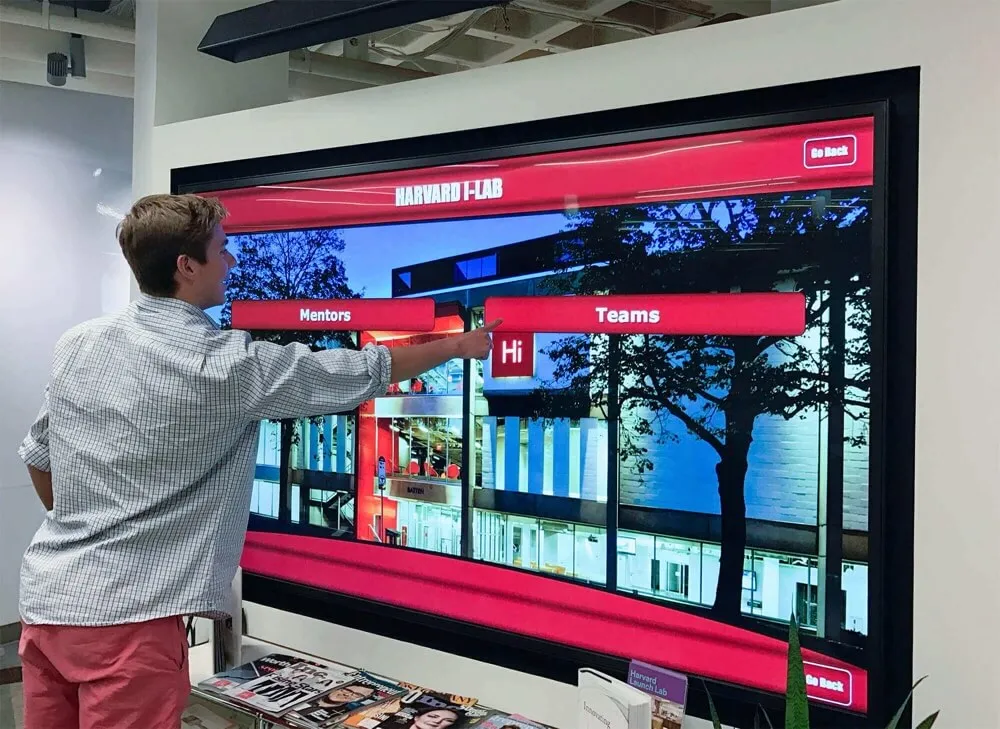
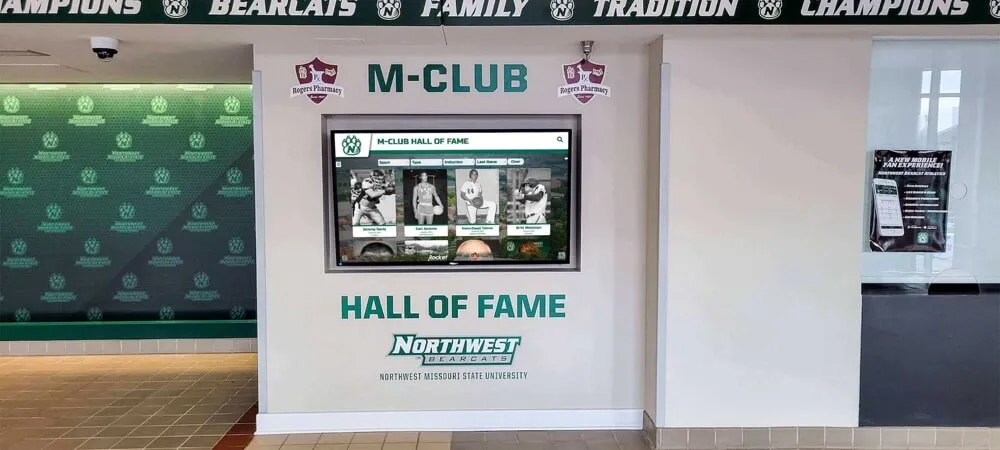
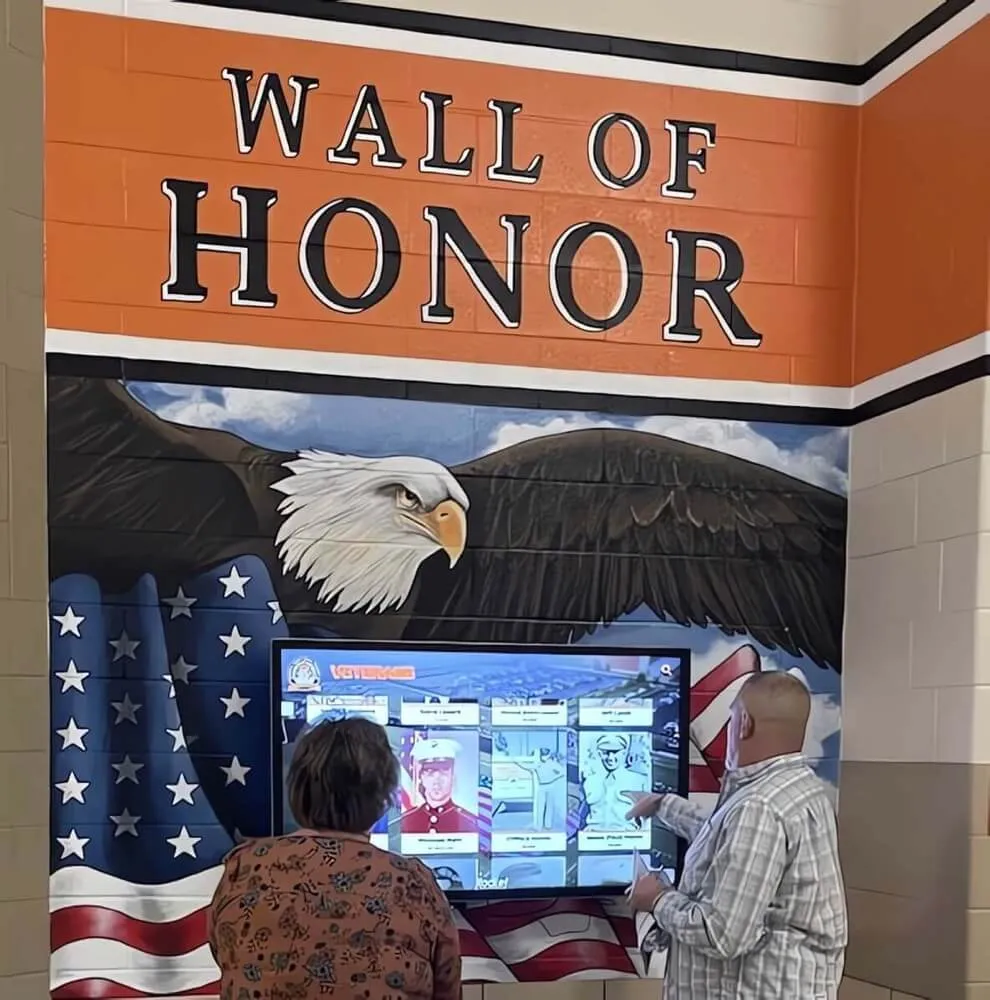
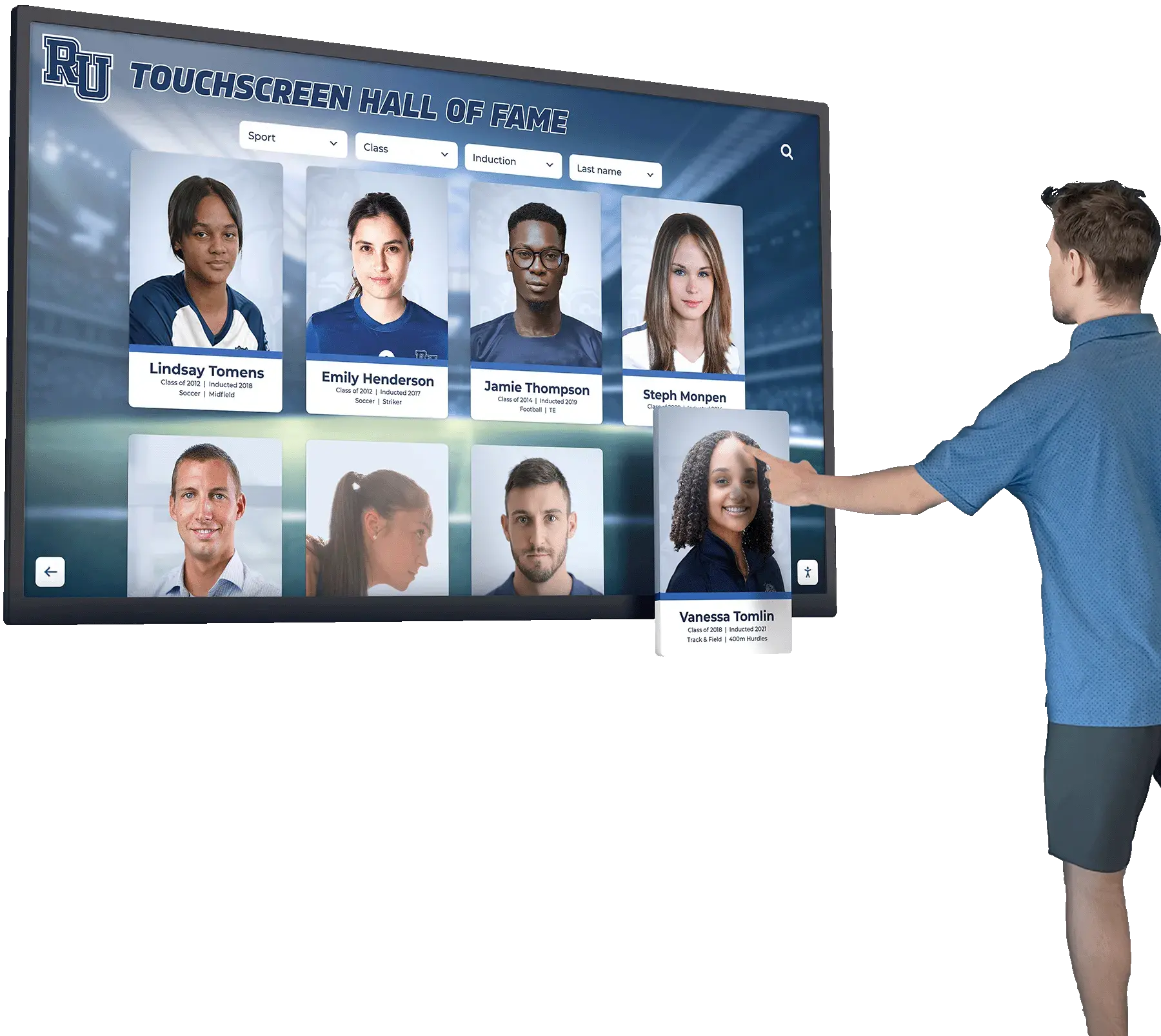
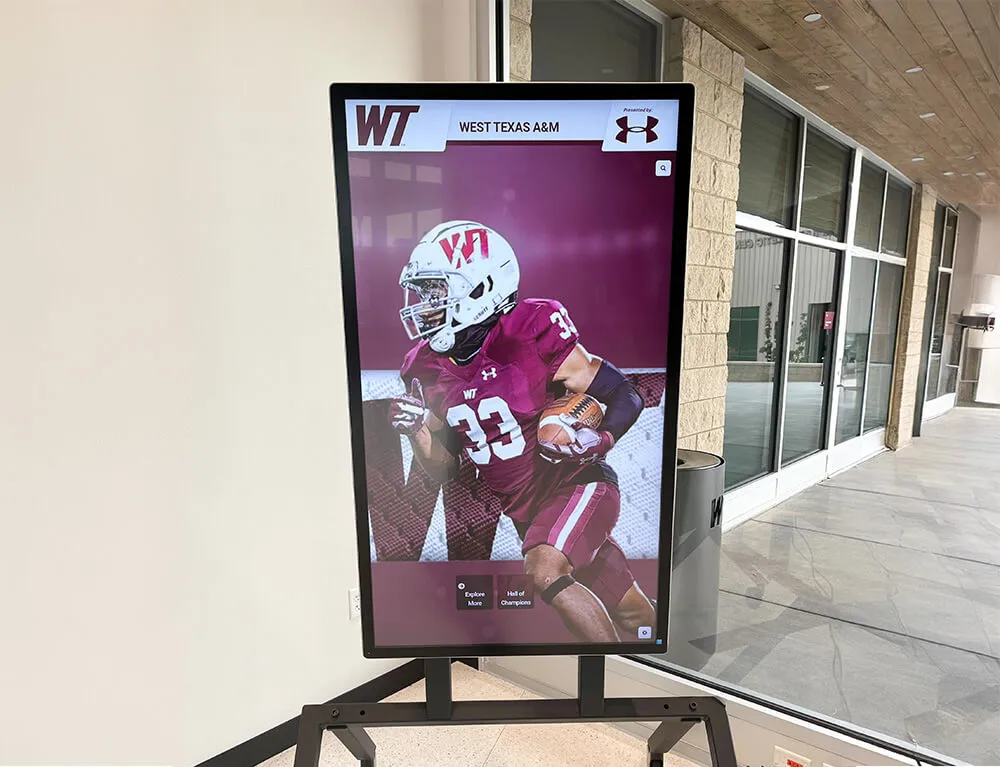
Interactive touchscreen kiosks allow schools to display volleyball records with unlimited depth — photos, statistics, career histories, and match-level documentation in a single searchable system
Ownership: Who Updates the Volleyball Record Board?
The practical failure point for most volleyball record boards is not design or budget — it is ambiguous ownership. When no specific person is responsible for updates, updates do not happen. Distributing the responsibility across multiple staff members without clear protocols produces inconsistency.
A sustainable ownership structure assigns:
Primary owner: The head volleyball coach or the school’s athletic director. This person is responsible for approving records before they are posted, maintaining the verification file, and ensuring the annual update cycle completes.
Statistical support: The program’s official statistician, the school’s sports information department (at schools with one), or a designated assistant coach. This person is responsible for producing the end-of-season documentation that feeds the verification process.
Facilities coordination: For physical boards, whoever coordinates with the sign shop or engraver for annual updates. For digital systems, the staff member with administrative access to the content management system.
Backup documentation: Athletic department administrative staff responsible for maintaining physical copies of scoresheets and statistical reports for the program’s archival retention period.
When these roles are written into job responsibilities or formally communicated at the start of each school year, the record board update cycle is far more likely to complete on time.
Connecting the Record Board to the Full Recognition Environment
A volleyball record board should not exist in isolation from the rest of the athletic recognition environment. Programs that integrate their record boards with other recognition elements — championship banners, hall of fame displays, award cases — create a cohesive narrative of program achievement that is more motivating and more meaningful than any single element alone.
Specific integration opportunities:
Record board + championship banners: Reference the season year on the record board that corresponds to championship seasons displayed on hanging banners. Visitors can connect a single-season records spike to the year the program won conference.
Record board + hall of fame: When hall of fame inductees held records at the time of their graduation, note that context in the inductee profile. Record holders are often exactly the athletes hall of fame programs should be recognizing.
Record board + digital walls of fame: Schools using digital recognition systems can link record board entries directly to the hall of fame profiles of athletes who appear on both, creating a discovery experience rather than a static list.
For schools designing comprehensive athletic recognition hallways that integrate multiple recognition formats, the sports bulletin board and display ideas guide provides design principles for combining record boards, achievement displays, and team recognition into cohesive hallway environments.
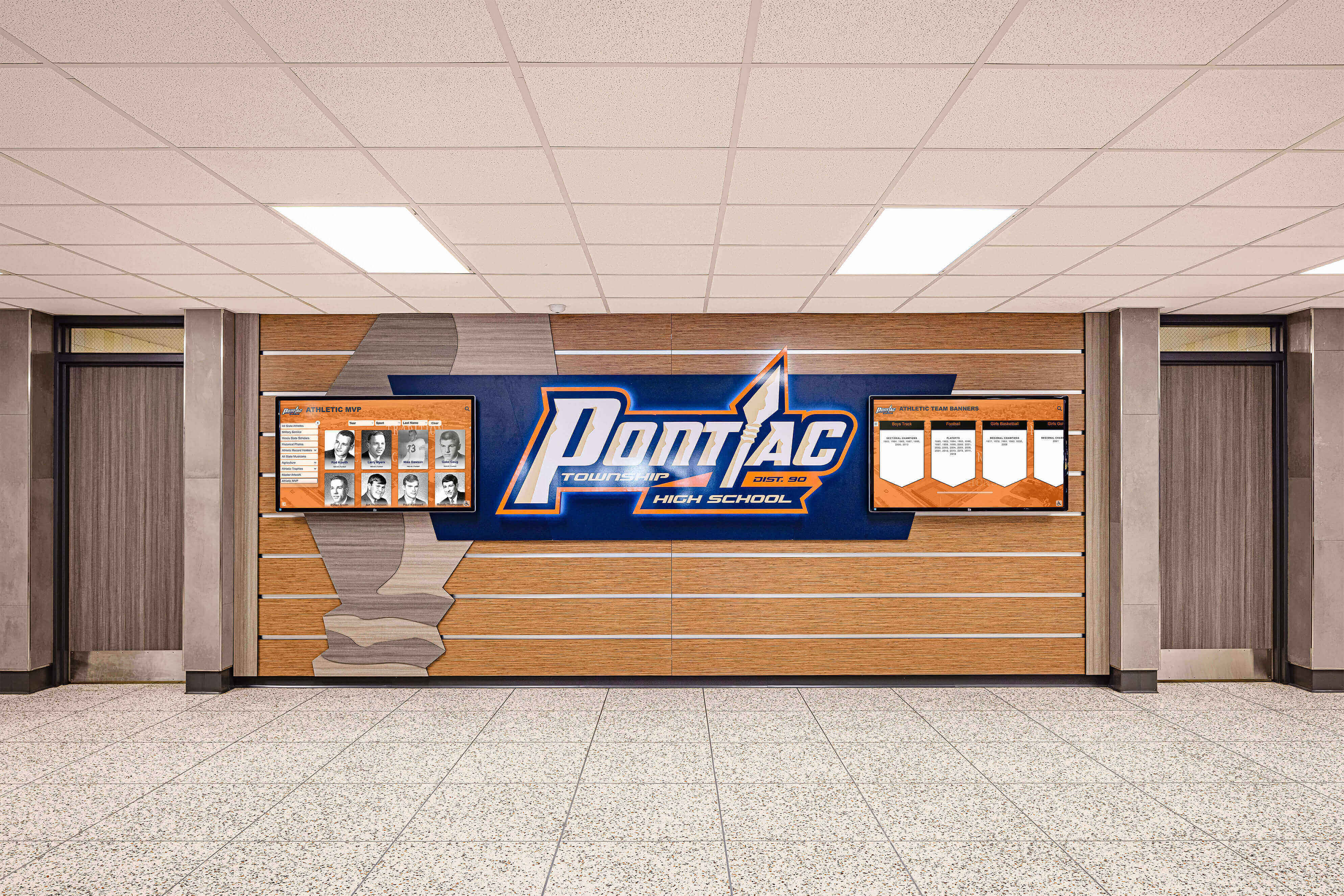
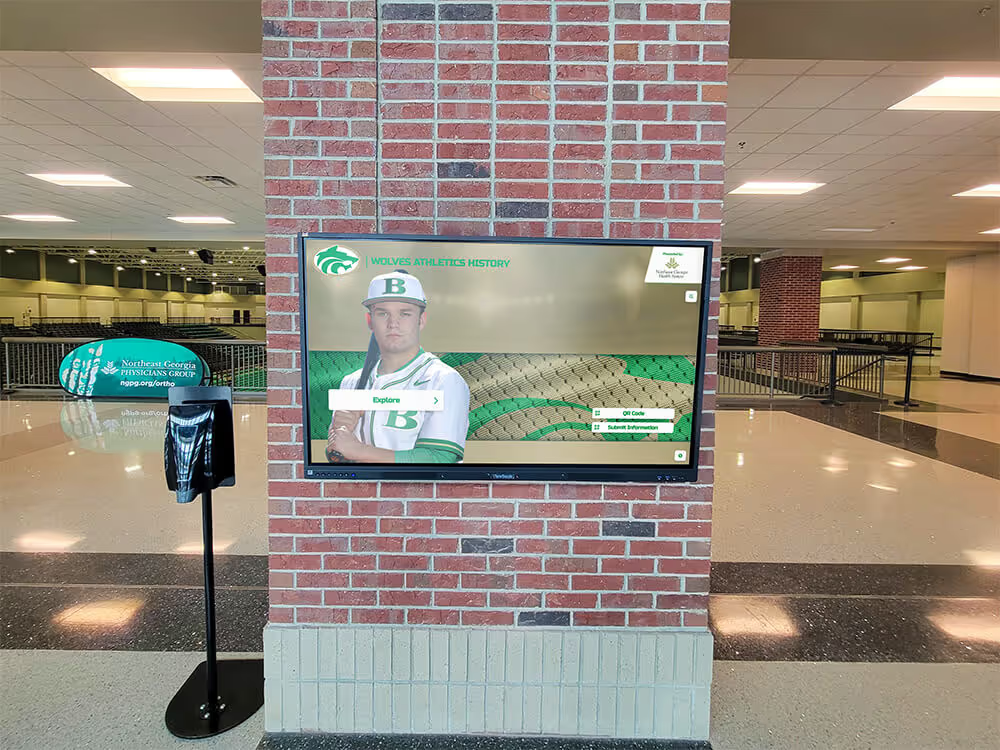
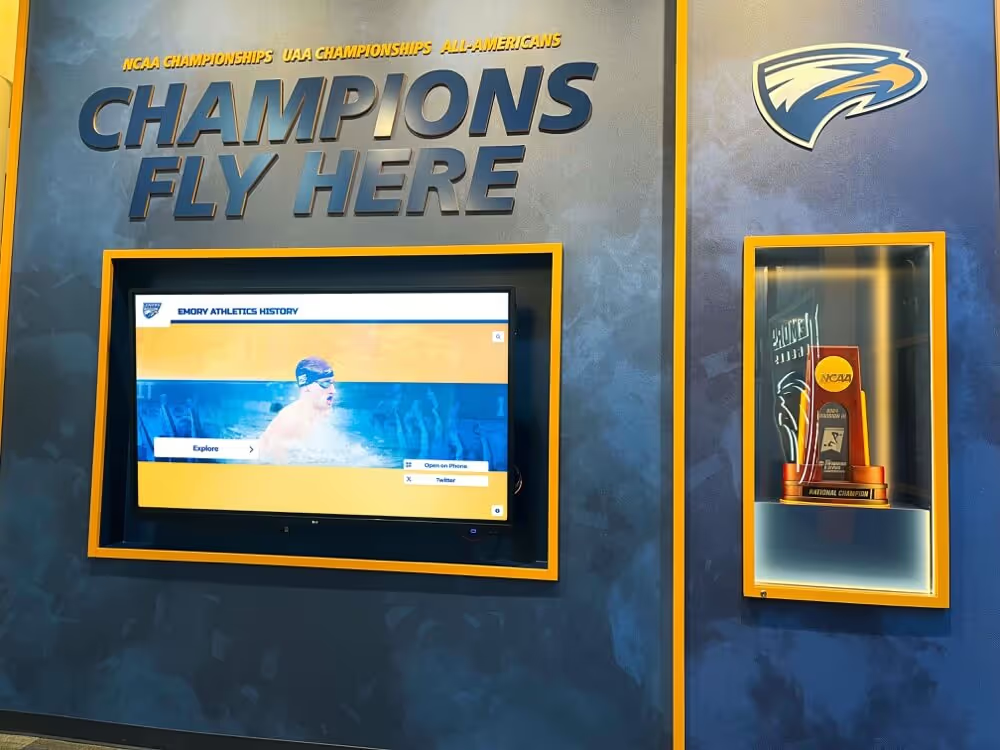
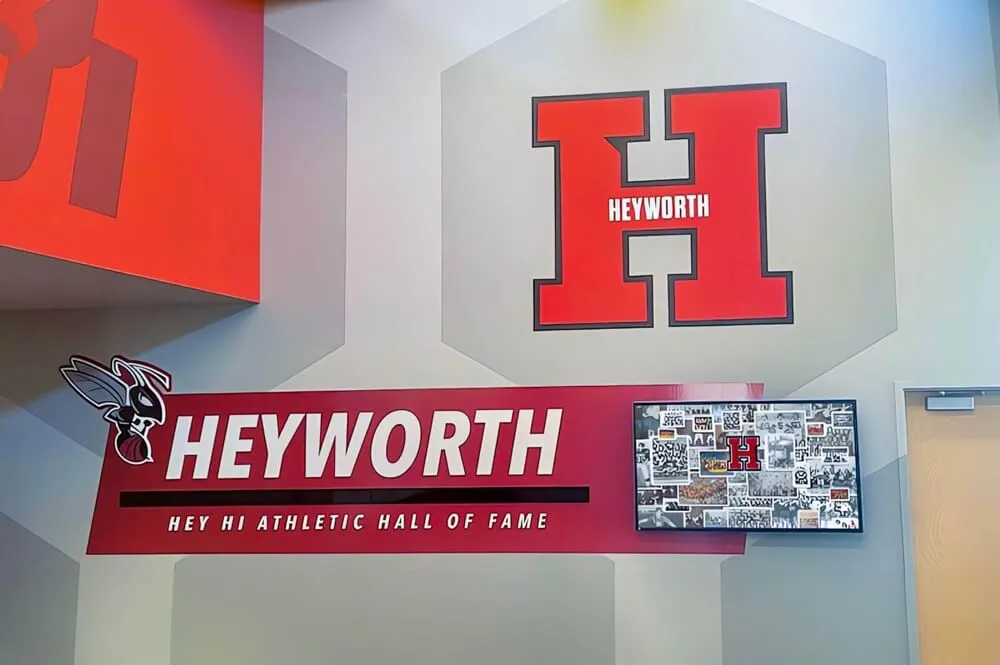
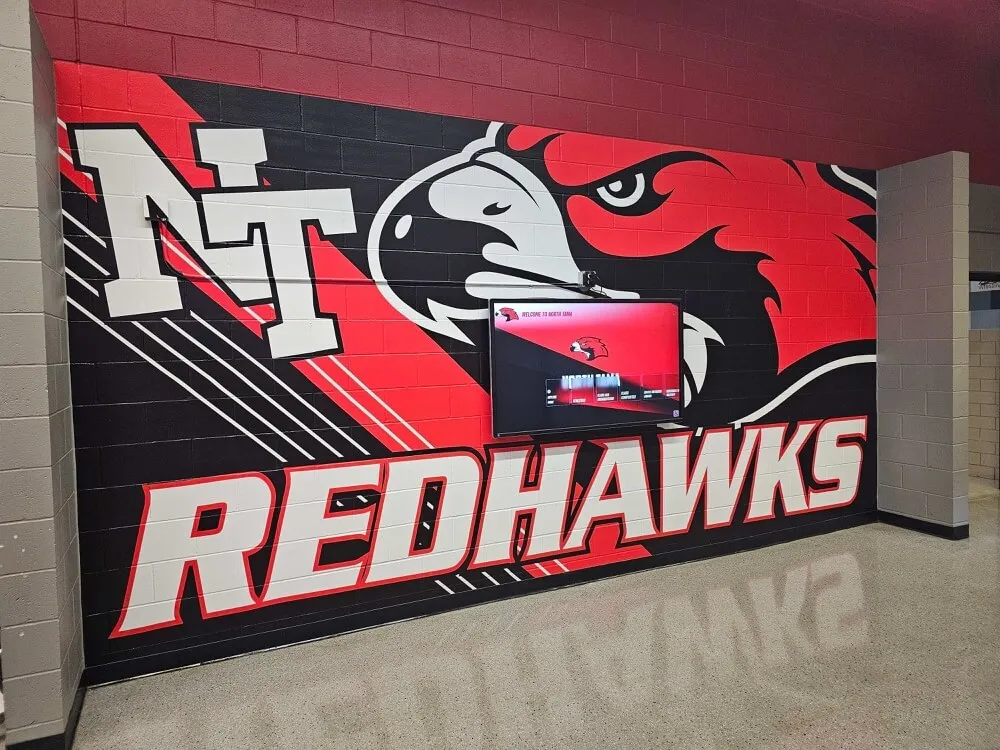
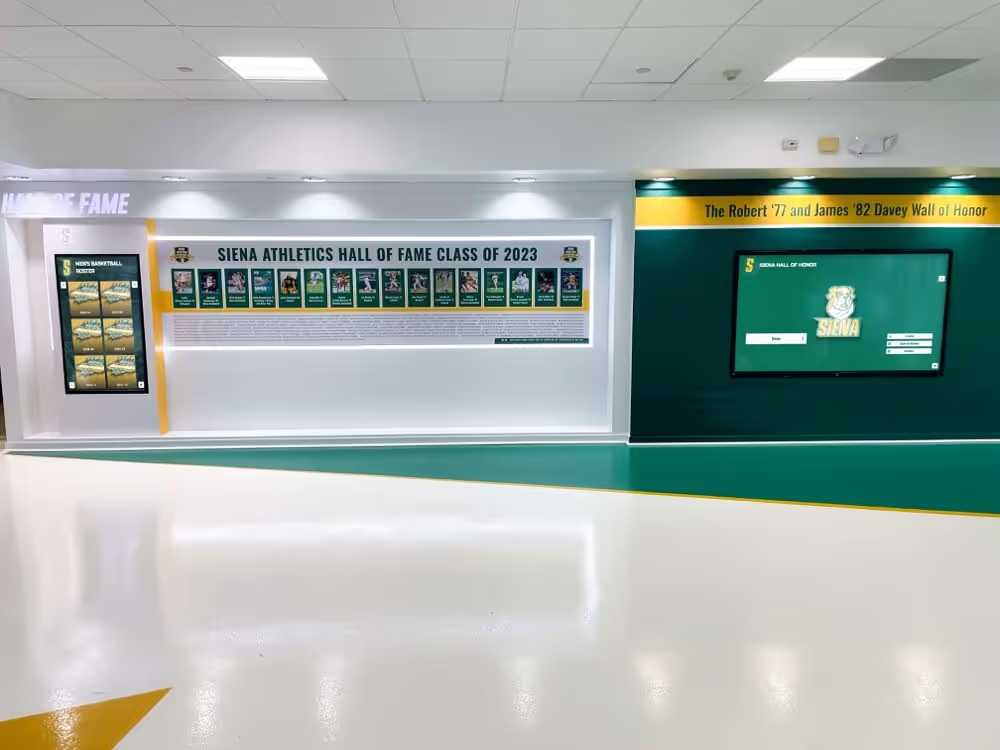
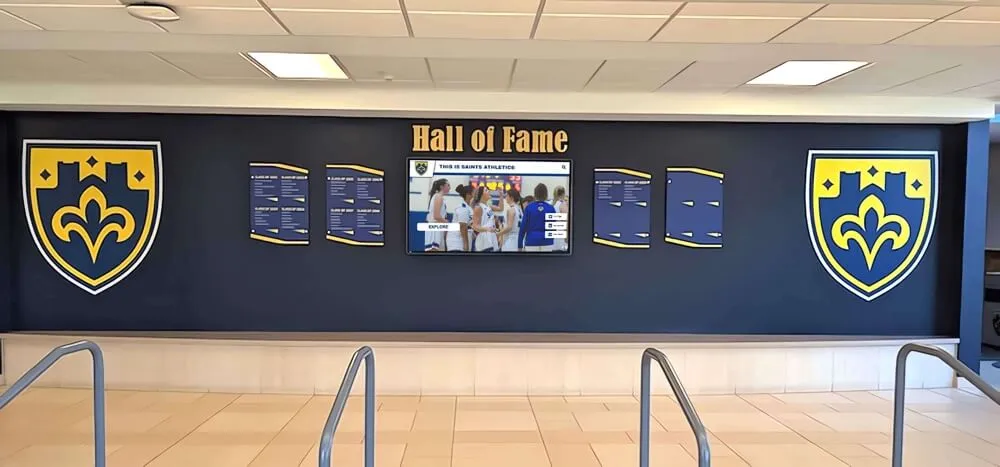
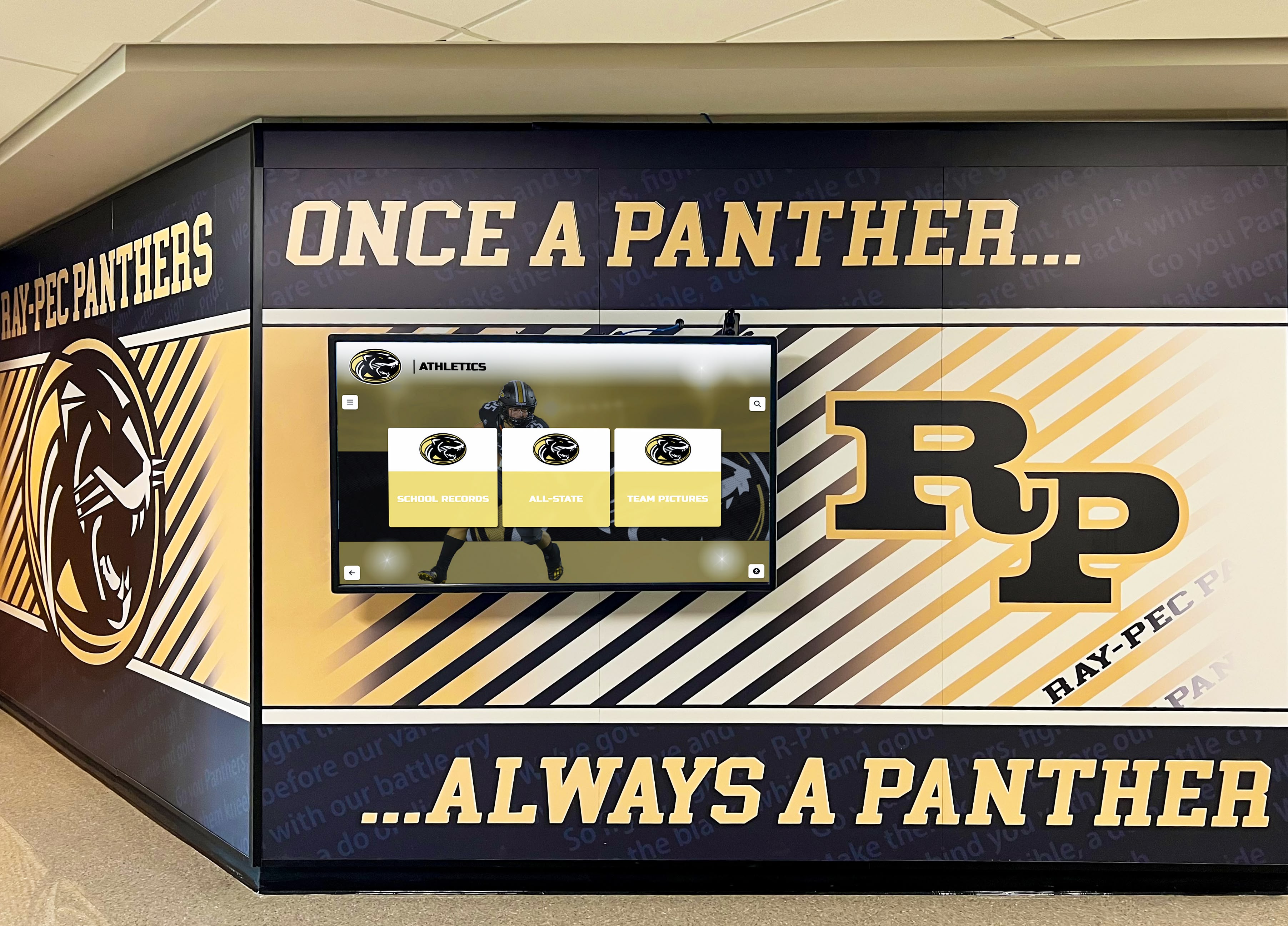
Athletic honor corridors that use consistent mascot branding and logo treatment across record boards and recognition displays create a unified identity rather than disconnected athletic elements
Rocket Alumni Solutions: Digital Record Boards for Volleyball Programs
Rocket Alumni Solutions builds touchscreen digital record boards and walls of fame designed specifically for school athletic programs. The platform allows volleyball programs to move beyond the capacity and update limitations of physical record boards — hosting complete statistical archives, award histories, career records, and season-by-season documentation in a single interactive display managed through a cloud-based content system.
For volleyball programs, the platform supports:
- Unlimited statistical categories: Track kills, aces, assists, digs, blocks, hitting percentage, per-set averages, and any custom category relevant to the program — without worrying about running out of physical space
- Searchable record archives: Visitors can search by player name, season, or category to find specific records or explore program history
- Rich media record profiles: Record holders can be displayed with photographs, career biographical information, and links to video highlights rather than a name and a number
- Annual update workflow: The content management system supports a straightforward annual update process that does not require technical expertise
- Physical + digital integration: Digital displays complement existing physical record boards and championship cases, creating a hybrid recognition environment rather than replacing what is already there
The platform serves more than 600 institutions — from single-sport high school programs to large university athletic departments — providing a system flexible enough to accommodate programs at any stage of recognition development.
For schools evaluating how digital recognition fits alongside traditional physical records displays, creative ways schools display athletic records outlines the hybrid approaches that work best in existing athletic facilities.
FAQ: Volleyball Record Board Planning
What statistics should a high school volleyball record board track?
A complete high school volleyball record board should track individual single-season and career records for kills, aces, assists, digs, and blocks — both as raw totals and as per-set averages. It should also include rate statistics like hitting percentage and aces percentage for players meeting minimum attempt thresholds. Team records should cover season wins, win percentage, team hitting percentage, and consecutive wins. Award and recognition records documenting conference championships, all-conference selections, all-state honorees, and state tournament results round out a comprehensive record board.
How often should a volleyball record board be updated?
A volleyball record board should be updated once per season — ideally within 30 days of the final match and before the next preseason begins. This timeline allows for verification of records broken during the season while memories and documentation are still current. A more thorough multi-year audit comparing records against original scorebooks should be conducted every three to five years to catch any inaccuracies that accumulated over time.
Who should be responsible for maintaining a school’s volleyball record board?
The head volleyball coach or athletic director should serve as primary owner of the record board, responsible for approving records and ensuring the annual update cycle completes. A designated statistician or assistant coach handles documentation verification, while a staff member with facilities access manages the physical or digital update. Writing these roles into formal job responsibilities prevents the common failure mode where update responsibility falls to no one in particular.
Should volleyball record boards include per-set averages or just total statistics?
Both. Total statistics are important and familiar, but per-set averages are essential for fair comparison across seasons where players competed in different numbers of sets. A player who competes in 120 sets will accumulate more total kills than an equally skilled player who played 60 sets. Tracking per-set averages with a minimum set threshold — typically 50 sets for a single season — ensures the record board rewards performance efficiency, not just volume.
What is the difference between a physical and digital volleyball record board?
A physical volleyball record board is a static display — typically mounted in a gymnasium lobby or athletic corridor — that lists records in a fixed format, updated through engraving or reprinting. Physical boards provide immediate visibility without technology but have finite capacity and require budget and time for physical updates. A digital record board uses an interactive touchscreen or display to host unlimited records with richer content including photos and video, updated instantly through a content management system. Many schools use both: physical boards for high-visibility location impact, digital systems for depth, searchability, and program history archives.
Building a Volleyball Record Board That Motivates for Decades
A volleyball record board is one of the most cost-effective program-building investments an athletic department can make — provided it is built with intention and maintained with discipline. The statistics selected, the verification standards applied, the update ownership assigned, and the integration with broader recognition infrastructure all determine whether the board becomes a living program asset or a static decoration.
Programs that get this right create a feedback loop: visible, credible records motivate current players to chase them; updated records each season signal that achievement is valued and noticed; comprehensive archives connect alumni to a program history they helped create. The display is small. The impact, sustained over years, is not.
Whether a school starts with a physical board and adds digital capacity over time, or launches with a digital system from the beginning, the planning framework is the same: decide what to track, establish how to verify it, assign who owns the process, and build the update cycle into the athletic calendar — before the season starts rather than after it is too late to document what just happened.

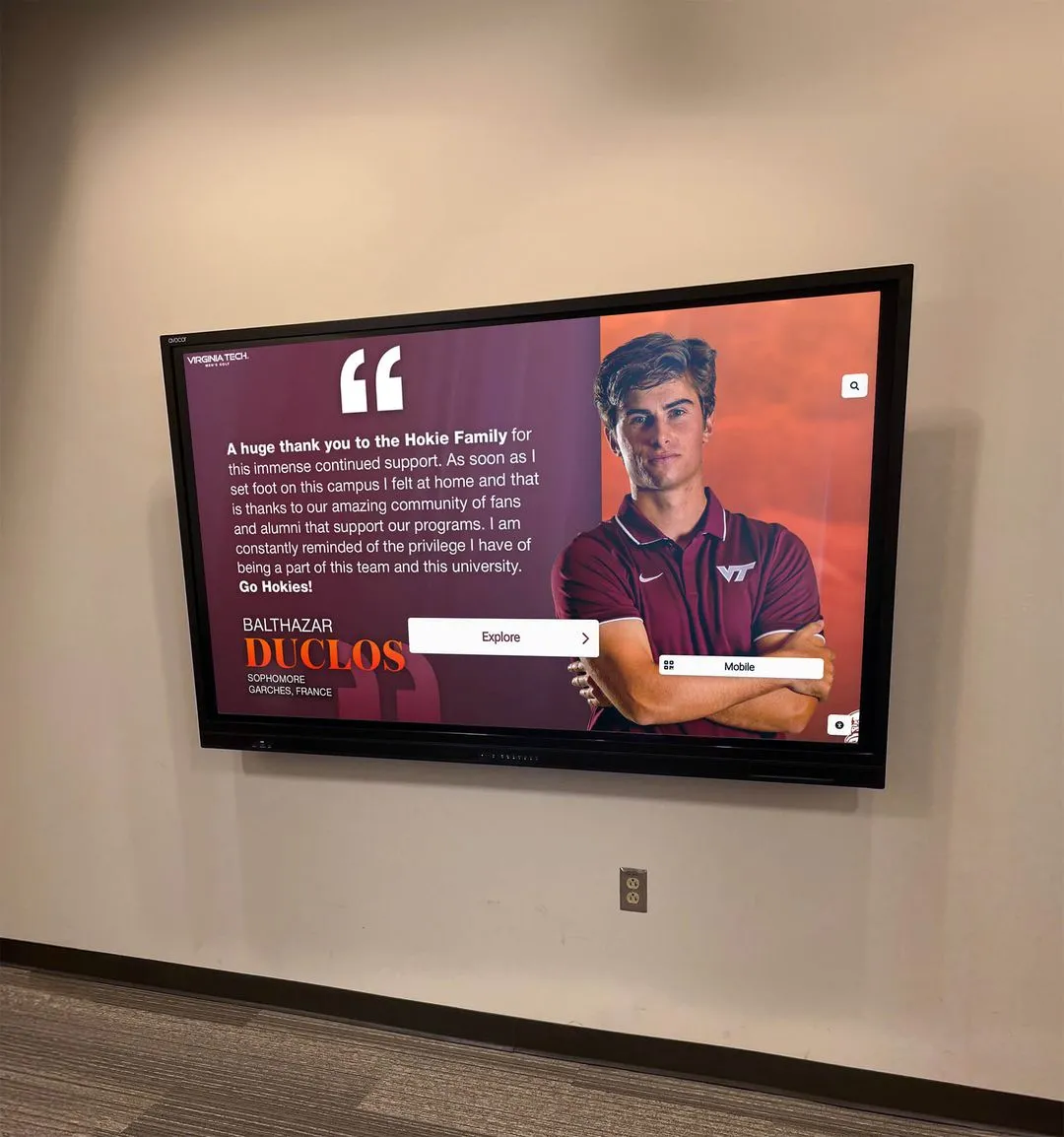
Permanent digital record displays integrated into school walls create recognition environments that outlast coaching staff transitions, facility renovations, and the physical limitations of traditional plaques
Ready to Build a Volleyball Record Board That Lasts?
Rocket Alumni Solutions touchscreen record boards and digital walls of fame give volleyball programs unlimited record capacity, rich athlete profiles, and a cloud-based update system that keeps recognition current season after season.
Request a Demo