



Latin honors represent one of the most prestigious forms of academic recognition in higher education, appearing on diplomas, transcripts, and graduation programs to distinguish students who have achieved exceptional academic performance throughout their college careers. These centuries-old designations—cum laude, magna cum laude, and summa cum laude—communicate scholarly excellence in a universally recognized language, signaling to employers, graduate schools, and professional networks that graduates have demonstrated sustained academic achievement at the highest levels.
Yet confusion about Latin honors remains surprisingly common. Families attending commencement ceremonies wonder what those Latin phrases actually mean, prospective students ask whether the extra effort required is worthwhile, and current undergraduates often don’t understand the specific GPA thresholds they’re working toward. Meanwhile, the proliferation of different institutional standards creates variation in what these honors truly represent across colleges and universities.
This comprehensive guide explains everything students and families need to know about Latin honors—from historical origins and precise meanings to GPA requirements, recognition practices, and the tangible benefits these distinctions provide for career advancement and graduate education opportunities.
Understanding Latin honors helps students set meaningful academic goals while enabling families to appreciate the significance of these achievements when graduates cross the commencement stage wearing honor cords and receiving special recognition for years of dedicated scholarship.

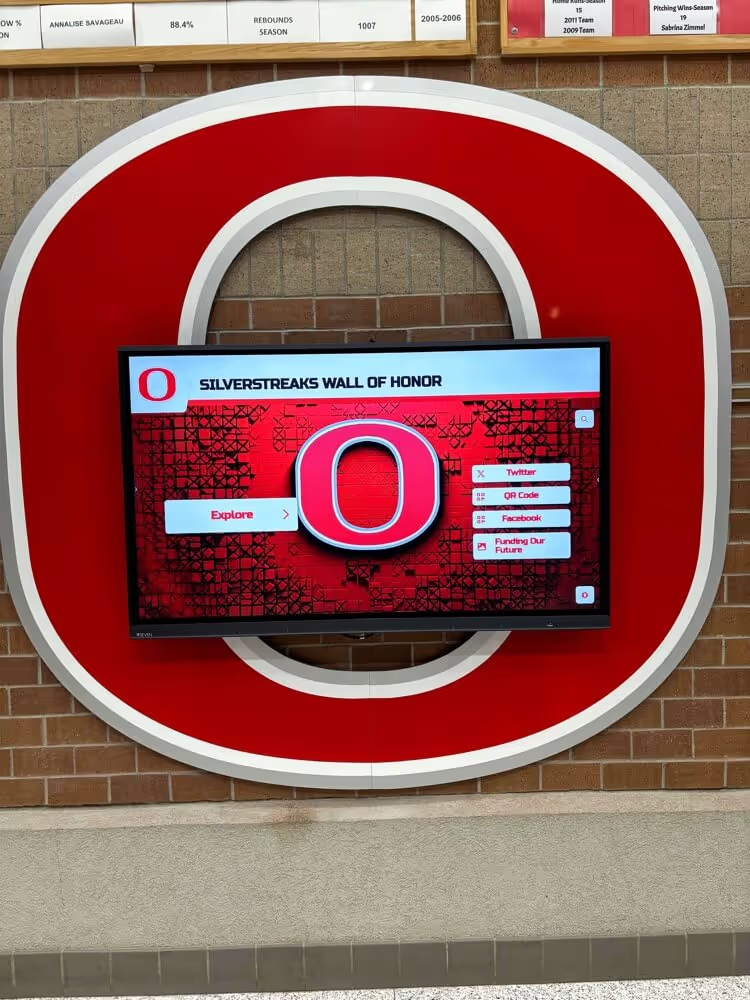
Modern academic recognition displays showcase Latin honors recipients and other distinguished scholars
What Is Latin Honors? Definition and Meaning
Latin honors represent academic distinction designations awarded to undergraduate students who achieve exceptional cumulative grade point averages throughout their college careers.
The Three Levels of Latin Honors
Cum Laude - “With Honor”
Cum laude (pronounced “koom LAU-day”) is the entry-level Latin honor, recognizing graduates who have achieved strong academic performance above standard graduation requirements. Students earning cum laude typically rank in the top 20-35% of their graduating class or meet specific GPA thresholds set by their institution.
Magna Cum Laude - “With Great Honor”
Magna cum laude (pronounced “MAG-nuh koom LAU-day”) represents the middle tier of Latin honors, acknowledging exceptional academic achievement. Recipients typically rank in the top 10-15% of graduates or achieve higher GPA benchmarks than cum laude honorees.
Summa Cum Laude - “With Highest Honor”
Summa cum laude (pronounced “SUM-uh koom LAU-day”) constitutes the highest academic honor most institutions award, reserved for students demonstrating truly outstanding scholarly excellence. This designation typically recognizes the top 1-5% of graduates or those achieving near-perfect GPAs throughout their undergraduate careers.
According to the National Association of Colleges and Employers, approximately 30% of bachelor’s degree recipients graduate with some level of Latin honors, though this percentage varies significantly across institution types and selectivity levels.
Historical Origins and Academic Traditions
Medieval University Roots
Latin honors originated in European universities during the medieval period when Latin served as the universal language of scholarship. Universities developed systematic methods for distinguishing exceptional students from general graduates, creating hierarchical recognition systems that evolved into modern Latin honors designations.
American Academic Adoption
American colleges and universities began adopting Latin honors traditions in the 19th century, adapting European practices to fit American educational contexts. Harvard University implemented one of the earliest systematic Latin honors programs in the United States, establishing precedents that spread to institutions nationwide.
Contemporary Practice Evolution
Modern Latin honors systems reflect both traditional foundations and contemporary adaptations. While the three-tier structure remains standard, institutions have developed diverse approaches to determining eligibility—from rigid GPA cutoffs to percentile-based systems that adjust recognition rates based on class performance distribution.
Learn more about comprehensive academic recognition in academic recognition programs that celebrate student excellence.

Individual recognition profiles celebrate the academic journeys that lead to Latin honors distinction
GPA Requirements for Latin Honors
GPA thresholds for Latin honors vary significantly across institutions, reflecting different academic cultures and student body characteristics.
Common GPA Benchmarks
Typical GPA Ranges by Honor Level
While specific requirements vary, common patterns emerge across American colleges and universities:
- Cum Laude: Typically 3.5-3.7 cumulative GPA
- Magna Cum Laude: Usually 3.7-3.85 cumulative GPA
- Summa Cum Laude: Generally 3.85-4.0 cumulative GPA
These ranges represent general trends rather than universal standards. Individual institutions set specific thresholds based on their academic cultures, grading distributions, and desired recognition rates.
Institutional Variation Examples
Different university approaches illustrate the diversity of Latin honors systems:
Fixed GPA Cutoffs: Some schools establish specific numerical thresholds (e.g., 3.5 for cum laude, 3.75 for magna cum laude, 3.9 for summa cum laude) that remain constant regardless of class performance distribution.
Percentile-Based Systems: Other institutions award Latin honors to top-performing percentages of each graduating class (e.g., top 5% receive summa cum laude, next 10% receive magna cum laude, next 15% receive cum laude), causing GPA requirements to fluctuate based on class achievement levels.
Departmental Honors Integration: Some schools combine overall GPA requirements with departmental honors thesis completion or comprehensive examination performance.
How Institutions Calculate Latin Honors GPA
Cumulative vs. Major GPA Considerations
Most institutions base Latin honors solely on cumulative GPA across all coursework, though some consider additional factors:
- Overall Cumulative GPA: Standard approach using all undergraduate coursework
- Major GPA Requirements: Some schools require minimum GPAs in major coursework alongside overall thresholds
- Last 60 Credits: Certain institutions emphasize junior and senior year performance
- Institutional Credits Only: Many schools exclude transfer credits from Latin honors calculations
Grade Exclusions and Adjustments
Institutions may apply specific calculation rules:
- Pass/fail courses typically excluded from GPA calculations
- Some schools exclude freshman year grades or allow grade forgiveness policies
- Repeated courses may be handled differently across institutions
- Withdrawal grades and incomplete grades typically don’t factor into calculations
Transfer Student Considerations
Transfer students often face modified Latin honors eligibility:
- Minimum institutional credit requirements (commonly 60-64 credits)
- GPA calculations typically use only coursework completed at the degree-granting institution
- Some schools exclude transfer students from Latin honors eligibility entirely
- Others create separate criteria accounting for shorter enrollment duration
Understanding your institution’s specific policies is essential for planning academic trajectories toward Latin honors achievement.
Checking Your Institution’s Requirements
Finding Official Standards
Students should consult multiple sources to understand their school’s Latin honors criteria:
- Academic catalogs and undergraduate bulletins
- Registrar’s office websites and publications
- Academic advising resources
- Department-specific honors program documentation
- Student handbook sections on graduation honors
Planning for Latin Honors Achievement
Once you understand requirements, strategic planning supports goal attainment:
- Calculate current GPA and determine required semester GPAs
- Understand how future grades will impact cumulative calculations
- Consider course load implications and difficulty levels
- Meet with academic advisors about honors pathways
- Track progress regularly throughout academic career

Interactive displays enable families and community members to explore Latin honors achievements and other academic distinctions
How Latin Honors Are Determined and Awarded
The process of earning and receiving Latin honors involves specific timelines, verification procedures, and recognition practices.
Eligibility Determination Timeline
When Latin Honors Are Calculated
Most institutions follow predictable timelines for Latin honors determination:
Final Semester GPA Inclusion: Latin honors calculations typically include all coursework through the final semester, meaning spring graduates’ final semester grades affect their honors status.
Preliminary Notifications: Some schools provide preliminary Latin honors notifications in late fall for spring graduates, though final designation remains conditional on maintaining required GPAs.
Official Determination: Final Latin honors status is usually confirmed shortly before graduation once all grades are finalized and degree requirements are verified.
Commencement Program Deadlines: Because commencement programs are printed weeks before final grades are submitted, some programs list anticipated honors rather than confirmed designations.
Verification and Certification Process
Institutional processes ensure accurate Latin honors awards:
- Registrar’s office conducts automated GPA calculations
- Academic deans or graduation committees review eligibility lists
- Manual verification for borderline cases or appeals
- Notation added to official transcripts and diplomas
- Commencement recognition coordinated with graduation ceremonies
Latin Honors Recognition Practices
Diploma and Transcript Notation
Latin honors appear on official academic credentials:
- Diplomas: Most institutions print Latin honors designations directly on diplomas, creating permanent recognition of achievement
- Official Transcripts: Latin honors appear on transcript header sections and final degree conferral lines
- Digital Credentials: Modern digital badge and credential systems include Latin honors verification
Commencement Ceremony Recognition
Graduation ceremonies incorporate Latin honors acknowledgment:
- Honor cords in distinctive colors (often gold) worn during ceremony
- Special recognition when crossing the stage or receiving diplomas
- “Please stand” acknowledgments for Latin honors recipients
- Listing in commencement programs with honors designations
- Separate honors convocation ceremonies at some institutions
Explore graduation honor recognition in commencement ceremonies and graduation planning.

Strategic placement of recognition displays in high-traffic areas celebrates Latin honors recipients year-round
Benefits and Value of Latin Honors
Latin honors provide tangible advantages for career advancement, graduate school admissions, and professional opportunities.
Career and Employment Advantages
Resume and Application Enhancement
Latin honors strengthen job applications significantly:
According to the National Association of Colleges and Employers’ Job Outlook survey, 67% of employers consider GPA when making hiring decisions for entry-level positions, with Latin honors serving as immediate visual confirmation of academic excellence. These designations:
- Demonstrate sustained work ethic and achievement over 4+ years
- Signal intellectual capability and learning aptitude
- Differentiate candidates in competitive applicant pools
- Provide conversation points during interviews
- Validate academic credentials on LinkedIn profiles and professional networks
Employer Perceptions and Preferences
Research indicates that employers value Latin honors recognition:
- Hiring managers report that magna cum laude and summa cum laude designations significantly influence candidate evaluation
- Latin honors can compensate for less prestigious institutional backgrounds
- Technical fields and professional services particularly value academic achievement markers
- Honors designations remain relevant years after graduation for some industries
Starting Salary Correlations
Studies suggest that Latin honors correlate with higher initial earnings:
- Georgetown University Center on Education and the Workforce research indicates that college graduates in the top quartile of academic achievement earn approximately 8-12% more in starting salaries compared to median graduates from the same institutions
- Latin honors provide negotiating leverage for compensation discussions
- Some employers offer specific hiring bonuses or programs for summa cum laude graduates
Graduate School and Advanced Education Benefits
Admissions Competitiveness
Latin honors strengthen graduate school applications:
- Professional programs (law, medicine, business) consider undergraduate honors in admissions
- Summa cum laude designation can offset slightly lower standardized test scores
- Honors demonstrate preparation for rigorous graduate-level work
- Latin honors from selective institutions carry particular weight
Scholarship and Fellowship Eligibility
Many competitive awards require or favor Latin honors recipients:
- Fulbright scholarships and similar prestigious programs often list Latin honors as preferred qualification
- Graduate assistantships and teaching fellowships frequently consider undergraduate honors
- Professional organization scholarships may require minimum academic achievement levels
- Research fellowship programs favor applicants with demonstrated scholarly excellence
Academic Career Pathways
For students pursuing academic careers, Latin honors provide essential credentials:
- PhD program admissions heavily weight undergraduate academic performance
- Faculty search committees review undergraduate honors for junior candidates
- Latin honors signal research potential and scholarly dedication
- Summa cum laude designation can facilitate acceptance to top-tier graduate programs
Learn about recognition that supports future success in student recognition approaches that increase achievement.
Professional Certifications and Licensure
CPA and Professional Examination Benefits
Some professional pathways connect to undergraduate achievement:
- CPA review courses and programs sometimes offer discounts to Latin honors graduates
- State bar associations and medical licensing boards note undergraduate honors in candidate profiles
- Professional organizations may reduce experience requirements for highly credentialed applicants
Networking and Alumni Connections
Latin honors facilitate professional relationship building:
- Honor society memberships (Phi Beta Kappa, etc.) provide lifetime networking access
- Alumni associations often maintain honors graduate directories
- Professional events for distinguished graduates create connection opportunities
- LinkedIn and professional platforms highlight academic achievements
Latin Honors vs. Other Academic Distinctions
Understanding how Latin honors relate to other recognition forms helps contextualize their significance.
Latin Honors and Honor Societies
Complementary Recognition Systems
Latin honors and honor societies serve different but overlapping purposes:
Phi Beta Kappa
- Nation’s most prestigious undergraduate honor society
- Highly selective membership (typically top 10% of graduates at member institutions)
- Considers GPA, breadth of liberal arts coursework, and other factors
- Separate from but often overlapping with Latin honors recipients
- Summa and magna cum laude graduates frequently receive Phi Beta Kappa invitations
Discipline-Specific Honor Societies
- Subject-area organizations like Sigma Tau Delta (English) or Psi Chi (psychology)
- Typically require minimum GPAs plus major coursework excellence
- Provide networking and scholarship opportunities within fields
- Can be earned alongside Latin honors
Learn about honor society recognition in touchscreen displays for academic achievement.
Departmental Honors and Thesis Programs
Departmental vs. General Latin Honors
Many institutions offer departmental honors programs distinct from Latin honors:
- Departmental Honors: Typically require honors thesis, comprehensive exams, or capstone projects beyond high GPA
- Combined Recognition: Students can earn both departmental honors and Latin honors simultaneously
- Additional Recognition: Some schools note both distinctions on diplomas and transcripts
- Enhanced Graduate School Appeal: Departmental honors demonstrate research capability beyond GPA achievement
University Honors Programs
Living-Learning Honors Colleges
Separate from Latin honors, many universities operate honors programs or colleges:
- Admission-based programs for high-achieving incoming students
- Enhanced curriculum, small seminars, and special housing
- Completion certificates or program graduation designations
- Independent from Latin honors—students can participate in honors programs without earning Latin honors and vice versa

Modern recognition systems create engaging ways for students to explore academic honors and achievement pathways
Special Considerations and Variations
Latin honors systems include important variations and special circumstances.
Transfer Students and Latin Honors
Institutional Credit Requirements
Transfer students face specific Latin honors policies:
According to the American Association of Collegiate Registrars and Admissions Officers, approximately 38% of undergraduate students transfer institutions at least once during their college careers. For these students:
- Most institutions require completing a minimum number of credits at the degree-granting school (typically 60-64 credits for Latin honors eligibility)
- GPA calculations usually include only coursework completed at the awarding institution
- Some highly selective universities exclude transfer students from Latin honors entirely
- Community college transfers should verify policies before matriculation
Dual Degree and Second Bachelor’s Programs
Students pursuing multiple degrees encounter specific considerations:
- Some schools award Latin honors for each degree separately based on program-specific GPAs
- Others calculate cumulative GPA across all undergraduate work
- Second bachelor’s degree students may be ineligible for Latin honors at institutions limiting recognition to first degree recipients
International Students and Study Abroad
Study Abroad Credit Transfer
Study abroad participation affects Latin honors calculations:
- Credits from approved study abroad programs typically transfer but grade policies vary
- Some institutions accept transfer grades into GPA calculations; others grant credit without grades
- Students should understand policies before studying abroad to protect Latin honors eligibility
- Strategic course selection abroad can preserve GPA while fulfilling requirements
International Student Perspectives
For international students, Latin honors provide particular value:
- Universal recognition aids employment in home countries
- Demonstrates English language proficiency alongside academic achievement
- Enhances competitive positioning for U.S. graduate programs
- Provides clear credential for employers unfamiliar with American university reputations
Graduate School Latin Honors
Master’s and Doctoral Degree Honors
Graduate-level Latin honors practices differ from undergraduate traditions:
- Many graduate programs don’t use Latin honors systems at all
- Some master’s programs award honors based on thesis quality or comprehensive exam performance
- Law schools use class ranking percentiles rather than traditional Latin honors
- PhD programs typically don’t employ Latin honors (the degree itself represents highest achievement)
Explore comprehensive recognition approaches in school awards ceremony planning that celebrates achievement.
Strategies for Achieving Latin Honors
Students aspiring to Latin honors can employ specific approaches to maximize achievement potential.
Early Planning and Goal Setting
Freshman Year Foundation Building
Starting strong provides crucial advantages:
- First-semester GPA significantly impacts cumulative calculations throughout college
- Building strong study habits early creates sustainable success patterns
- Understanding institutional Latin honors criteria enables informed planning
- Meeting with academic advisors establishes achievement roadmaps
GPA Calculation Understanding
Mathematical literacy about grade point averages supports strategic planning:
- Recognize that later grades have proportionally smaller impact on cumulative GPAs
- Understand credit hour weighting in GPA calculations
- Calculate required semester GPAs to achieve target cumulative thresholds
- Track progress using unofficial transcripts regularly
Course Selection Strategies
Balancing Rigor and Achievement
Thoughtful course selection supports Latin honors pursuit:
- Consider difficulty-to-GPA-impact ratios when selecting courses
- Balance challenging coursework demonstrating capability with courses where high grades are achievable
- Understand that Latin honors consider GPA alone—course difficulty typically doesn’t factor directly
- Some institutions offer honors sections providing enhanced learning without GPA penalty risk
Distribution Requirement Optimization
General education requirements offer strategic opportunities:
- Research professor reputations and course grading patterns
- Consider taking distribution requirements in areas of strength
- Spread challenging requirements across semesters to maintain balanced workloads
- Investigate pass/fail options for courses outside comfort zones (where policies permit)
Academic Support Resource Utilization
Office Hours and Professor Relationships
Engaging with faculty enhances academic performance:
- Regular office hour attendance improves understanding and demonstrates commitment
- Building professor relationships creates advocacy for borderline grade situations
- Faculty members often provide study guidance and examination preparation insights
- Strong professor connections support learning and potential grade appeals if necessary
Tutoring and Academic Success Centers
Institutional support services provide achievement assistance:
- Free tutoring helps master challenging material before grades suffer
- Writing centers improve paper quality across disciplines
- Study skills workshops teach efficient learning techniques
- Time management resources support workload balance
Study Groups and Peer Learning
Collaborative learning enhances retention and understanding:
- Form study groups for challenging courses
- Teaching material to peers reinforces personal understanding
- Collaborative problem-solving develops deeper comprehension
- Peer accountability supports consistent studying
Learn about building achievement culture in school entrance design that celebrates excellence.
Celebrating and Showcasing Latin Honors
Once earned, Latin honors deserve appropriate recognition and strategic presentation.
Including Latin Honors on Resumes and Applications
Professional Resume Formatting
Effective resume presentation maximizes Latin honors impact:
Education Section Formatting Example:
Bachelor of Arts in Economics, Magna Cum Laude
University Name, City, State
Graduated May 2026 | GPA: 3.82/4.0
Key Resume Guidelines:
- List Latin honors designation immediately after degree title
- Include GPA if 3.5 or higher (many employers use 3.0 or 3.5 cutoffs)
- Capitalize Latin terms or italicize according to formatting preference
- Include graduation date to contextualize recent achievement
LinkedIn and Professional Profiles
Digital professional presence should highlight academic achievement:
- Add Latin honors to education section descriptions
- Include in headline for early-career professionals (e.g., “Marketing Analyst | Economics Graduate, Summa Cum Laude”)
- Mention in summary sections when relevant to positioning
- Ensure honors appear in downloadable PDF resume versions
Physical Display and Commemoration
Diploma Framing and Home Display
Many families choose to showcase Latin honors achievements:
- Professional diploma framing highlighting honors designation
- Shadow boxes incorporating graduation regalia and honor cords
- Photo displays featuring commencement ceremony moments
- Home office placement demonstrating professional achievement
Digital Recognition Displays
Educational institutions increasingly utilize modern technology to celebrate Latin honors recipients:
Rocket Alumni Solutions provides interactive touchscreen systems that enable schools to showcase Latin honors graduates alongside other distinguished alumni, creating permanent institutional recognition that:
- Profiles individual summa, magna, and cum laude graduates
- Provides searchable databases of honors recipients throughout school history
- Displays achievement statistics and trends over time
- Creates accessible web platforms enabling families to explore graduate accomplishments
- Motivates current students by showcasing the Latin honors achievements of recent graduates
These systems transform traditional static plaques into dynamic recognition that preserves Latin honors achievements for decades while making them accessible to future generations.

Comprehensive recognition systems celebrate Latin honors recipients within broader alumni achievement contexts
Common Misconceptions About Latin Honors
Clarifying frequent misunderstandings helps students and families accurately understand these distinctions.
“Latin Honors Guarantee Job Offers”
Reality Check on Employment Impact
While valuable, Latin honors alone don’t ensure employment:
- Employers consider multiple factors: experience, skills, cultural fit, and interview performance
- Latin honors strengthen applications but don’t replace relevant experience
- In saturated job markets, many qualified candidates hold academic honors
- Practical skills, internships, and demonstrated competencies often matter more than GPA after initial job
Where Latin Honors Matter Most
Academic achievement carries more weight in certain contexts:
- Entry-level positions immediately after graduation
- Highly competitive industries (consulting, investment banking, big tech)
- Graduate program admissions where academic performance predicts future success
- Competitive fellowship and scholarship applications
“All Summa Cum Laude Graduates Have 4.0 GPAs”
GPA Ranges Within Latin Honors Levels
Summa cum laude doesn’t always require perfection:
- Institutional thresholds vary significantly (some schools award summa cum laude for 3.85+ GPAs)
- Percentile-based systems may confer summa cum laude on top 5% regardless of specific GPA
- Different schools maintain different standards and grading cultures
- A 3.9 summa cum laude from a rigorous institution may represent greater achievement than a 4.0 from less selective schools
“Transfer Students Can’t Earn Latin Honors”
Transfer Student Eligibility Reality
While more complex, transfer students can often achieve Latin honors:
- Most institutions permit transfer student Latin honors if minimum institutional credit thresholds are met
- Success depends on strong performance after transfer
- Transfer students should verify policies during college selection process
- Community college transfer students can and do earn Latin honors at four-year institutions
Explore how schools celebrate diverse achievement in school spirit activities that build community.
FAQ: Frequently Asked Questions About Latin Honors
What GPA do you need for cum laude, magna cum laude, and summa cum laude?
GPA requirements vary by institution, but common ranges include 3.5-3.7 for cum laude, 3.7-3.85 for magna cum laude, and 3.85-4.0 for summa cum laude. Some schools use percentile-based systems instead of fixed GPA cutoffs, awarding Latin honors to the top-performing percentages of each graduating class. Always check your specific institution’s requirements, as standards vary significantly across colleges and universities.
Is magna cum laude a big deal?
Yes, magna cum laude represents significant academic achievement. Graduating with magna cum laude typically means you ranked in the top 10-15% of your class, demonstrating sustained scholarly excellence throughout your undergraduate career. This distinction enhances graduate school applications, strengthens job candidacy, and provides lifelong professional credibility. Employers and admissions committees recognize magna cum laude as evidence of strong work ethic, intellectual capability, and academic dedication.
Do employers care about Latin honors?
According to the National Association of Colleges and Employers, 67% of employers consider GPA in hiring decisions for entry-level positions, with Latin honors serving as immediate visual confirmation of academic achievement. Employers particularly value these distinctions in competitive industries like consulting, finance, technology, and professional services. While Latin honors strengthen applications significantly for recent graduates, their impact typically diminishes as professionals build work experience and demonstrated career accomplishments.
Can you lose Latin honors after they’re awarded?
No, Latin honors cannot be revoked after degrees are officially conferred, as they’re based on cumulative GPA at degree completion. However, if academic integrity violations or transcript fraud are discovered after graduation, institutions may revoke the entire degree, which would nullify all associated honors. During the final semester before graduation, students must maintain their GPAs above Latin honors thresholds, meaning provisional honors status can change before official degree conferral if final semester grades lower cumulative GPAs below required levels.
What is the difference between summa cum laude and valedictorian?
Summa cum laude represents the highest level of Latin honors awarded to students meeting specific GPA thresholds or percentile rankings (typically top 1-5% of class). Valedictorian designates the single student with the highest GPA in the entire graduating class. A valedictorian typically qualifies for summa cum laude, but many students earn summa cum laude without being valedictorian. Valedictorian is a singular title; summa cum laude may be awarded to multiple students who meet the criteria. Some institutions have multiple valedictorians when students tie for highest GPA.
Conclusion: The Lasting Value of Latin Honors Achievement
Latin honors represent far more than decorative Latin phrases on diplomas—they symbolize years of sustained intellectual effort, academic dedication, and scholarly excellence that distinguish graduates throughout their personal and professional lives. From cum laude recognition of strong academic performance to summa cum laude acknowledgment of exceptional achievement, these centuries-old distinctions continue providing meaningful recognition in contemporary educational and professional contexts.
Understanding what Latin honors mean, the specific GPA requirements at your institution, and the strategic approaches that support achievement enables students to pursue these distinctions effectively while families can appropriately appreciate the significance of these accomplishments. Whether strengthening graduate school applications, enhancing employment competitiveness, or opening doors to prestigious fellowships and opportunities, Latin honors provide tangible benefits that extend far beyond commencement day.
Celebrate Latin Honors and Academic Excellence
Discover how modern digital recognition solutions can showcase Latin honors graduates, preserve academic achievement records, and inspire future students through interactive displays that celebrate scholarly excellence.
Explore Recognition SolutionsFor students currently pursuing Latin honors, the journey requires consistent effort, strategic planning, and sustained dedication to academic excellence. The GPA thresholds may seem daunting, but thousands of students achieve these distinctions each year by utilizing academic resources, making thoughtful course selections, and maintaining focus on long-term goals despite semester-to-semester challenges.
Educational institutions increasingly recognize the importance of celebrating Latin honors recipients beyond commencement ceremonies. Modern digital recognition displays preserve these achievements permanently while making them accessible to future students, families, and community members who can explore the academic excellence these Latin designations represent.
Whether you’re a prospective student evaluating whether Latin honors pursuit is worthwhile, a current undergraduate working toward these distinctions, or a family member celebrating a graduate’s summa, magna, or cum laude achievement, understanding the history, requirements, benefits, and lasting value of Latin honors enriches appreciation for these meaningful academic recognitions that honor scholarly dedication in its highest forms.
Your academic achievements deserve recognition that extends beyond graduation day. Through comprehensive academic display solutions and digital hall of fame platforms, institutions can create lasting tributes to Latin honors graduates that inspire excellence for generations to come.